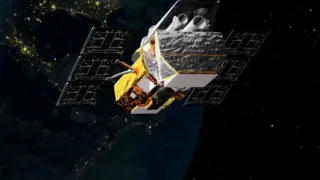
The Neil Gehrels Swift Observatory, a 1.5-tonne NASA space telescope launched nearly 22 years ago on November 20, 2004, is re-entering Earth's atmosphere. Originally named the Swift Gamma-Ray Burst Explorer, NASA expects the telescope to enter the atmosphere on November 4 at approximately 3:30 AM ET (2:00 PM IST), within an 11-hour window. While most of the satellite will burn up during re-entry, some debris could reach the surface.
NASA Scientist Brad Cenko, in an interview, said that parts of Africa, Australia, India, Southeast Asia and Central and South America are within the telescope's re-entry zone, AP reported. NASA estimates that the telescope's re-entry zone lies between 20.6 degrees south latitude and 20.6 degrees north latitude. On a map, that creates a band covering portions in the middle of the Earth.
Zone Covers Major Cities of India
The telescope is likely to fall in the middle of the earth. The broad band included regions south of an imaginary line running approximately from Daman on the western coast to Cuttack in Odisha on the eastern coast. Mumbai, Hyderabad, Bengaluru and Chennai fall within the zone, while Delhi, Kolkata and much of northern India lie outside it.
Significantly, falling under the latitude band does not imply that these cities are directly in the path of falling debris. The actual re-entry location depends on the telescope's position when it enters the atmosphere.
India has its own infrastructure to monitor objects approaching atmospheric re-entry. ISRO's Multi-Object Tracking Radar (MOTR), located at Sriharikota, tracks space objects, including rocket bodies and satellites, during their final few orbits before atmospheric re-entry.
The Indian Space and Research Organisation (ISRO) has not shared any response to the update yet.
Some analysts said that the telescope may land in the ocean. McDowell said he will be stunned if 100 kilograms of the component from the telescope's 1,500 kg weight survives re-entry. "If 70 per cent of the Earth is ocean, 30 per cent is land. So three out of 10 times it's on land, not ocean," Brad Tucker, an astrophysicist at the Australian National University, told ABC News.
Chances of injuring or destroying are very low
Others claimed that the chances of a falling piece of the telescope damaging infrastructure or injuring someone are extremely low. NASA's efforts to save the falling telescope were unsuccessful.
The mission was supposed to last for two years, but its career surprisingly lasted much longer. In its 22-year journey, Swift observed more than 2,000 gamma-ray bursts and 1,400 supernovae.
Failed Rescue Mission
NASA contracted commercial startup Katalyst Space to attempt an in-orbit servicing rescue. In July, Katalyst launched a robotic vehicle equipped with three mechanical arms dubbed Link, designed to rendezvous with Swift and boost it to a higher, stable orbit. However, the Link spacecraft suffered attitude-control and thruster failures, went into an uncontrolled spin, and could get no closer than roughly 12 to 15 kilometres (7–9 miles) from the observatory, forcing mission controllers to declare the rescue a failure.
Asteroid Defence Hits Lump In Road
New planetary defence simulations led by Sandia physicist Nathan Moore show that an asteroid’s irregular, "lumpy" geometry fundamentally alters how it responds to a nuclear deflection attempt. For decades, mission models assumed asteroids were smooth spheres to keep calculations manageable, but spherical asteroids do not exist in reality.
Nuclear standoff deflection: an adjacent nuclear blast bathes the asteroid with intense X-rays to vaporise surface material and push it off course. Targeting different sides of the exact same simulated asteroid changed the deflection velocity by nearly fivefold (from 3.9 mm/s down to 0.8 mm/s).