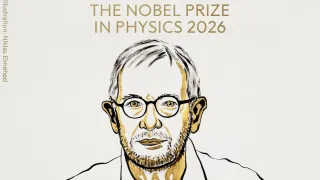
The Royal Swedish Academy of Sciences has awarded the 2026 Nobel Prize in Physics to Belgian-American particle physicist Francis Halzen for his decisive contributions to the IceCube Neutrino Observatory and the discovery of high-energy neutrinos of astrophysical origin. According to the organisation, Halzen has laid the foundation for an entirely new type of astronomy. His idea was to use glacial ice at the South Pole to capture the secretive particles called neutrinos. The result was the IceCube Neutrino Observatory, which can track neutrinos that originate in the distant cosmos.
"During the experiment, the celebrated scientist realised that ice at the South Pole could be used to track particles known as neutrinos. His vision and scientific leadership have been fundamental to the IceCube Neutrino Observatory – a cubic kilometre of ice that is equipped with light sensors. Using IceCube, researchers can capture neutrinos from extremely energy-rich processes in the distant universe," read the statement released by the Nobel Prize.
How much money will he get?
The winners of the Nobel Physics Prize are selected by the Royal Swedish Academy of Sciences and receive a prize sum totalling 12 million Swedish crowns (USD 1.2 million), which is shared among the winners if there are several.
Why are Nobel Prizes awarded every year?
The Nobel Prizes were established under the will of Swedish inventor and entrepreneur Alfred Nobel, whose fortune was built in part on the invention of dynamite. First awarded in 1901, the prizes honour achievements in science, literature and peace, with the economics award added later by Sweden's central bank.
Physics occupied a prominent place in Nobel's will and the prize remains one of the discipline's highest distinctions. Over the decades, it has recognised discoveries that have fundamentally reshaped humanity's understanding of the universe. Among past laureates are some of the most celebrated figures in science, including Albert Einstein, Marie and Pierre Curie, Max Planck and Niels Bohr, whose work helped establish the foundations of modern physics.
Nobel medals are presented to the winners by Sweden's King Carl XVI Gustaf at a ceremony in Stockholm on December 10, the anniversary of Alfred Nobel's death. The awards are followed by an elaborate banquet at Stockholm City Hall. The peace prize, the only Nobel not presented in Sweden, is awarded separately in Oslo.
(With inputs from Reuters)