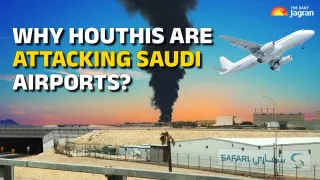
A four-year ceasefire in Yemen has collapsed, triggering the heaviest Houthi attacks on Saudi Arabia in years. In recent weeks, missile and drone strikes have hit major Saudi airports and energy hubs, killing two Indian nationals and injuring at least 13 others. The attacks come amid renewed fighting between the Iran-backed Houthis and the Saudi-backed Yemeni government, and mark a shift in Houthi strategy from oil facilities to saudi airports.
Since the October 2023 Gaza war, the Houthis have stated that they are attacking anyone supporting the US and Israel.
In September, the Houthis said they had captured the strategic Perim Island that sits in the Bab el-Mandeb Strait, a critical maritime chokepoint. They also seized other islands in a bid to tighten their grip on the Red Sea coastline.
The Houthis have claimed responsibility for missile and drone attacks on Saudi airports and energy facilities, saying the strikes were in response to Saudi airstrikes and military operations in Yemen. They have also threatened further attacks unless Saudi Arabia stops its military action and lifts restrictions on Yemen.
With Saudi airports and energy infrastructure increasingly in the kingdom, a key question remains: why are the Houthis targeting airports after striking oil facilities?
Why are Houthis striking Saudi airports?
For Saudi Arabia, attacks on major airports pose a serious security and economic challenge. The latest escalation follows the reported collapse of a four-year UN-brokered ceasefire in July 2026, with both sides stepping up their military actions.
The Houthis have said their missile and drone attacks on Saudi airports, including King Khalid International Airport in Riyadh, King Fahd International Airport in Dammam and Abha International Airport, are retaliation for Saudi-led coalition airstrikes in Yemen. These reportedly include an attack on Sanaa International Airport.
Following reported deadly strikes on Riyadh's King Khalid International Airport, the Houthis have threatened to continue targeting airports. The attacks appear to be aimed at putting economic and political pressure on Saudi Arabia, rather than limiting the conflict to military targets.
ALSO READ: Saudi Arabia Airport Attack: One Indian Killed, 8 Injured In Missile Strike At King Fahd Airport
Riyadh's airport is a major international hub, connecting Saudi Arabia to destinations across the world. Any disruption can affect airlines, tourism, business travel and investor confidence, all of which are important to the kingdom's Vision 2030 economic diversification programme, which aims to create a strategic framework to diversify Saudi Arabia’s economy, reduce its reliance on oil, and modernise society through massive investments in tourism, technology, and human capital. Moreover, flight suspensions and changes to international airline schedules can add to the economic fallout.
The Houthis have also targeted, or threatened to target, important energy infrastructure. The attack on King Khalid Airport on October 11 left 13 dead and over 300 injured, making it one of the deadliest incidents in Saudi Arabia in recent years.
Strikes on oil facilities linked to Saudi Aramco, including those in Dhahran and Shaybah, could disrupt energy operations and raise concerns about the security of regional oil supplies.
ALSO READ: Saudi Arabia's King Fahd Airport Attack: One Killed, Eight Injured In Dammam, Flights Diverted
By targeting facilities that are important to Saudi Arabia's economy and international connectivity, the Houthis can draw global attention to the conflict while increasing pressure on the kingdom.
Another key reason is Saudi Arabia's continued support for Yemen's government. The Houthis want Riyadh to stop backing government forces and halt airstrikes on Yemeni airports. In July, Saudi-backed forces reportedly bombed the runway at Sanaa International Airport to prevent an Iranian aircraft from landing.
The attacks also threaten to undermine Saudi Arabia's reputation as a safe destination for international travellers, workers and investors. After years of relative calm, the prospect of repeated strikes on major civilian infrastructure has renewed concerns about the kingdom's security.
In recent weeks, Saudi airports reportedly targeted by the Houthis include King Khalid International Airport in Riyadh, King Fahd International Airport in Dammam, Abha International Airport, King Abdullah bin Abdulaziz International Airport in Jazan and Najran Airport.
Why Indian workers are caught in Saudi Arabia's expanding conflict
At least two Indian nationals have been killed and at least 13 others injured in recent weeks in a series of reported Houthi attacks targeting Saudi Arabian airports and energy infrastructure. For India, the escalating conflict is a particular concern because of the large number of Indians living and working in Saudi Arabia. More than 27 lakh Indians live in the kingdom, making them one of the largest foreign communities in the country.
Many Indians work in construction, aviation and other sectors across Saudi Arabia. Those living or working in cities such as Jizan, Najran and Dammam may face greater concerns because of their proximity to areas affected by security threats and reported Houthi attacks.
YOU MAY ALSO LIKE TO WATCH
Airports in Riyadh and Dammam are also important travel hubs for Indians who regularly fly home or return to the Gulf for work. Disruptions at these airports can leave passengers facing delays, cancellations and uncertainty about their travel plans. Airport employees and ground-handling staff could also face additional risks if attacks affect aviation facilities.
For Indian workers, the impact goes beyond flight disruptions. Many live away from their families and depend on regular employment to support relatives back home. Any escalation that affects workplaces, transport or access to essential services can add to their concerns.
Amid the growing security threat, the Indian Embassy in Riyadh has issued safety advisories urging Indian nationals to remain indoors during alerts, stay away from external windows and follow local civil defence instructions.