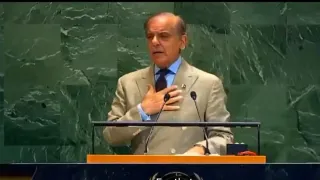
United Nations/New Delhi: Pakistan's Prime Minister Shehbaz Sharif, speaking from the United Nations podium on Tuesday, for the first time publicly acknowledged that the country has harboured terrorists and claimed that it has now brought them under control through targeted operations (encounters). In a statement that effectively exposed Pakistan's long-standing foreign-policy narrative, Sharif asserted that had these terrorists not been confronted by Pakistani forces, they would have been free to roam the streets of New York, London, or the Far East (a term generally referring to the easternmost regions of Asia, including East Asia, Southeast Asia, and parts of eastern Russia).
"Pakistan has made perhaps the greatest sacrifices of any country in the world," Sharif claimed while speaking at the UNGA. "This must be respected and appreciated, because we have served as a bulwark against terrorism. Had these terrorists not been encountered by us, they would have been roaming the streets of New York, London, and God knows the Far East. So I believe this is our humble contribution not only for the people of Pakistan but for people all over the world," added Sharif.
In essence, Sharif's remarks amount to an admission that Pakistan has had terrorists on its soil, that it has taken action to control them, and that by doing so it has prevented them from reaching cities such as New York, London, and locations in the Far East.
Pakistan's terrorism oriented foreign policy
For decades, Pakistan has been widely accused by India, the United States, Afghanistan and international bodies of systematically using Islamist militant groups as instruments of foreign policy. For example, India at many times presented evidence about how, through its military and the Inter-Services Intelligence (ISI), successive Pakistani governments cultivated, funded, trained and sheltered organisations such as the Taliban, the Haqqani network, Lashkar-e-Taiba and Jaish-e-Mohammed.
The strategy, often described as "strategic depth" or proxy warfare, aimed to pressure India over Kashmir, install a friendly regime in Afghanistan, and project power against stronger conventional adversaries while maintaining plausible deniability.
India is a victim of Pakistan-sponsored terrorism
In the 1980s, Pakistan channelled US and Saudi support to the Afghan mujahideen; after the Soviet withdrawal, it backed the Taliban's rise. From the 1990s onward, Kashmir-focused groups carried out high-profile attacks inside India, including the 2001 Parliament attack and the 2008 Mumbai attacks. American officials repeatedly charged Pakistan with playing a "double game-- accepting Western aid while protecting militants who targeted US and Afghan forces.
Although Pakistan bans these groups on paper and insists it is itself a victim of terrorism, critics point to continued safe havens, incomplete prosecutions and weak action against terror financing as evidence that the policy of instrumentalising militants has persisted for more than four decades.
You may also like to watch