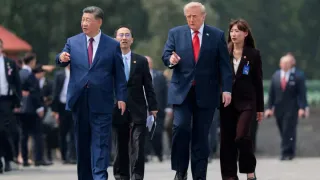
Trump-Xi Meet: Chinese President Xi Jinping will visit Washington from September 23 to 25 for summit talks with his US counterpart Donald Trump, marking their second meeting in four months, a development Beijing has described as a "milestone of historic significance". Xi will visit the US for three days at the invitation of Trump, Foreign Ministry spokesperson Guo Jiakun announced at a media briefing here on Monday.
During his talks with Trump, Xi will have in-depth exchanges on key issues concerning China-US relations, as well as world peace and development, Guo said. "The reciprocal visits by the two heads of state within a span of six months will mark a milestone of historic significance," he said.
Second visit in less than 6 months
The two leaders last met in Beijing in May during Trump's China visit, when they held talks aimed at improving ties between the world's two largest economies. "China will work with the US to enrich the dimensions of the China-US constructive relationship of strategic stability, strengthen dialogue and cooperation and properly manage differences so as to deliver greater benefits to our two peoples and to further contribute to world peace, stability and prosperity," Guo said.
Trump plans to accord a rare airport reception to Xi by personally receiving him on the tarmac at Joint Base Andrews, according to the Hong Kong-based South China Morning Post. From trade tariffs and technology to AI, military-to-military ties, the conflict in West Asia, the Russia-Ukraine war, the space arms race and US arms sales to Taiwan, a range of issues are expected to figure in the meeting between the two world leaders.
A big face-off expected
Ahead of Xi's visit, Chinese Vice Premier He Lifeng, US Treasury Secretary Scott Bessent and US Trade Representative Jamieson Greer held "candid, in-depth and constructive" talks on economic and trade issues, including AI, on Sunday in New York. In his talks with He, Bessent said the US had proposed a new notification mechanism for artificial intelligence incidents that could affect national security.
"We want a shared vision of common goals and common threats," Bessent told the media in New York. "We think that just like any cross-border activity, that moving from opaque to more transparency between the No. 1 and the No. 2 AI powers in the world is very important."
"Guided by the important consensus reached by the heads of state of the two countries, He and Bessent engaged in exchanges on important economic and trade issues of common concern, as well as the implementation of consensus reached in previous talks, while upholding the principles of mutual respect, peaceful coexistence and win-win cooperation, the state-run Xinhua news agency reported.
The Xi-Trump talks assume significance against the backdrop of Trump signing a new sanctions law that authorises him to impose tariffs of up to 100 per cent on countries buying Russian oil and gas, including China and India. Trump last week signed the Lindsey O Graham Sanctioning Russia and Iran Act of 2026, which authorises expanded sanctions and gives the president powers to impose tariffs on countries that buy Russian energy.
China rejects US sanctions bill
China has rejected US attempts to impose tariffs over its purchases of Russian oil and gas, saying normal trade cooperation between countries should not be subject to interference by third parties. China engages in normal economic and trade cooperation with other countries based on equality and mutual benefit, Guo Jiakun told reporters on September 17.
ALSO READ: Trump Signs Russia Sanctions Bill, India Among Countries At Risk Of 100% Tariffs; What Happens Next
China opposes long-arm jurisdiction and unilateral sanctions that have no basis in international law and lack a UN Security Council mandate, he said.
Despite the tariff threat, Washington and Beijing are also negotiating a reciprocal tariff reduction framework covering products worth USD 30 billion from each side, China's commerce ministry said.
The consultations aim to reach a reciprocal tariff reduction arrangement at the earliest possible date, ministry spokesperson Huang Ling said.
Ahead of the summit, Chinese Foreign Minister Wang Yi and US Secretary of State Marco Rubio also held a telephone conversation on September 17, focusing on high-level exchanges between the two countries.
Trump has also unveiled a new "AI Force" in a potential escalation of the high-stakes technology race between the rival powers. In a social media post on Saturday, Trump said attempts at the "decimation, or destruction" of artificial intelligence were among what he described as hoaxes generated by the "Radical Left Democrats".
(With inputs from PTI)
You may also like to watch