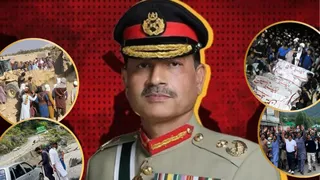
Pakistan is currently facing four massive, interconnected crises across its territory. Its military establishment, led by Field Marshal General Asim Munir, is struggling to maintain control as violence and unrest escalate. The situation has become so severe that some experts and politicians are openly questioning the state's survival, with former Afghan Vice President Amrullah Saleh even hinting at the birth of a new country in the region.
Balochistan: An intense, two-front rebellion
Balochistan is experiencing its worst security crisis in modern history. The Pakistani military is fighting two completely different "enemies" here:
The Balochistan Liberation Army (BLA): An ethno-nationalist group fighting for an independent Balochistan. They have shown advanced coordination, temporarily seizing urban spaces and launching deadly ambushes on military convoys.
The Tehreek-e-Taliban Pakistan (TTP): An Islamist group expanding into the province's Pashtun regions.
Local politicians admit the government has lost its authority in the province, while peaceful political activists demanding rights face severe crackdowns and forced disappearances.
Khyber Pakhtunkhwa (KP): The TTP’s stronghold
In KP, the TTP is waging a relentless war against Pakistani security forces. The group has evolved, now using commercial drones for attacks and expanding far beyond its traditional tribal strongholds. Despite frequent military operations, the TTP continues to regenerate and inflict heavy casualties, forcing the military to dangerously split its resources.
Pakistan-occupied Kashmir (PoK): Mass civil unrest
Unlike the armed insurgencies in the west, the crisis in PoK is a popular civil movement. The Jammu Kashmir Joint Awami Action Committee (JAAC) is leading massive protests over inflation, high electricity prices, and unfair political representation. The Pakistani establishment has responded with a heavy-handed security crackdown—deploying thousands of paramilitary personnel, shutting down the internet, and banning activist groups—which has only deepened local alienation.
Afghanistan border: Former allies turned foes
Pakistan’s border with Afghanistan has transformed into an active battleground. Islamabad accuses the Afghan Taliban of sheltering TTP terrorists, leading Pakistan to launch airstrikes inside Afghanistan. In response, the Taliban has retaliated with cross-border strikes. The cordial relationship Pakistan once hoped for after the Taliban took Kabul has collapsed into an open, undeclared conflict.
State authority in decline
Pakistan’s current turmoil is the direct blowback of its historical "security-first" policies and regional meddling. While these four crises are driven by different groups with conflicting ideologies, they collectively expose the limits of the military's power. The country's defence minister Khawaja Asif has even warned that the nation is falling apart, raising serious concerns that the establishment might resort to external military distractions to cover up its internal failures.
You may also like to watch