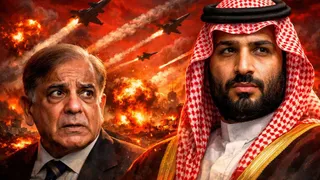
In a mocking display of the Pakistan-Saudi Arabia strategic defence pact, Iran bombarded several locations in Saudi Arabia and the wider region, while Islamabad remained a mere passive spectator. Notably, Pakistan and Saudi Arabia had signed a "Strategic Mutual Defence Agreement," which declares that any attack on either country will be considered "an aggression against both." The defence pact was signed in September last year.
The eal was signed last year, days after an Israeli attack on the Hamas leadership in Qatar, a key US ally in the Gulf region. At that time, Pakistan had boasted of itself as the umbrella shield for Saudi Arabia, but as Iran has launched attacks on different locations in Saudi Arabia, a question arises whether Islamabad would send its troops or warplanes to safeguard the region or would just act to play a “constructive role.”
Earlier on Tuesday, Pakistan's Deputy Prime Minister and Foreign Minister Ishaq Dar claimed that Pakistan’s diplomatic intervention helped deter heavier Iranian strikes on Saudi Arabia. However, neither Iran nor Saudi Arabia echoed the statement.
Why is Pakistan unable to afford involvement in the ongoing Israel-US-Iran conflict?
Afghanistan conflict: Pakistan is already involved in a conflict with the Taliban-led Afghanistan. Even before the start of the Israel-US-Iran war, Islamabad and Kabul have been fighting at the border regions following a spike in terror attacks in Pakistan. As per media reports and Taliban claims, the Afghan side has damaged multiple airbases of Pakistan, including the Nur Khan Airbase, which India had earlier attacked during Operation Sindoor in May last year.
(Credit: Reuters)
No nuclear protection: Both sides had signed what Pakistan dubbed as crucial for the security of Saudi Arabia, the core provisions of which only focused on conventional cooperation, joint exercises, intelligence sharing, and drones. As of the information available in the public domain, Pakistan did not commit a nuclear shield for Saudi Arabia. It means Islamabad has categorically reserved its nukes in defence against its immediate neighbour, India.
Religious angle in Iran: Although Iran is a Shia Muslim-dominated country, and Pakistan has a Sunni-majority population, a rare moment was witnessed in the region where both factions appeared to be grieving the same leader, despite a long history of theological distance. Iran's late Supreme Leader Ayatollah Ali Khamenei, who led Iran since 1989 after the death of Ayatollah Ruhollah Khomeini, was a Shia cleric and not a religious authority for Sunnis. Yet reactions to his death have crossed sectarian lines.
(Credit: AI-generated)
Fear of domestic unrest: Recently, a massive protest was witnessed in Pakistan against the US operation, resulting in the killing of over 50 people. The angry protestors attacked the US Consulate in Pakistan and set a United Nations building on fire. If Pakistan takes any action against Tehran, it may be possible that rage will erupt again.
(Credit: Reuters)
Fear of the US: Ever since US President Donald Trump came into power, the Pakistani administration has constantly been trying to manage the Republican leader. In fact, Pakistan Army chief General Asim Munir had multiple bilateral meetings with Trump in Islamabad when Israel attacked Gaza. As America is directly involved this time in attacking Iran, Islamabad will not risk irking the Trump administration.
ALSO READ: Pakistan To Enter US-Iran-Israel Conflict In Middle East? All Eyes On Saudi Defence Pact