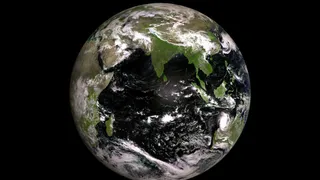
Russia’s space agency Roscosmos has shared a breathtaking image of Earth taken by its weather satellite Electro-L. The image showing the Earth in green and blue colours has mesmerised users on social media. The photos have been taken by a satellite, specifically designed to continuously monitor the planet from space and track weather conditions.
Electro-L Captures Breathtaking View Of Earth
The Russian Embassy in Kenya shared the image on X on Friday. The image, captured in wide angle, shows the Indian Ocean, Eurasia, Africa, Australia, and Antarctica. According to the embassy, Moscow currently operates around 1,559 active satellites, including both civilian and military systems. It also plans to expand its satellite network to about 2,600 in the coming year.
"Roscosmos has shared a new image of Earth captured by its hydrometeorological satellite Electro‑L. #Russia operates about 1559 active satellites, including numerous classified military systems, and plans to expand its orbital constellation to around 2,600 over the next decade," the Russian Embassy wrote.
India Glows Green From Space, Netizens React
As the image surfaced online, netizens reacted with amusement, calling the pictures “amazing.” A user pointed out how beautiful Indian mainland looked and wrote, “Bharat hits different.’ Another user wrote, "Thank you for sharing this beautiful picture of India. As we say, ‘Saare Jahan Se Achha, Hindustan Hamara.’” A third user added, “I think earth is the most beautiful of God's creations. just look at it.” "Wow, Earth is green," commented one more us
While many users commented about how mesmerising the Earth looked, some also expressed curiosity about the blue and green colours in the image. Notably, the colours are due to Electro-L’s feature, which captures images in 10 different spectral bands and different ranges of light. Two of these are visible light (green and blue), while the rest include infrared bands that cannot be seen by the human eye. These infrared channels help scientists track heat, moisture, and cloud movements at different heights in the atmosphere.
Earlier this month, NASA shared a beautiful image of the Milky Way galaxy and the Moon captured by the Artemis II crew during a lunar flyby. Sharing the photos, the space agency wrote, “The first flyby images of the Moon captured by NASA’s Artemis II astronauts during their historic test flight reveal images no human has seen, including a rare in-space solar eclipse.”
You May Also Like To Watch: