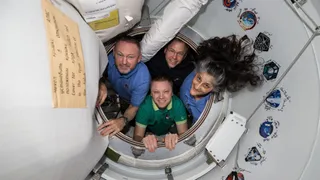
The human body was not built for spaceflight, with its microgravity conditions, exposure to high-energy radiation and other issues. As a result, trekking beyond the Earth's confines causes many physiological changes that affect an astronaut's health. The issue gained new currency with the March mission to return astronauts Butch Wilmore and Suni Williams to Earth after they were stranded on the International Space Station for nine months.
Here is an explanation of some of the effects on human the health of space travel.
Why is space travel tough on the human body?
The human body evolved over millions of years to function optimally in Earth's environment, which includes its gravity, atmospheric composition and relatively low levels of radiation. Space travel exposes people to quite a different environment, posing a range of physiological and psychological challenges, especially with prolonged exposure, according to Afshin Beheshti, director of the Center for Space Biomedicine at the University of Pittsburgh.
As researchers seek new countermeasures to protect space travellers, more data is needed on astronauts with varying health backgrounds and undertaking different kinds of missions in order to map out personalized risk profiles and mitigation strategies, according to Chris Mason, a professor of physiology and biophysics at Weill Cornell Medicine in New York.
What are the hazards of space radiation?
Unlike on Earth, where the atmosphere and planetary magnetic field provide a shield from space radiation, astronauts are exposed to high-energy radiation permeating the cosmos. This can lead to DNA damage, increased cancer risk, neurodegenerative effects, cardiovascular issues and immune system dysregulation.
Earth's magnetosphere - the region of space dominated by the planetary magnetic field - provides some protection for astronauts in missions in low-Earth orbit. But astronauts travelling beyond that - such as on missions to the moon or Mars- would experience much higher radiation doses.
What does microgravity do?
Gravity plays a critical role in regulating bodily functions. Its absence triggers widespread physiological adaptations, according to Beheshti. Without gravity, bodily fluids shift upward, leading to facial swelling and increased intracranial pressure, which can affect vision. The lack of mechanical loading on bones and muscles associated with the downward pull of gravity leads to bone density loss and muscle atrophy.
In addition, the cardiovascular system undergoes major changes, including difficulty regulating blood pressure upon return to Earth. Prolonged exposure to microgravity conditions also affects vestibular function - the inner ear's ability to sense movement and orientation. That can cause balance and coordination issues.
How about confinement and psychological stress?
Long-duration space missions require astronauts to live in confined and isolated environments with limited social interaction and exposure to natural stimuli. This, according to Beheshti, can lead to psychological stress, sleep disturbances, cognitive performance declines and mood disorders.
The effects of prolonged isolation and close-quarters living among astronauts - during stints aboard space stations or longer future missions to destinations like Mars - could aggravate interpersonal conflicts, further impacting mental well-being and mission performance.
What happens after returning to Earth?
How astronauts recover after returning to Earth depends in large part on mission duration. For short-duration missions of a few days in low-Earth orbit, about 95% of the biological damage sustained appears to be reversed upon return. For astronauts who spend months aboard the International Space Station, or ISS, recovery appears proportional to their time in space. Many physiological systems gradually return to normal. But some issues persist.
One example is Spaceflight-Associated Neuro-Ocular Syndrome (SANS), linked to vision impairment due to microgravity-induced fluid shifts and changes in intracranial pressure affecting the eyes. Research suggests that dysfunction in subcellular structures called mitochondria plays a role in SANS. Some astronauts experience lasting impairment that may require corrective lenses.
Questions remain about the effects of long-duration deep-space missions in which astronauts would experience much higher levels of space radiation and prolonged microgravity.Without effective countermeasures, recovery could be problematic. Researchers are actively developing mitochondrial-based countermeasures to mitigate space-induced damage.
(With inputs from agency)
Also Read: Top 10 Must- Know FAQs About Sunita Williams And Butch Wilmore’s Historic Space Mission