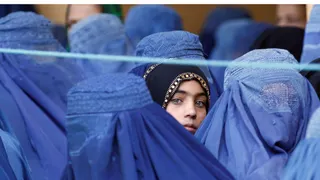
The Taliban regime in Afghanistan has once again caught attention after it legalised the silence of a "virgin girl" as her consent to marriage. The 31-article regulation, titled "Principles of Separation Between Spouses," has been officially approved by Taliban supreme leader Hibatullah Akhundzada and was published in the regime's official gazette in mid-May, according to Afghan outlet Amu TV.
The document underlines several rules covering child marriage, missing husbands, forced separation, adultery, dissolution of marriage, and so on.
What Are The Provisions?
One of the most controversial provisions states that a "virgin girl's silence" after reaching puberty may be considered "consent" to marriage. Additionally, it states that the silence of a boy or a previously married woman would not be automatically counted as "consent" to marriage.
ALSO READ: Pakistan's 'Peace' Pitch vs Ground Reality Exposed: Mediating Iran War While Bombing Afghanistan
The regulations also hold some regressive and conservative features. It says if relatives other than the child's father and grandfather finalise the marriage, it may be considered legally apt, provided the spouse is socially compatible and the dowry appropriate. The minor may later seek annulment through a Taliban court order.
A second provision, which is questionable in contemporary society, is that marriages involving a "non-compatible" spouse or an unfair dowry would not be considered valid. The provision provides final authority to the fathers and grandfathers over child marriages. The only condition is that marriages could be declared null only if the guardians are found to be abusive, mentally unfit, or morally corrupt. The regulation does not include the significance of choice of the girl child in any part.
The contentious document also includes intervention of the Taliban judges in disputes that involve adultery, apostasy, and absence of husbands for a long period. The judges would also hold the ability to intervene in cases of "Zihar" in which husbands compare their wife to a female relative to whom marriage would be forbidden. In all such cases, the judges may order separation, imprisonment, or punishment.
Human Rights Organisations Lash Out
Several human rights organizations and women’s rights associations have issued a protest statement expressing concern over the Taliban’s new regulations.
ALSO READ: Afghanistan Introduces E-Visa System With New Hurdles For Indians
Analysts claim that the regulation reflects an approach in which the basic rights of women and children are ignored, creating conditions for the continuation of systemic regression towards children.
"Child marriage is not marriage in any meaningful sense. A child cannot properly consent, and treating silence as consent is dangerous as it removes a girl's voice completely," the New York Post quoted political commentator Fahima Mahomed as saying.