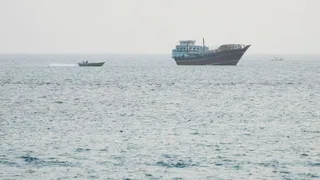
The United States intensified its strikes targeting Iran early on Thursday, hitting targets further north as American forces also fired into a ship it accused of trying to break its naval blockade on the Islamic Republic. Iran retaliated with missile and drone fire targeting Bahrain and Kuwait before dawn. This forced the sailors to avoid the US-guided routes in the Strait of Hormuz, according to a report by Reuters.
Days of back-and-forth strikes by the US and Iran across the Middle East - and renewed threats to the Strait of Hormuz - have shredded the interim deal to end the Iran war and could tip the region back into all-out war. Already, Iranian officials say US strikes have killed more than 35 people and wounded more than 300 others. Strikes also reached into areas around Iran's capital, Tehran, for the first time of this latest round of violence.
Iran fully prepared for full scale war: Qalibaf
Iran's parliament speaker and lead negotiator, Mohammad Bagher Qalibaf, said Iran was prepared for a fuller military confrontation if the US does not live up to the terms of the interim deal, and Iran's paramilitary Revolutionary Guard threatened to halt all energy exports from the Middle East over the blockade. "The export of oil and gas from the region will be either for everyone or for no one," the Guard said.
ALSO READ: US Carries Out First Daylight Offensive, Strikes Iranian Military Sites Near Strait Of Hormuz
US President Donald Trump again insisted Iran was ready to strike a peace deal, but he did not elaborate. "They don't like what we're doing, and they do want to settle. We'll find out whether or not we settle with them, or we just finish it off," he said Wednesday at the US Army War College in Pennsylvania.
Vessels avoiding US-guided routes in Hormuz
Meanwhile, news agency Reuters, citing its industry sources, reported that the shipping companies are avoiding using a US military-guided transit scheme through the Strait of Hormuz after a wave of Iranian attacks on vessels sparked safety concerns. For decades ships sailed into and out of the Gulf using a safe set of lanes down the middle of the strait established by the UN’s shipping agency in 1968, dubbed the Traffic Separation Scheme.
ALSO READ: Missing Indian Marine Engineer Confirmed Dead After Oman Ship Attack; Second Fatality In 3 Days
Since the Iran war began on February 28, Iranian forces have mined this area, forcing vessels to use one of two makeshift routes close to either the Iranian or Omani coast.
The US military had helped vessels through as part of an operation involving scores of secretive ship-to-ship oil transfers to keep Gulf energy exports flowing, using aerial and water drones as well as helicopters to guide tankers. Yet shippers are evaluating the route on the Omani side of the strait as increasingly dangerous after a wave of attacks on ships.
(With inputs from agencies)
You may also like to watch