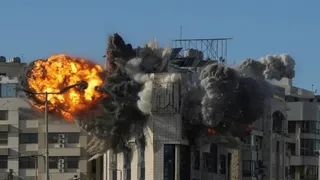
US-Iran Tensions: Amid renewed tensions between Iran and the US, the United States carried out deadly overnight airstrikes on multiple targets in Iran. According to Iranian state media, the attacks targeted an airport in southeastern Iran, a railway station in the port city of Bandar Abbas, and two bridges near the Strait of Hormuz.
The US intensified its military campaign against Iran on Thursday, striking targets farther north and firing on a vessel it accused of attempting to breach its naval blockade of the Islamic Republic. Iran retaliated by launching missiles and drones at US allies in the region and warned that its attacks could intensify.
Where did the US strike?
According to Iran's state broadcaster IRIB, three loud explosions were heard around Iranshahr Airport in southeastern Iran.
Iranian state television reported that at least one US projectile struck the airport in Sistan and Baluchestan Province, causing a power outage.
The Bandar Abbas railway junction was also targeted in a US strike, injuring two Iranian citizens.
An official report, citing the Iranian news agency IRNA, stated that airstrikes were carried out on two bridges near the Strait of Hormuz in Hormozgan Province. Two people were killed and four others were injured in the attacks.
The fresh strikes came as US attacks continued across southern Iran. Iranian media reported that bridges near Bandar Khamir were hit, while explosions and damage were also reported in Bandar Abbas, Bushehr, Qeshm Island, Sirik, and Ahvaz.
Security Tensions Renewed Across Hormuz
The latest exchange of strikes between the US and Iran has renewed concerns over the security of the Strait of Hormuz, undermined the interim agreement aimed at ending the conflict, and heightened fears of a wider regional war. The Strait of Hormuz remains one of the world's most critical oil transit routes, and any further escalation could significantly disrupt global energy supplies and international markets.
You may also like to watch
The Middle East conflict started following the killing of 86-year-old Iran's Supreme Leader, Ayatollah Ali Khamenei, in joint military strikes by the US and Israel, after which Iran, in its retaliation, targeted Israeli and US assets in several Gulf countries and Israel, causing disruption in the waterway and affecting international energy markets and global economic stability since February 28.