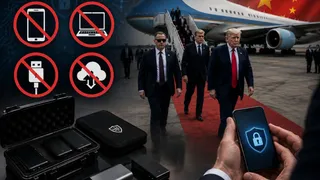
Before US President Donald Trump arrived for his high-stakes visit to China, hundreds of American officials, aides and corporate executives accompanying him left behind one of the most essential tools of modern communication, their personal mobile phones.
According to current and former US officials, members of the delegation entering China often travel with "clean" devices, temporary laptops and tightly controlled communication systems to reduce the risk of surveillance, hacking and data theft.
Why US officials take such step in China
The move reflects longstanding concerns within Washington that anything brought into China, including phones, tablets, hotel Wi-Fi connections and even charging ports, could potentially be monitored or compromised.
The precautions highlight the deep mistrust shaping the US-China relationship, where cybersecurity and espionage concerns now influence nearly every aspect of diplomatic engagement between the two powers.
Former Secret Service special agent Bill Gage described China as a “mass surveillance state”, saying American officials are briefed extensively before arrival. “Everything is monitored,” he warned, adding that officials are trained to assume that both their physical and digital activities could be watched.
Former White House Chief Information Officer Theresa Payton also said US delegations entering China operate under the assumption that there are “no safe electronic communications” inside the country. Officials are often advised to limit digital activity to only what is absolutely necessary during the mission.
As a result, even basic communication becomes complicated. Messages that would usually be sent through encrypted apps are instead routed through controlled systems, temporary accounts or relayed in person. Many officials lose access to cloud services, synced devices and regular contact lists during the visit.
Charging phones even barred
The cybersecurity precautions also extend to charging phones and laptops. US federal guidance has long warned against using unknown USB ports or local charging stations because of fears of "juice jacking", a cyberattack technique where compromised charging hardware can steal data or install malicious software. Officials traveling to high-risk countries often carry government-approved chargers, battery packs and secure accessories instead of relying on local infrastructure.
ALSO READ: Can We Work Together? Xi's Big Question To Trump During High-Stakes Meeting In China
Reports suggest several top American business leaders from companies such as Apple, Boeing, Qualcomm and BlackRock may also join the delegation.
China rejects allegations of cyber surveillance
Meanwhile, China has rejected accusations of improper surveillance. Chinese Embassy spokesperson Liu Pengyu said privacy and data security are protected under Chinese law and denied claims that the government forces companies or individuals to illegally collect information.
ALSO READ: Marco Rubio Arrives In Beijing Despite China Sanctions And Entry Ban; How Did It Happen?
For US officials, however, the extraordinary digital precautions surrounding Trump’s China visit reveal how cybersecurity fears have become central to the modern geopolitical rivalry between Washington and Beijing.
You may also like to watch