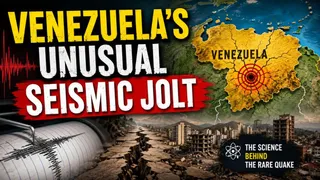
Venezuela, a country already facing political turmoil since the US "kidnapped" its president, has been hit by its strongest earthquake in a century. On Wednesday evening, the national capital, Caracas, was struck by two powerful, back-to-back earthquakes measuring 7.2 and 7.5 in magnitude. Although officials have put the initial death toll at 32, a US earthquake monitoring agency estimates the final toll could reach 100,000.
While the country sits near multiple fault lines, its position straddling the South American and Caribbean plates make earthquakes much less common than in other parts of Latin America. Along the Pacific coast -- in Mexico and Chile, for example -- earthquakes are frequent. The two countries sit along the seismically active tectonic belt known as the "Pacific Ring of Fire," which is responsible for 90 per cent of earthquakes, according to the USGS.
What causes earthquakes?
According to British Geological Survey, the earth’s outermost layer is fragmented into about 15 major slabs called tectonic plates. earthquakes are the result of sudden movement along faults within the Earth. During the earthquake, these tectonic plates experiences sudden movement. The movement releases stored-up ‘elastic strain’ energy in the form of seismic waves, which propagate through the Earth and cause the ground surface to shake. Such movement on the faults is generally a response to long-term deformation and the buildup of stress.
Tectonic geography and the Doublet Explained
Latin American nations along the Pacific "Ring of Fire" (like Chile and Mexico) frequently experience devastating megathrust earthquakes. However, in the case of Venezuela, its geographic position makes massive tremors exceptionally rare.
Instead of crashing head-on or diving beneath one another, the two tectonic plates meeting near Venezuela, the Caribbean Plate and the South American Plate, simply scrape sideways past each other. This horizontal grinding happens through a network of underground cracks known as the Bocono–Moron–El Pilar Fault System.
Because these plates are sliding past each other rather than colliding, the movement is much slower, moving at about the same speed your fingernails grow each year. This sideways motion typically results in smaller, shallow tremors rather than major disasters. While massive earthquakes can still happen in Venezuela, the country's unique geography makes them highly unusual events that typically occur only once a century.
The Science of the "Doublet"
The massive structural damage seen in Caracas following the event was caused by a highly unusual geological phenomenon known as an "earthquake doublet". Seismologists recorded a shallow 7.2 magnitude earthquake, which was followed just 39 seconds later by an even stronger 7.5 magnitude earthquake along the same Moron fault zone in Yaracuy.
In a standard seismic sequence, a major mainshock is followed by a predictable series of much smaller aftershocks as the earth settles. However, in an earthquake doublet, neither event is clearly dominant. When a fault ruptures, it usually relieves enough tectonic strain to stabilise the immediate area. In this rare instance, the interconnected nature of northern Venezuela's fractured fault segments worked against it.
The immense stress accumulated over decades wasn't entirely dissipated by the first 7.2 rupture; instead, the sudden movement instantly transferred critical mechanical load onto an adjacent, already-strained fault segment. This domino effect triggered the second 7.5 mega-quake almost immediately, unleashing a devastating double-punch of independent energy.
(With inputs from agencies)
You may also like to watch