

- By Dr (Prof) Sadhana Kala
- Sat, 29 Aug 2026 08:31 PM (IST)
- Source:JND
In the summer of 1999, the mountains of Kargil became the center of one of the most challenging military campaigns in modern Indian history. As Indian soldiers fought to reclaim strategically important heights occupied by Pakistani forces, another battle was unfolding in the skies above them.
That air campaign was Operation Safed Sagar, the Indian Air Force's (IAF) contribution to the Kargil War. Conducted alongside the Indian Army's Operation Vijay, it represented an extraordinary test of air power, technology, courage, and improvisation. The IAF was tasked with conducting combat operations at altitudes of 14,000 to 18,000 feet against wellentrenched targets in some of the world's most difficult terrain.
The IAF itself describes Safed Sagar as one of its most unique air operations: an air campaign conducted at unprecedented heights and under exceptionally difficult climatic conditions.
A war unlike any other
When the scale of the Kargil intrusion became clear in May 1999, Indian forces discovered that Pakistani troops and irregulars had occupied a series of commanding heights along the Line of Control (LOC), from the Mushkoh Valley through Dras and Kargil to Batalik and Turtuk.
These positions overlooked vital Indian supply routes and gave the intruders an enormous tactical advantage. For the Army, recapturing the peaks meant attacking uphill against heavily fortified positions, often under observation and fire from above.
Air power could potentially change that equation.
But there was a fundamental problem: this was terrain and altitude for which conventional air-attack tactics had not been designed.
On May 26, 1999, IAF aircraft began combat operations. MiG-21s, MiG-23BNs, and MiG-27s were employed against Pakistani positions, while MiG-29s provided combat air patrols. The campaign marked the first major employment of Indian air power in the region since the 1971 war.
Fighting at 18,000 feet
At such heights, virtually every aspect of flying and weapons delivery became more complicated.
The thin air affected aircraft performance. Engines generated less thrust, while weapon trajectories differed significantly from those familiar to pilots operating at lower altitudes. Targets were often tiny fortified positions camouflaged among rocks and snow.
There was another geographical complication. On a flat battlefield, a bomb missing its target by a few dozen meters might still land relatively close. In the mountains, however, the same error could send a bomb tumbling down a steep slope or into a distant valley.
The IAF also had to operate under a crucial political restriction: Indian aircraft were not to cross the Line of Control. This meant pilots had to attack targets from India's side of the LoC, considerably narrowing their options.
In other words, the IAF had to fight a high-altitude air-to-ground campaign against difficult targets while operating within a tightly constrained battlespace.
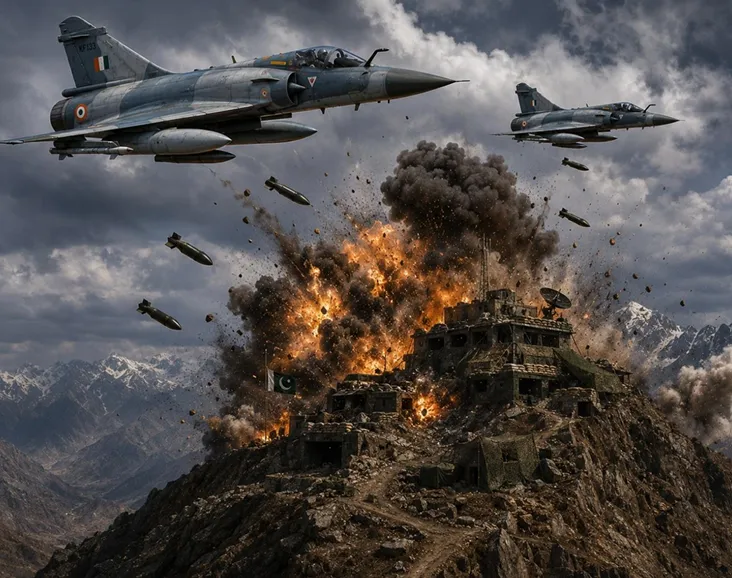
(Tiger Hill: Mirage 2000 fighter jets delivered precision laser-guided bombs directly onto the Pakistani battalion headquarters and command post atop Tiger Hill, destroying the bunker network and disrupting enemy command and control.)
The painful early lessons emerged.
The opening phase involved experimentation and, tragically, resulted in losses.
On May 27, an IAF MiG-27 was lost after an engine problem during an attack mission, while a MiG-21 was also shot down. The following day, a shoulder-fired missile brought down an Mi-17 helicopter, resulting in the deaths of four air warriors.
The losses demonstrated how dangerous low-level helicopter operations could be against well-defended mountain positions. Tactics had to change.
The Mi-17s, initially pressed into an attack role, were subsequently withdrawn from direct rocket-attack missions. Fighters became increasingly important, while the IAF worked urgently on ways to improve the accuracy and effectiveness of its strikes.
The mountains were forcing the Air Force to rewrite its tactical playbook in real time.
Enter the Mirage-2000.
One of the defining chapters of Safed Sagar was the employment of the Mirage-2000.
The aircraft offered capabilities particularly suited to the evolving requirements of the campaign. More importantly, the IAF rapidly operationalized precision-strike technology, including laser-guided bombs and laser-designation systems.
The Kargil conflict was a remarkable example of wartime adaptation.
The IAF had been working to integrate precision-guided weapons into its Mirage-2000 and Jaguar fleets before the war, but the Kargil conflict accelerated their operational deployment. The introduction and rapid standardization of Litening targeting pods enabled pilots to identify, designate, and attack targets with substantially greater precision.
The transformation was dramatic. Instead of relying primarily on conventional bombing against nearly indistinguishable mountain targets, the IAF could increasingly deliver precision weapons against specific enemy positions.
Muntho Dhalo: A pivotal moment
Among the most significant Safed Sagar missions was the strike on Muntho Dhalo, a Pakistani logistics camp in the Batalik sector.
The target: The surrounding mountainous terrain concealed the target, making it difficult to identify from the air. The target: The surrounding mountainous terrain concealed the target, making it difficult to identify from the air. The surrounding mountainous terrain concealed the target, making it difficult to identify from the air. The surrounding mountainous terrain concealed the target, making it difficult to identify from the air. The target was difficult to identify from the air because it was concealed beneath the surrounding mountainous terrain. The Lightning pod helped locate the camp and establish its scale.
On June 17, Mirage-2000 aircraft attacked the position using precision-guided bombs. The destruction of the logistics complex disrupted the supply chain supporting Pakistani troops on the heights.
The significance went beyond the destruction of one camp.
The mission demonstrated that precision air power could reach targets that conventional bombing struggled to engage effectively. It also showed how reconnaissance, target acquisition, precision strike, and battle-damage assessment could be combined into a single operational cycle.

(Mirage 2000 strike on Muntho Dhalo, a Pakistani logistics camp in the Batalik sector.)
Safed Sagar was becoming more than an exercise in aerial bombardment. A sophisticated campaign of intelligence-led air operations was emerging.
The role of air power was crucial in the battle for the peaks
The IAF's contribution included not only the destruction of camps and gun positions but also other significant efforts.
Air strikes helped suppress enemy positions and disrupt their ability to reinforce and resupply troops. This created opportunities for army units fighting their way up the mountains.
Targets included supply dumps, ammunition stores, troop concentrations, artillery positions, and logistical routes.
The relationship between air power and ground operations became increasingly important. Air strikes could not themselves occupy a mountain peak. That task remained with the soldiers on the ground. But by degrading enemy positions and supply networks, air power could make the Army's extraordinarily difficult assaults more achievable.
The IAF eventually flew around 5,000 strike missions, 350 reconnaissance/ELINT missions, and approximately 800 escort sorties during the conflict. Its helicopters also flew more than 2,000 sorties for casualty evacuation and air transport.
These figures underline an important point: Safed Sagar was not simply a story about fighter aircraft dropping bombs. It was a vast air operation involving combat, reconnaissance, transport, logistics, and medical evacuation..
Courage, innovation, and sacrifice
The story of Safed Sagar is ultimately about people.
Pilots flew into an environment where weather could change rapidly, mountains left little room for error, and enemy positions were difficult to distinguish from the surrounding landscape. Engineers and ground crews worked under intense pressure to modify systems and keep aircraft operational.
The campaign also demonstrated the importance of adaptability.
The IAF entered the conflict without a ready-made manual for sustained air-to-ground operations at 16,000 or 18,000 feet. It learned from early setbacks, modified tactics, accelerated technology.
deployment, and progressively increased the accuracy of its strikes.
The official record notes that rapid technical modifications and on-the-job training helped the IAF overcome the extraordinary operational difficulties presented by the terrain.
Lessons that reshaped Indian airpower
Operation Safed Sagar left behind lessons that went far beyond the Kargil battlefield.
One was the importance of precision weapons. Another was the value of real-time intelligence, surveillance, and target acquisition. The war also showed how important it is for the Army and Air Force to work together more closely from the very beginning of operational planning.
Perhaps most importantly, Kargil demonstrated that air power had to be tailored to the battlefield rather than applied rigidly.
The experience contributed to subsequent efforts to modernize India's air-combat capabilities, improve precision-strike capacity, and strengthen joint planning.
Safed Sagar is a memory
The Kargil War: The courage of soldiers who climbed steep, exposed ridges under enemy fire primarily defines its memory. The memory of the Kargil War: The courage of soldiers who climbed steep, exposed ridges under enemy fire primarily defines it. The memory of the Kargil War is primarily defined by the courage of soldiers who climbed steep, exposed ridges under enemy fire. The memory of the Kargil War is primarily defined by the courage of soldiers who climbed steep, exposed ridges under enemy fire. But above those mountains, IAF air warriors were fighting their own extraordinary battle.
Operation Safed Sagar was conducted under restrictions, at extreme altitudes, and against targets that challenged conventional assumptions about air warfare.
It was not a flawless campaign. It involved losses, difficult early lessons, and rapid tactical adaptation. Yet that is precisely what makes it historically significant.
Safed Sagar showed what happens when technology, training, courage, and improvisation come together under extraordinary pressure.
More than two decades later, Operation Safed Sagar remains one of the defining chapters in the history of the Indian Air.
(Note: Dr (Prof) Sadhana Kala is a USA-trained robotic & laparoscopic surgeon, Uppsala University, Sweden, trained fertility specialist, Icon Endoscopic Surgeon of North India, and National Icon Endoscopic Surgeon of India. She is rated as India's Best Gynaecologist by Google.)
(Disclaimer: The views expressed in this article are the personal opinions of the author.)