8 Kg Vs 10 Kg Front Load Washers: The Ultimate Capacity Comparison (December 2025)
Deciding between an 8 Kg and a 10 Kg front load washing machine? Our expert comparison breaks down key differences in capacity, features, spin speed (1200 RPM vs 1400 RPM), and energy efficiency. Review top models from IFB, Bosch, and Haier to find the perfect washer for your family size, bulk laundry needs, and budget.
Choosing the right capacity is the foundational step when investing in a new front load washing machine. In the Indian market, the choice often narrows down to the highly popular 8 Kg and the rapidly growing 10 Kg categories. While both offer superior wash quality, efficiency, and advanced features like inverter technology and steam cycles, they cater to fundamentally different household needs. An 8 Kg model is typically suited for medium to large families (4–6 members) who run moderately frequent loads, offering a balance of performance and space efficiency. Conversely, a 10 Kg washing machine is designed for genuinely large families (6+ members) or those who regularly handle bulky laundry like duvets, curtains, and large weekly loads, drastically cutting down the number of cycles required. This guide provides an in-depth, feature-by-feature comparison of top models in both segments to help you make an informed, long-term decision.
8 Kg Vs 10 Kg Washing Machines: Key Differences To Know
The fundamental difference between 8 Kg and 10 Kg models goes beyond just 2 kilograms; it impacts cycle efficiency, machine size, and initial investment.
Feature
8 Kg Front Load Washer
10 Kg Front Load Washer
Ideal Family Size
Medium to Large (4-6 members)
Large to Extra-Large (6+ members)
Load Handling
Excellent for daily wear, average bedding. Can manage one duvet/quilt.
Typically 1200 RPM (sufficient) or 1400 RPM (premium models).
Often 1400 RPM (Standard in high-end models) for faster drying of bulk loads.
Vetted Options
We thoroughly evaluate every product through a combination of hands-on research and insights from reputable industry sources.
IFB 8 Kg 5 Star, DeepClean Technology, AI Powered, WiFi, Fully Automatic Front Load Washing Machine (SENATOR MBN 8012 CMS, PowerSteam, 9 Swirl, Steam Refresh, Inbuilt Heater, Eco Inverter, Mocha)
The IFB Senator MBN 8012 is a feature-rich, 8 Kg front load washer designed for the tech-savvy, modern home. It is distinguished by its Powered by Ai capability, which intelligently detects fabric type and weight to optimize the wash cycle, ensuring deep cleaning while preserving garment quality. The machine features Power Steam® for germ elimination and wrinkle reduction, complemented by Aqua Energie to treat hard water, enhancing detergent action. The 1200 RPM spin speed ensures efficient moisture extraction. It is an ideal choice for families of 4 to 6 members who value laundry care, hygiene, and the convenience of smart integration. The strong 4-year comprehensive warranty plus 10 years motor warranty provides excellent peace of mind.
Who Is It Suitable For: Families of 4-6 members living in hard water areas and seeking AI-driven, hygienic cleaning with smart home connectivity (Wi-Fi/Voice enabled).
User Review: Users consistently praise its silent operation, superior wash quality, and the effective use of AI/Steam features. The robust build and extended warranty are frequently highlighted as major advantages.
Reasons to buy:
✓Advanced AI washing
✓Excellent hard water treatment (Aqua Energie)
Reason to avoid:
✗Higher initial price point
01
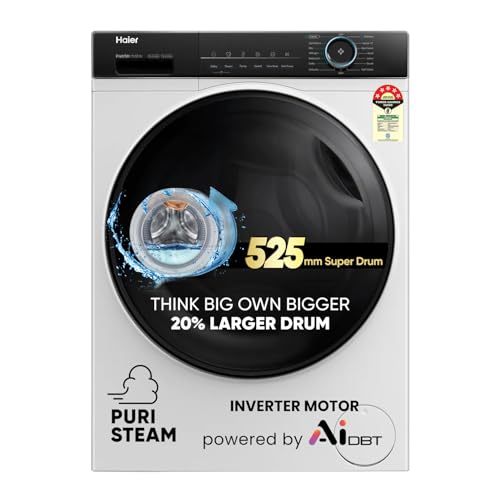
Haier 8 kg 5 Star Powered by AI-DBT with PuriSteam, 525mm Super Drum Fully Automatic Front Load Washing Machine (HW80-IM12929C, Inverter Motor with In-Built Heater, White)
The Haier HW80-IM12929C stands out for its focus on drum technology and quiet performance. Its key selling point is the massive 525mm Super Drum, which offers a larger diameter than conventional 8 Kg drums, resulting in superior tumbling action and less wear and tear on clothes. Powered by AI-DBT (Direct Balance Technology), it minimizes noise and vibration by dynamically balancing the load. The Direct Drive Inverter Motor contributes to its silent operation and increased lifespan. PuriSteam offers hygiene and wrinkle reduction. This model is perfect for medium to large families prioritizing durability, ultra-quiet functioning, and a physically larger wash capacity within the 8 Kg class.
Who Is It Suitable For: Households of 4-6 members where low operating noise and high drum capacity are priorities, such as homes with infants or open-plan living.
User Review: Customers highly rate the machine for its virtually silent wash and spin cycles, thanks to the Direct Drive motor. The large drum size is also appreciated for handling medium-sized blankets easily.
Reasons to buy:
✓Direct Drive Motor (ultra-quiet, durable)
✓Largest drum size in its class
Reason to avoid:
✗not explicitly Wi-Fi enabled
02
Our Core Values
Transparent, Honest Reviews
We provide straightforward insights into each product’s strengths and weaknesses, so you can make confident, informed decisions.
Trusted Brands Priority
We focus on products from reliable brands known for quality, consistency, and customer satisfaction.
Smarter Value for Your Money
We highlight products that strike the perfect balance between cost, quality, and performance, so you get true value without the extra cost.
Bosch 8 kg 5 Star Fully-Automatic Front Loading Washing Machine (WAJ2826CIN, Black Grey, AI active water plus, In-Built Heater)
Representing German engineering excellence, the Bosch WAJ2826CIN 8 kg washer emphasizes efficiency, durability, and high spin performance. With a top spin speed of 1400 RPM, this machine ensures minimal drying time, a significant advantage, especially in humid climates. Its EcoSilence Drive motor is renowned for quiet, friction-free operation. Key wash features include Anti-Vibration Side Panels for stability and SpeedPerfect for reducing wash time by up to 65%. The VarioDrum provides gentle yet powerful cleaning. This model is ideal for discerning buyers who seek a reliable, robust machine with high spin speed and world-class build quality.
Who Is It Suitable For: Families of 4-6 members focused on robustness, long-term durability, and needing the highest possible spin speed (1400 RPM) for quick laundry drying.
User Review: Reviewers frequently laud the machine's solid build and exceptional stability even at 1400 RPM. Wash performance is consistently rated as excellent, with users noting the silent operation.
Reasons to buy:
✓High 1400 RPM spin speed
✓EcoSilence motor (extremely quiet)
Reason to avoid:
✗Fewer smart connectivity features compared to IFB
03
IFB 10 Kg 5 Star AI Eco Inverter Fully Automatic Front Load Washing Machines with Wifi (Executive Plus MXC 1014, 2023 Model, Mocha, Oxyjet 9 Swirl Wash, 4 Years Comprehensive Warranty)
The Godrej WFEON 1014 IEBT SLSR offers a generous 10 Kg capacity at a competitive price point, making large-volume laundry manageable for big families. It boasts a powerful 1400 RPM spin speed for quick drying of heavy loads and is equipped with i Sense Technology which optimizes washing parameters based on fabric type and load. The inclusion of Steam Wash ensures hygienic, wrinkle-free clothes by eliminating germs and allergens. Its Digi Inverter Motor ensures high energy efficiency and durability. This machine delivers a comprehensive suite of features—including Drum Clean and Rapid 15—focused on powerful, efficient cleaning for high-frequency usage.
Who Is It Suitable For: Large joint families (6-8+ members) or households that wash bulky items frequently, seeking high capacity and high spin speed within a value-for-money proposition.
User Review: Users highly appreciate the massive capacity and the high 1400 RPM spin, noting that it effectively handles large, mixed loads. The Steam Wash feature is popular for sanitization.
Reasons to buy:
✓Excellent capacity-to-price ratio
✓1400 RPM for fast drying
Reason to avoid:
✗May lack some premium aesthetic finishes of competitors
04
IFB 10 Kg 5 Star AI Eco Inverter Fully Automatic Front Load Washing Machines with Wifi (Executive Plus MXC 1014, 2023 Model, Mocha, Oxyjet 9 Swirl Wash, 4 Years Comprehensive Warranty)
The IFB Executive Plus MXC 1014 is IFB's flagship 10 Kg offering, merging maximum capacity with cutting-edge technology. It features the patented Oxyjet® technology, which pre-mixes detergent with water and injects O2 bubbles to deliver a deep, professional-grade clean, while saving detergent, water, and energy. Like its 8 Kg counterpart, it is Powered by Ai, includes Power Steam®, Aqua Energie for hard water, and is Wi-Fi and Voice Enabled. The powerful 1400 RPM spinner quickly dries substantial loads, making it highly efficient. It's built for luxury, maximum load convenience, and the most advanced washing care.
Who Is It Suitable For: Large households (6-10 members) with significant laundry volumes and a preference for the most comprehensive set of smart, hard-water-friendly, and hygiene-focused washing technologies.
User Review: Customers are overwhelmingly positive about the Oxyjet technology and the superior clean it provides. The Wi-Fi controls and voice commands are often cited as convenient additions for managing big laundry days remotely.
Reasons to buy:
✓Oxyjet deep cleaning
✓Top-tier 1400 RPM, Comprehensive 4-year machine + 10-year motor warranty
Reason to avoid:
✗Highest investment cost
05
Bosch 10kg 5 Star Anti Stain & AI Active Water Plus Fully Automatic Front Load Washing Machine with Built in Heater (WGA254ZPIN, Pretreatment, Iron Steam Assist & Allergy Plus, Dark lake)
The Bosch WGA254ZPIN is a premium 10 Kg machine from the Series 6 lineup, offering high performance and specialized stain management. Its core feature is Anti-Stain Plus, which automatically targets and removes up to four common stubborn stains without the need for pre-treatment. Paired with a robust EcoSilence Drive and 1400 RPM spin, it guarantees a stable, quiet wash and quick turnaround time for large loads. The AntiWrinkle feature minimizes creases, saving ironing time. This model is the choice for large families who prioritize powerful stain removal and reliable, quiet performance over extensive smart connectivity features.
Who Is It Suitable For: Large families (6-8+ members) with members prone to generating tough stains (e.g., young children or sports enthusiasts) who demand a fast, high-quality, and reliable wash cycle.
User Review: The 1400 RPM spin and Anti-Stain program are praised for delivering exceptional results on heavy and soiled garments. Users confirm the motor runs extremely quietly, enhancing the home environment.
Reasons to buy:
✓Best-in-class stain removal
✓High 1400 RPM
Reason to avoid:
✗generally higher price than competing 10 Kg Indian brands
Comparison Table For 8 Kg And 10 Kg Front Load Washing Machines
The following table offers a direct, feature-by-feature comparison of the six top-rated 8 Kg and 10 Kg front load washing machines reviewed above. This side-by-side analysis highlights crucial differences in spin speed, motor type, unique cleaning technologies, and smart capabilities, providing a complete overview to facilitate your final purchase decision.
Feature
IFB (8 Kg) MBN 8012
Haier (8 Kg) HW80-IM12929C
Bosch (8 Kg) WAJ2826CIN
Godrej (10 Kg) WFEON 1014
IFB (10 Kg) MXC 1014
Bosch (10 Kg) WGA254ZPIN
Capacity
8 Kg
8 Kg
8 Kg
10 Kg
10 Kg
10 Kg
Energy Rating
5 Star
5 Star
5 Star
5 Star
5 Star
5 Star
Max Spin Speed
1200 RPM
1200 RPM
1400 RPM
1400 RPM
1400 RPM
1400 RPM
Motor Type
Eco Inverter
Direct Drive Inverter
EcoSilence Drive
Digi Inverter
Eco Inverter
EcoSilence Drive
Steam/Hygiene
Power Steam®
PuriSteam
Allergy Plus
Steam Wash
Power Steam®
Steam / Anti-Stain Plus
Smart/AI Tech
AI, Wi-Fi/Voice
AI-DBT
Active Water Plus
i Sense Technology
AI, Oxyjet®, Wi-Fi/Voice
Anti-Stain Plus
Hard Water Tech
Aqua Energie
No Specific Tech
Active Water Plus
Inbuilt Heater
Aqua Energie
Inbuilt Heater
Special Drum
Crescent Moon
525mm Super Drum
VarioDrum
Stainless Steel Tub
Crescent Moon
VarioDrum
Motor Warranty
10 Years
10–12 Years
10 Years
10 Years
10 Years
12 Years
Disclaimer: At The Daily Jagran Smart Guide, we prioritize providing up-to-date information on the latest trending commodities and goods. Links in this article are affiliate links. Please note that our product recommendations are based on independent research and analysis however, The Daily Jagran Smart Guide shall not be held liable for any claims, damages, or disputes arising under applicable laws, including the Consumer Protection Act, 2019. Any issues regarding product quality, delivery, or warranties must be directed to the respective manufacturer or seller. Furthermore, the products featured in this article are organized for reader convenience and are listed in no particular order of priority or ranking.
Faq's
How do I determine if I need an 8 Kg or a 10 Kg front load washing machine?
You should choose based primarily on family size and laundry habits. An 8 Kg model is perfect for families of 4 to 6 people who wash 1–2 times per day. A 10 Kg model is necessary for large families (6+ members), joint families, or if you regularly wash heavy, bulky items like king-size comforters, multiple blankets, or weekly laundry in a single cycle. Choosing the right capacity prevents wear on the machine and your garments.
Is a 10 Kg washing machine less energy efficient than an 8 Kg model?
No, modern 5-star rated 8 Kg and 10 Kg front load washers are highly energy efficient, primarily due to Inverter technology. While a 10 Kg machine may consume slightly more power per cycle because it uses more water and has a larger motor, it allows you to wash a larger volume of clothes in fewer cycles. This overall reduction in cycle frequency can make the 10 Kg model more time and energy efficient over the long run for heavy laundry users.
Does the spin speed (RPM) difference between 1200 RPM and 1400 RPM matter for standard washing?
For standard clothes (cotton, synthetics), the difference between 1200 RPM and 1400 RPM is marginal. Both speeds extract water efficiently. However, the 1400 RPM spin speed found in premium 8 Kg and most 10 Kg models becomes a significant advantage when washing very heavy or bulky items (e.g., towels, blankets, duvets). The higher speed significantly reduces the moisture content in these heavy fabrics, leading to much faster air-drying times, which is highly beneficial in monsoon or high-humidity regions.