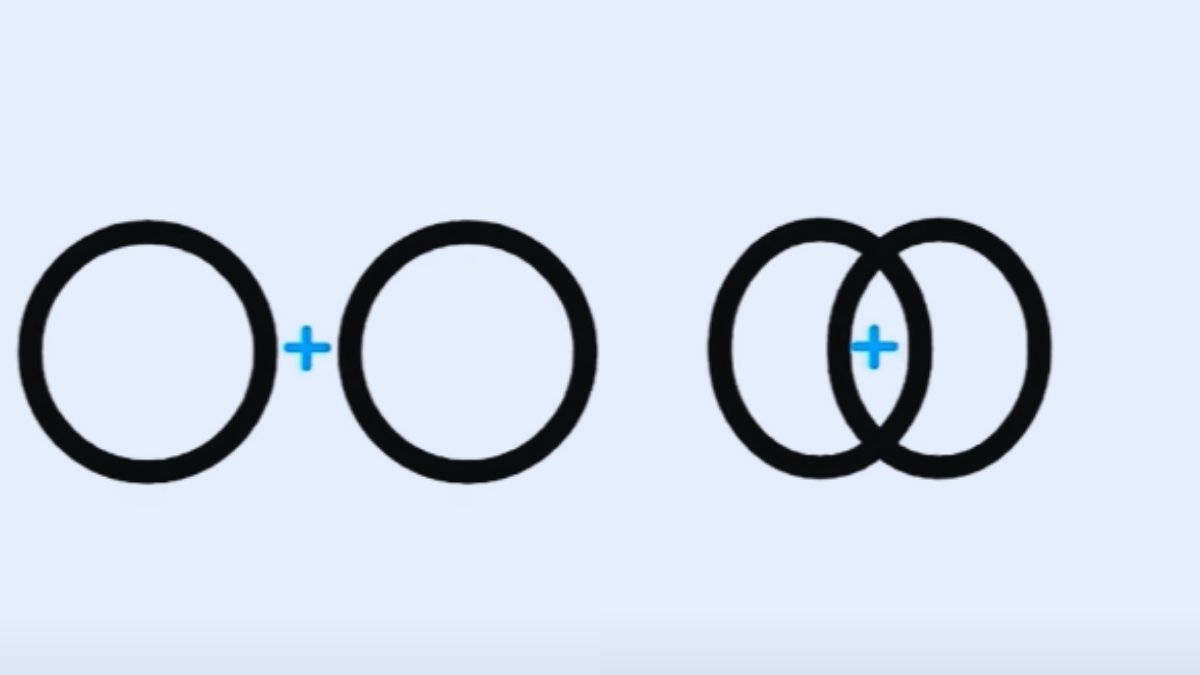
We often see some videos or images that are just mind-boggling and confusing. We are not able to believe our eyes as it does not match reality. Those images or videos are called optical illusions, that trick our minds to believe something different. Our brain perceives these illusions differently. Now take a look at this 'double ring illusion'. This illusion of rotating rings is not as simple as it looks.
This illusion was created by Dawei Bai and Brent Strickland and it is called 'The Double Ring Illusion'. The video was uploaded by the YouTube channel 'Best Illusion of the Year Contest".
The video first shows two rings moving, with a cross sign in the centre. The caption says, "How do the rings movie when you look at the cross? Most people see the rngs moving in unstable 360-degree rotations. Then, we see two rings moving but they overlap with each other and the plus sign. The caption says, "Who do you see now? Do you see the rings moving in 180-degree rotations, bouncing back and forth?"
Later, we see both videos of four rings moving together. The caption says, "In reality, all the rings are identical. But you interpret their motions differently. This is because our visual system knows that objects cannot pass through each other. Thus forcing you to see the rings rotating back and forth here."
Recommended For You
After that, we see one complete ring and another ring with holes rotating together. It is explained that if the rings are holed, they no longer (necessarily) appear to rotate back and forth. Therefore, this illusion demonstrates that our visual system is sensitive to physical laws.
The description by Dawei Bai and Brent Strickland says, "When two bistable rings are presented separately, they appear to move in unstable 360° rotations. However, if the same rings partially overlap, they now appear to move in stable 180° rotations, bouncing back and forth – as if they avoid passing through each other. Remarkably, when one ring is holed, in a way that the other ring can pass through the holes, the unstable 360° percept is restored. In all three cases, the rings undergo the exact same motion, but our visual system interprets the stimuli differently depending on whether the rings can traverse each other."