
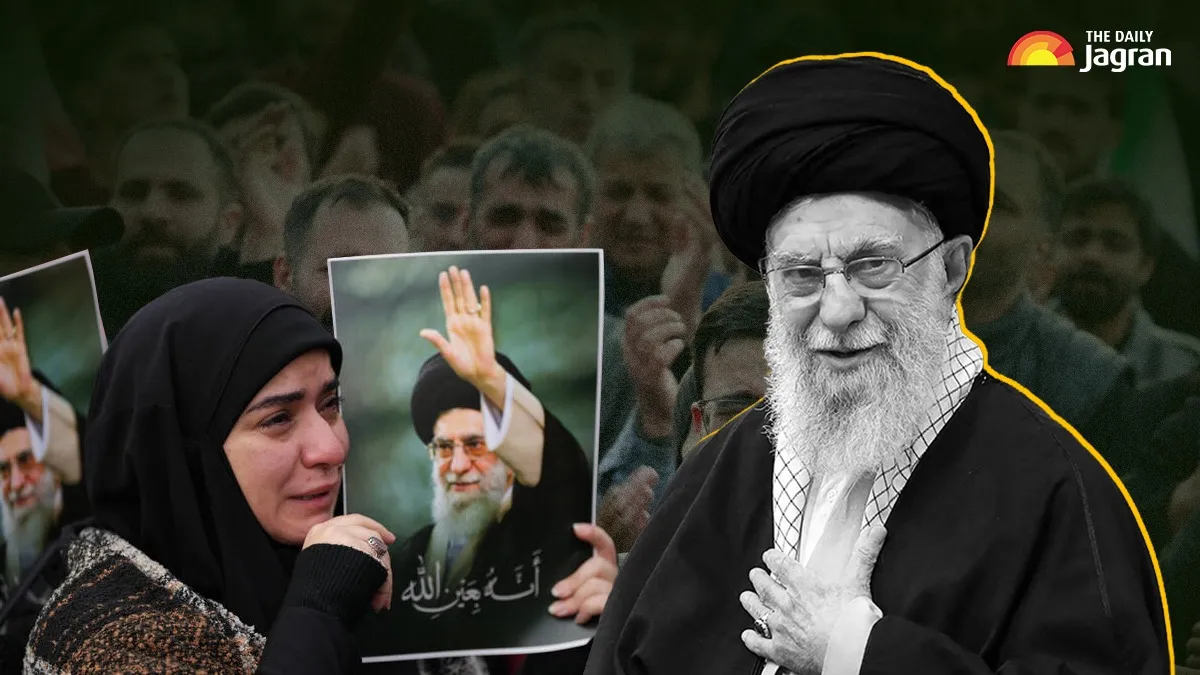
Ayatollah Ali Khamenei's Death: As protesters took to the streets in Srinagar, Lucknow, Delhi, Karnataka, Ladakh, Maharashtra, Rajasthan, and numerous other parts of India following the death of Ayatollah Ali Khamenei on Sunday, chants reverberated through the crowds: "Allahu Akbar, Khamenei rehbar" (God is great and Khamenei is the leader). This was a powerful demonstration of both sorrow and outrage as mourners paraded through the streets, rhythmically striking their chests.
Large gatherings of mourning and protests were also reported in several countries, including India, as Shia communities expressed their grief and frustration over the loss of Iran’s Supreme Leader, Ayatollah Ali Khamenei. Khamenei’s full name, Ayatollah Syed Ali Hussaini Khamenei, reflects his Hussaini Syed lineage, tracing his ancestry directly back to the Prophet.
In India, images depicted crowds gathering outside the Iran Cultural House in Delhi, where a ceremony was organised to commemorate Khamenei’s death. Meanwhile, members of the Shia community in Jammu and Kashmir were organising an important demonstration outside the headquarters of the United Nations Military Observer Group in Srinagar.
Recommended For You
The mourning and protests somehow resembled Ashura, the Muharram processions commemorating the martyrdom of Imam Hussain, Prophet Mohammed’s grandson, in the Battle of Karbala.
Why Were There Large-Scale Mourning Gatherings & Protests Across Kashmir?
Khamenei’s full name, Ayatollah Syed Ali Hussaini Khamenei, reflects his Hussaini Syed lineage, tracing his ancestry directly back to the Prophet. Khamenei had visited Kashmir just once in 1980 and played a pivotal role in uniting Shia and Sunni Muslims. He offered prayers with Sunnis at Jamia Masjid in Srinagar, delivering a brief sermon during his visit.
In 1989, after the death of Ayatollah Ruhollah Khomeini, Khamenei assumed the role of Supreme Leader and the highest religious authority for Shia Muslims. Since that time, his followers have adhered to his leadership. Many followers also pay khums religious dues amounting to approximately 20% of their annual savings, to Khamenei or his chosen representatives.
One woman protester expressed, "He (Khamenei) is more dear to me than my parents. It’s an irreplaceable loss. They have martyred our Imam. He was the biggest pillar of Islam," she told NDTV. Her husband, Ajaz Rizvi, stood by, speechless with grief. "They can't kill the idea of Khamenei after his martyrdom," he declared.
Another protester, Raashid, said, "Imam Khamenei followed in the footsteps of his forefathers and was killed alongside his family. He stood for justice, the oppressed, and the persecuted people of Gaza."
Aga Ruhollah Mehdi, an MP from Srinagar, suggested that there was no single reason behind the intense grief and anger felt over Khamenei's death. "He represented an institution of resistance, and for those who believed in resistance rather than submission to power, his stance on Gaza is a prime example. He stood against those who submitted to imperialist powers like the US and Israel, and he stood for the people of Gaza," he explained.
Aga continued, Khamenei could have pursued negotiations and "lived in peace" like many Arab leaders, but he chose to follow a different path. "He could have negotiated a deal with the US and lived the way Arab leaders and countries did," he said, adding that the manner of Khamenei's assassination left a "sense of loss" among his followers. "He was the only ray of hope for people facing subjugation for standing against imperialistic powers," he concluded.
ALSO READ: Who Is Responsible For Israel-US-Iran War? When Middle East Conflict Could End | Explained
Ayatollah Ali Khamenei's Death: Why Indian Shia Muslims Are Protesting and Grieving?
Iran's late supreme leader, Ayatollah Khamenei, was believed by his followers to be the vice-regent of Imam Mahdi, the last of the Twelve Imams, who is prophesied to return at the end of time to establish peace and redeem Islam. "His death is not just the passing of a leader; it concerns our very faith," said a Shia scholar.
As the Imam of Shia Muslims, Khamenei was more than a political figure; with his death, Shia scholars argued that they had lost a leader, Marja al-taqlid (meaning "source of emulation"), and Wali al-Faqih (meaning "guardian jurist").
Mourners drew striking parallels between Khamenei's assassination and Imam Hussain's killing in the Battle of Karbala. They believe that Karbala has been repeated in Tehran, which explains the widespread mourning marches.
Khamenei held the title of 'marja-e taqlid' (Source of Emulation), the highest religious rank in Twelver Shia Islam. For millions of Shia Muslims, he was not just a political figure but a spiritual authority whose fatwas (religious rulings) governed every aspect of daily life and faith.
As a Sayyid, Khamenei was considered a direct descendant of the Prophet Muhammad through Imam Ali, a status that was symbolised by his black turban, a revered symbol in Shia Islam.
Khamenei's influence extended deeply into the lives of Shia Muslims. His religious edicts guided everything from worship to financial transactions, family law, and ethical conduct. His rulings were considered the final authority, and Shia Muslims across the globe adhered to them in accordance with Sharia law.
While there is no single official leader for Shia Muslims worldwide, akin to the Pope for Catholics, most Shia Muslims follow either the Grand Ayatollah Ali Sistani of Iraq or Ayatollah Ali Khamenei.
A mourner shared, "His reverence comes from the Shia memory of the infallible imams, their struggle and steadfastness for truth, honour, and justice. We are not just mourning the loss but also expressing our resolve to live up to those ideals."
"There is a striking similarity between his martyrdom and those of revered Shia imams Ali and Hussain. Ali, the Prophet's son-in-law, was killed during Ramadan while praying in a mosque. Hussain was killed under siege, hungry and thirsty, along with his family. Khamenei has also been killed in Ramadan. So, too, he shares the status of being ‘mazloom’ (oppressed) like his ancestors and imams," explained a Shia scholar. "In his speeches, he invoked the sayings of Hussain, which emphasised not giving allegiance to tyrants, and he lived up to that standard."