
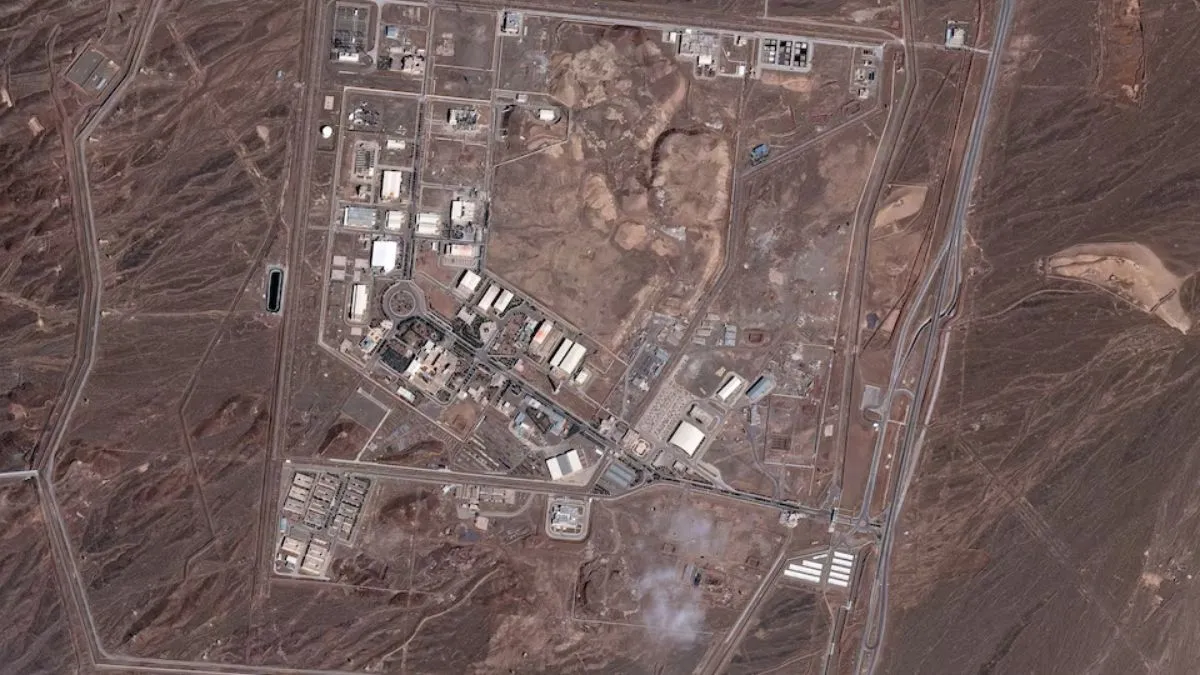
Commercial satellite imagery has captured what appears to be the first known strikes on an Iranian nuclear site since the start of the US-Israeli air operation, news agency Reuters reported, citing an independent policy institute, which said on Monday. The Institute for Science and International Security said imagery produced by Colorado-based Vantor showed two strikes on access points to the underground uranium enrichment plant at Natanz, which was hit by the US last June.
When did US launch strike on Iran's nuclear sites?
David Albright, a former UN nuclear inspector and founder of the institute, said the strikes appeared to have occurred sometime between Sunday afternoon and Monday morning local time, based on the satellite imagery his group reviewed. He was unable to identify whether the US or Israel hit the Natanz complex, one of the main facilities of Iran's nuclear program. He credited Ben Tzion Macales, an Israeli geo-analyst, as being the first to find satellite imagery of the Natanz strikes.

(A satellite image shows a closer view of the Natanz Nuclear Facility, near Natanz, Iran, March 1, 2026 | CREDIT: REUTERS)
The US and Israel launched their air war against Iran early Saturday, triggering Iranian retaliatory strikes around the region. Albright's findings appeared to corroborate an earlier statement by Reza Najafi, Iran's envoy to the International Atomic Energy Agency, that Natanz was hit on Sunday.
Recommended For You

(A satellite image shows a historical view of the Natanz Nuclear Facility under construction, near Natanz, Iran, September 16, 2002. Vantor. CREDIT: REUTERS)
What global nuclear watchdog said on Iran nuke sites attack
Najafi was disputing a comment by IAEA chief Raphael Grossi, who said there was no sign that any nuclear site had been hit. Albright said it was likely that Grossi had relied on imagery produced before the pictures obtained by his institute.
Iran's nuclear programme is among the reasons Israel and the US have given for the attacks, alleging Iran was getting too close to being able to eventually make a nuclear bomb. Iran has repeatedly denied seeking a nuclear arsenal.
What satellite images reveal
Albright's report said Vantor's imagery showed that three buildings at Natanz had been destroyed. Two were personnel entrances to two underground halls housing thousands of centrifuges, machines that enrich uranium for use in power plants or weapons, depending on the duration. Even though the halls were rendered inoperable by the US attack in June, the strikes could indicate that the halls still contained "recoverable centrifuges" or other related equipment, the report said.
The third building destroyed covered the only vehicle access ramp to the underground halls, it said. Grossi said in a statement to a meeting of the IAEA's 35-nation board of governors that the agency had no indication that "any of the nuclear installations ... have been damaged or hit." Moments after Grossi's remarks, Najafi told reporters outside that Natanz had been attacked. "Again, they attacked Iran's peaceful, safeguarded nuclear facilities yesterday," Najafi said. Asked by Reuters which facilities were hit, he replied: "Natanz" and left.
IAEA has limited contact with Iran
While the IAEA's crisis-response centre has been unable to reach Iran's nuclear regulatory authorities, there has been some contact with Iranian officials, Grossi told a press conference. "We are, of course, in conversation with Iran, but at the moment, it's very limited. Until last Thursday, it was very intense," he said, adding that while the IAEA has no staff in Iran at the moment, it is watching satellite images closely. Tehran has not let the IAEA return to its bombed facilities since they were attacked in June.
(With inputs from Reuters)