
- By Supratik Das
- Sun, 07 Dec 2025 09:05 AM (IST)
- Source:JND
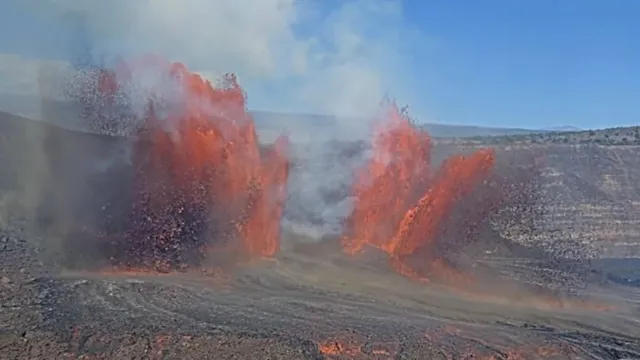
Hawaii Kilauea volcano eruption: Hawaii’s Kilauea volcano roared back to life on Saturday, erupting from multiple vents inside the Halemaʻumaʻu crater and producing rare triple lava fountains that climbed hundreds of feet into the air within minutes.
Live webcam feeds from the United States Geological Survey (USGS) captured the moment the fountains surged upward, marking one of the most visually striking phases since the volcano’s current eruption cycle began late last year.
According to USGS volcanologists, the latest activity, classified as Episode 38, began at 8:45 am HST on December 6. Within minutes, sustained fountains from the north vent were shooting 50 to 100 feet (15–30 meters) high, with officials noting a fast rise in intensity.
Triple Fountains Create Rare Spectacle
While Kilauea is known for rapid-fire activity, Saturday’s display stood out. Scientists observed rare triple lava fountains, two erupting from a north double vent and a third from the south.
By noon, the south vent was throwing lava more than 1,000 feet into the air, producing sideways “lava rainbows”. The fountain sharply inclined toward a closed section of Hawaii Volcanoes National Park. One of USGS’s remote cameras, positioned in a closed section of Hawaii Volcanoes National Park, was buried under tephra.
In case you ever wondered what it would be liked to be engulfed in a lava fountain...
— USGS Volcanoes🌋 (@USGSVolcanoes) December 6, 2025
This video was recorded by the V3 camera, located on the south rim of Halema‘uma‘u crater at the summit of Kīlauea volcano on the Island of Hawai‘i. The camera, located in a hazardous closed… pic.twitter.com/7coXye39AK
Moments later, the agency issued another update noting that the plume generated by the eruption had grown dramatically, rising more than 20,000 feet above sea level. USGS also addressed misinformation circulating online, clarifying that groundwater was not driving the fountains. “This is magma-driven activity,” the bulletin emphasised.
USGS estimated that Episode 38 had produced nearly 13 million cubic yards (10 million cubic meters) of lava in about six hours. The north vent remained inactive, while the south-vent fountains had decreased to under 575 feet. Total summit deflation had reached 24.5 microradians.
Here are some other views of Kīlauea summit eruption lava fountaining episode 38 in Halema‘uma‘u crater on the Island of Hawai‘i, and answers to some of your questions about this activity.
— USGS Volcanoes🌋 (@USGSVolcanoes) December 6, 2025
This eruptive episode began from the north vent at about 8:45 am HST this morning,… pic.twitter.com/MjhcX93MLg
ALSO READ: Ethiopia’s Hayli Gubbi Volcano Erupts: Residents Recount Terrifying Moments, Say 'It Felt Like Bomb'
Volcanic Landscape In Motion
The park’s two summits, Kilauea and the neighboring Mauna Loa, rank among the world’s most active volcanoes. Though Kilauea is smaller in size, it remains significantly more active, with its most powerful display in the current cycle recorded on November 9, when fountains soared to nearly 1,100 feet.
Authorities say the eruption remains fully contained within the national park’s boundaries. Local airports are expected to remain unaffected, and no tsunami threat has been issued. What concerns scientists, however, is the elevated release of volcanic gases and the spread of “Pele’s hair” long, delicate threads of volcanic glass that form during strong fountaining. These strands can drift more than 10 miles from the vent, while heavier glassy fragments may fall within a two-mile radius.