
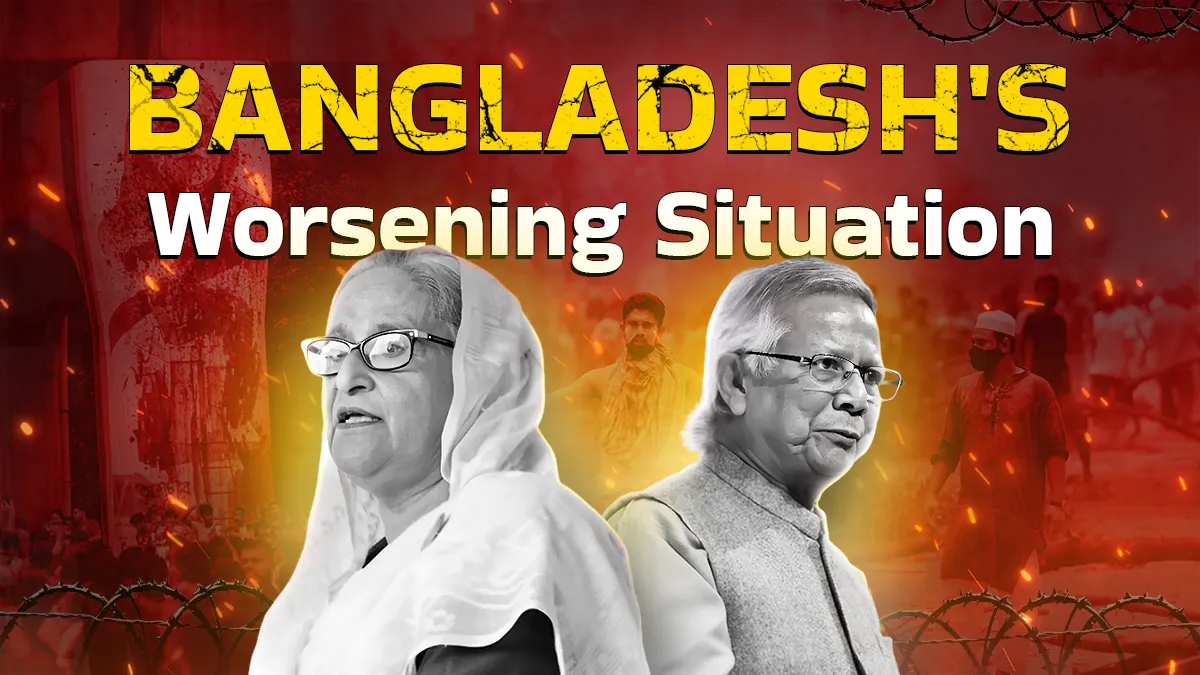
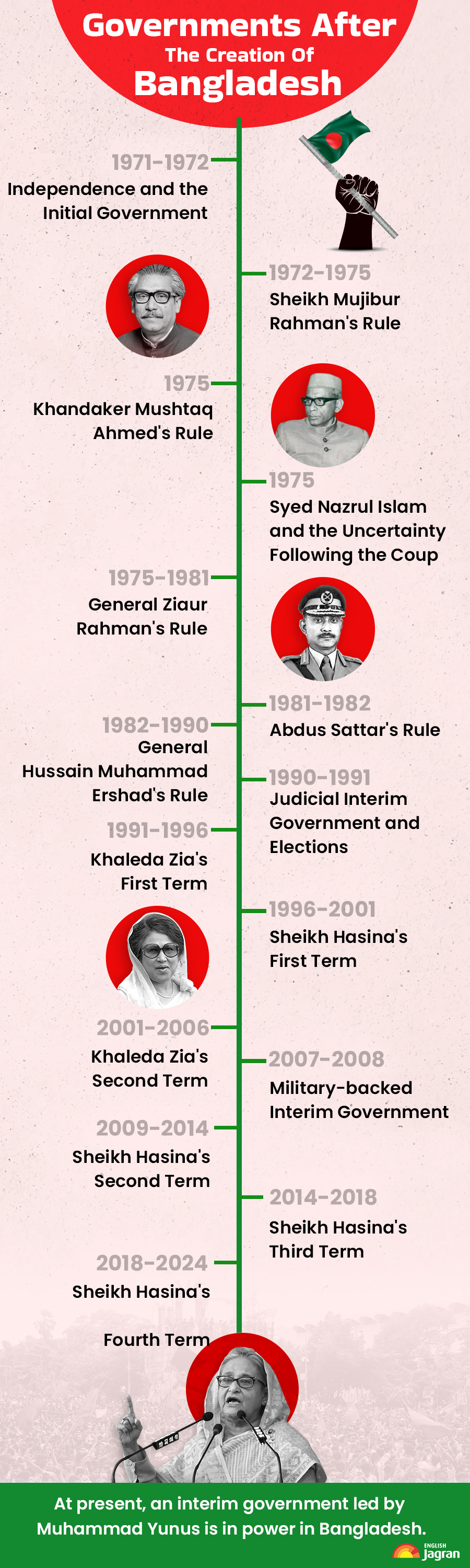
New Delhi, Prime Team. Since Bangladesh's independence, its early years have been marked by political instability. The country has witnessed 13 rulers and four military coups. Like Pakistan, Bangladesh also experienced a period of upheaval, but in recent years it has emerged as a prosperous and promising nation on the global stage. However, it was unable to sustain this prosperity for long. The erratic political power, internal conflicts between leaders and the public, and the fleeting economic prosperity prevented Bangladesh from becoming the 'Amar Sonar Bangla' it aspired to be. Recent protests have underscored Bangladesh's image as an unstable nation globally. This not only weakened its economy but also labelled it as democratically unstable. Over the past few decades, India and Bangladesh's relationship has evolved significantly. Since independence, India has consistently played the role of an elder brother, providing support and advice during difficult times. Whether the current state of India-Bangladesh relations will remain stable or if the warmth will diminish is something that time will reveal. The instability in Bangladesh raises a crucial question about the challenges it might pose to India's security. Another question is whether China and Pakistan will exploit this situation to bolster their position against India. In such circumstances, what strategy should India adopt to maintain equilibrium and enhance its growing global stature?
Reason Behind Recent Protests
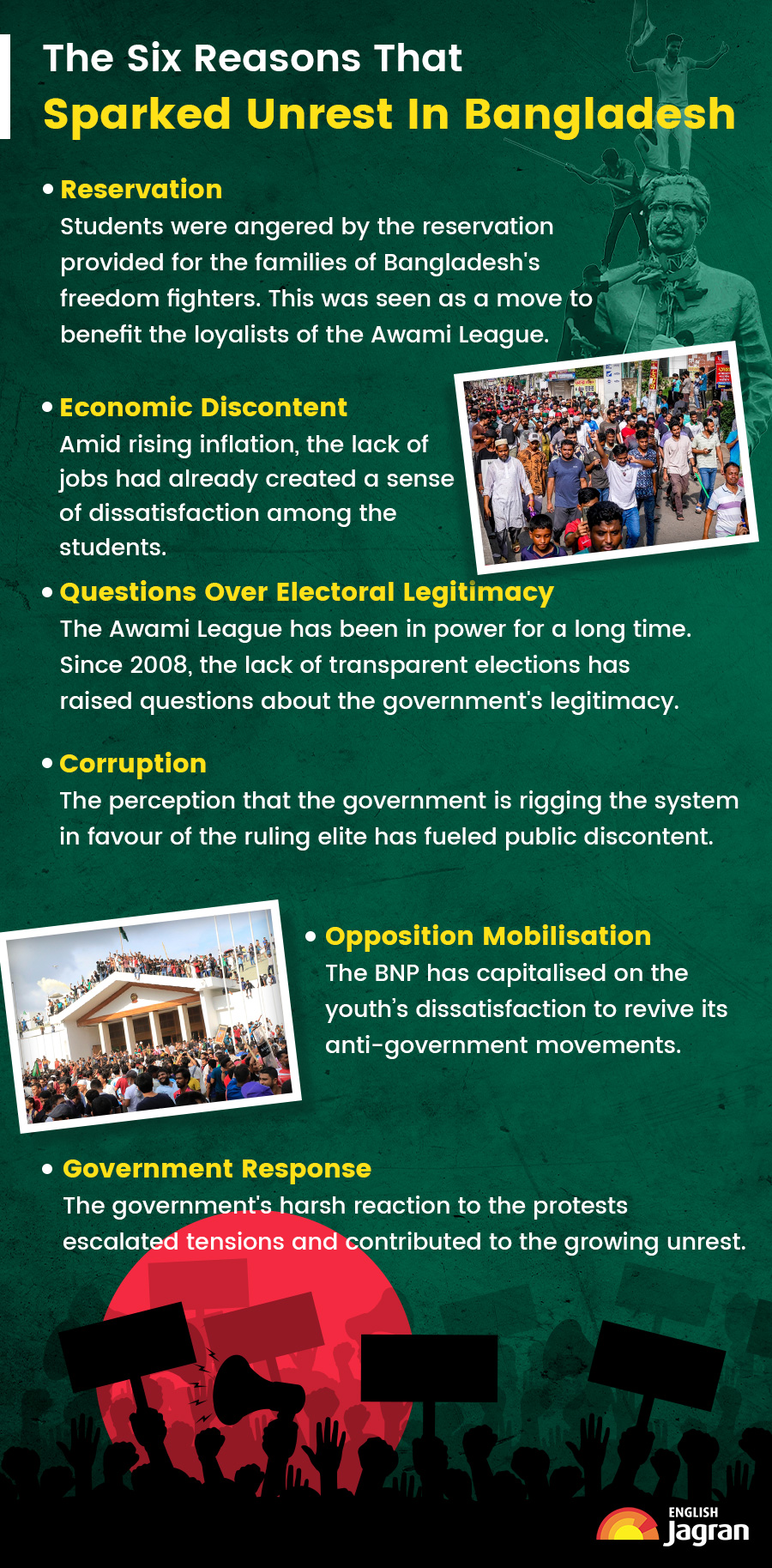
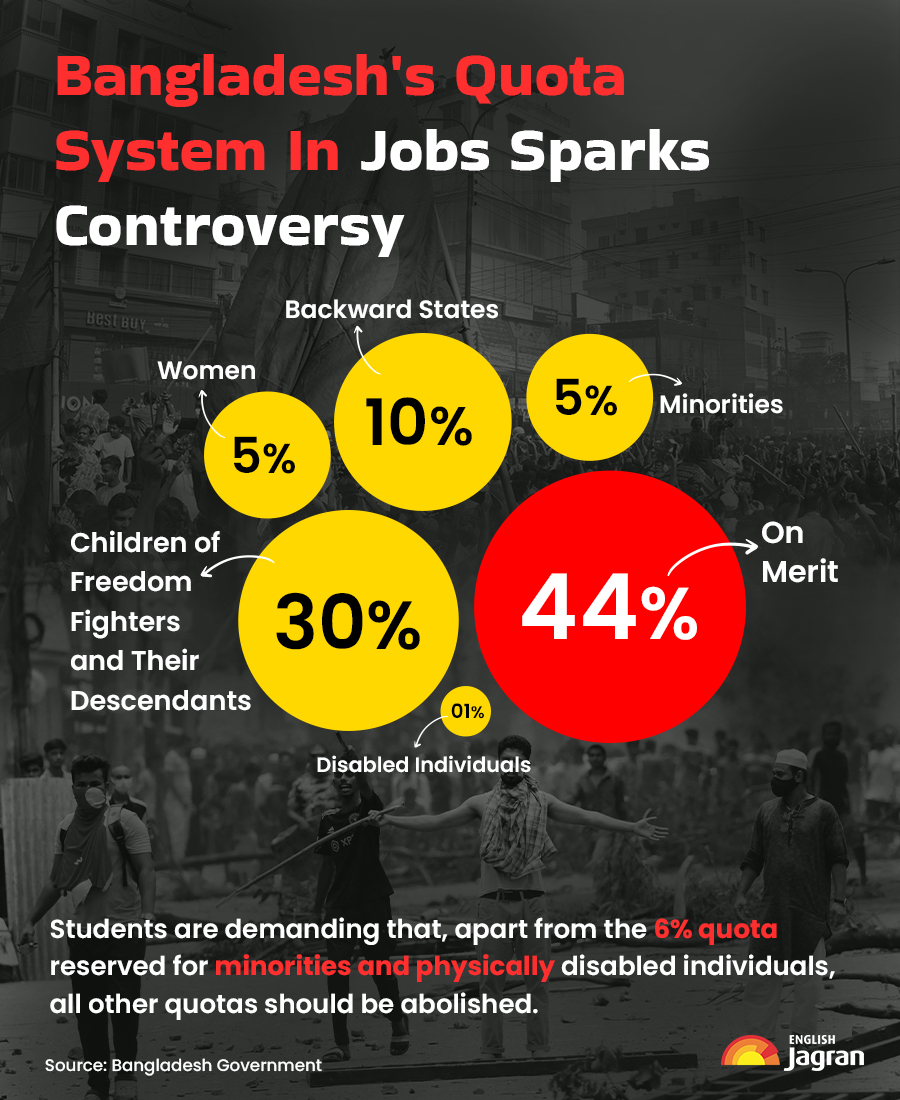
There are two major parties in Bangladesh: one is the Awami League, led by Sheikh Mujibur Rahman’s daughter, Sheikh Hasina. The second party is the BNP, led by Khaleda Zia. Sheikh Hasina first won the election in 1996. After the 1971 Liberation War of Bangladesh, Mujibur Rahman, who is also known as the ‘father of the nation’, had introduced a law that 30 per cent reservation would be given to ‘Mukti Jodhas’ or freedom fighters who participated in the war. In 1997, Sheikh Hasina amended this law, stating that along with the freedom fighters, their children would also receive reservation, leading to rise in public resentment. While most were not opposed to the quota given to freedom fighters, they questioned its extension to their children. The quota amendment was met by protests which were held on a small scale and were easily suppressed. In 2011, Sheikh Hasina made another significant mistake by introducing a new law which further granted reservation to the grandchildren of freedom fighters. This led to widespread anger in Bangladesh, and the resentment kept growing.
During her continuous 15-year rule, Sheikh Hasina exercised dictatorial control over institutions like the Bangladesh Election Commission and the Broadcasting Council, appointing her people, which further fuelled public anger. In recent years, Bangladesh made significant economic progress, with their exports growing rapidly. As people started earning money, they began to feel that their democratic rights were being crushed. According to a report by the United Institute of Peace, there were multiple reasons behind this movement. While rising inflation and lack of jobs created discontent among students, the perception that the government was rigging the system in favour of the ruling elite further fuelled public dissatisfaction. The government's harsh response to the protests escalated tensions and contributed to the growing unrest.
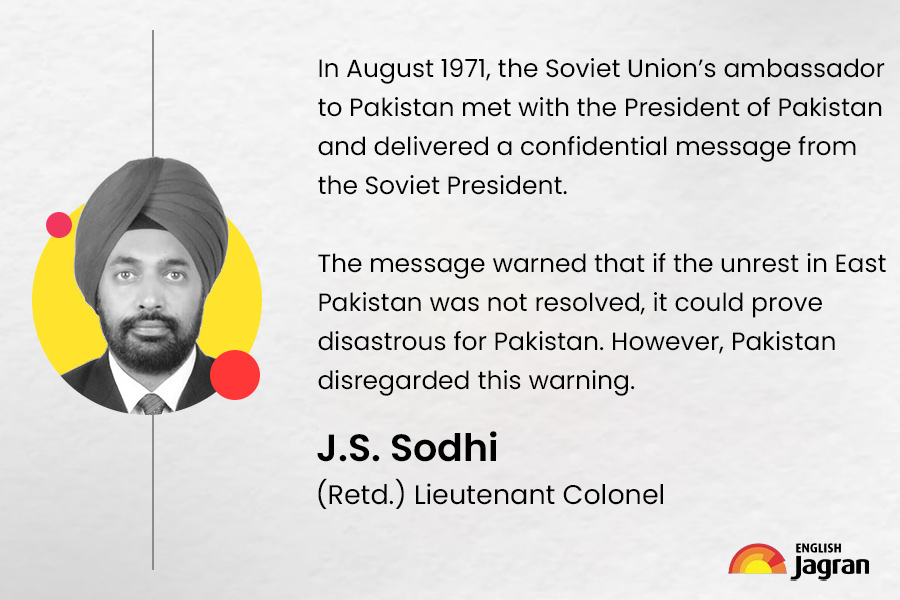
Lt Colonel (Retired) JS Sodhi says that when the reservation issue resurfaced, Sheikh Hasina questioned, "Should I give reservations to Razakars?" Razakars were those who fought on Pakistan's side during Bangladesh's 1971 war of independence and are seen as traitors. Thus, the term 'Razakar' is considered extremely derogatory.
When Sheikh Hasina used the term 'Razakar' for the protesters, it further infuriated the agitating citizens. The widespread protests, which soon turned violent and went out of control, culminated in the end of Sheikh Hasina's 15-year tenure on August 5, forcing her to flee the country.
With Sheikh Hasina gone, the instability in Bangladesh provided an opportunity for Pakistan and China. Both countries had faced significant difficulties during Hasina’s rule. They reportedly began to encourage protests in Bangladesh and even funded them. A Congressional Research Service article mentioned that Bangladesh was slowly turning into a one-party state. Observers did not consider the 2018 election fair and transparent.
Like India, Bangladesh also has a constitutional head of state, the President, while the Prime Minister is the head of the administration. The President is elected every five years. The Prime Minister, appointed by the President, is chosen from among the members of Parliament who must prove their majority in the legislature. The Prime Minister forms their cabinet of ministers, whose appointments are approved by the President. Bangladesh’s Parliament is known as the Jatiyo (National) Parliament, comprising 300 elected members who serve a five-year term.
From Progress To Present Crisis
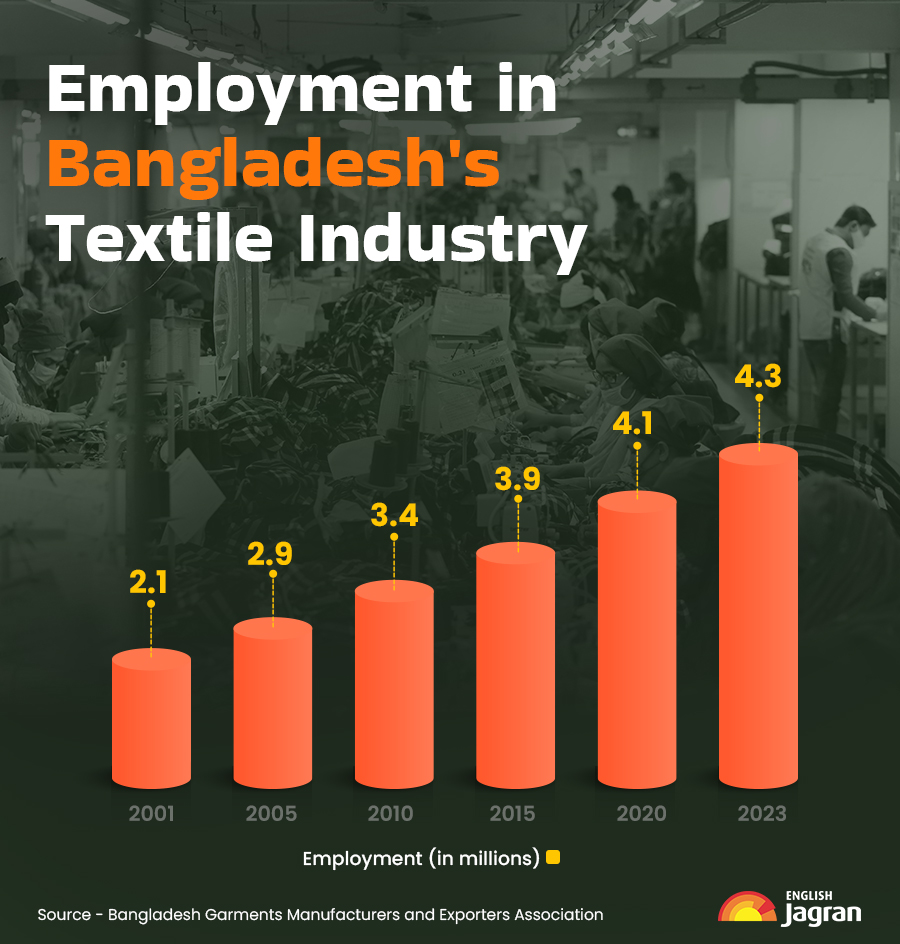
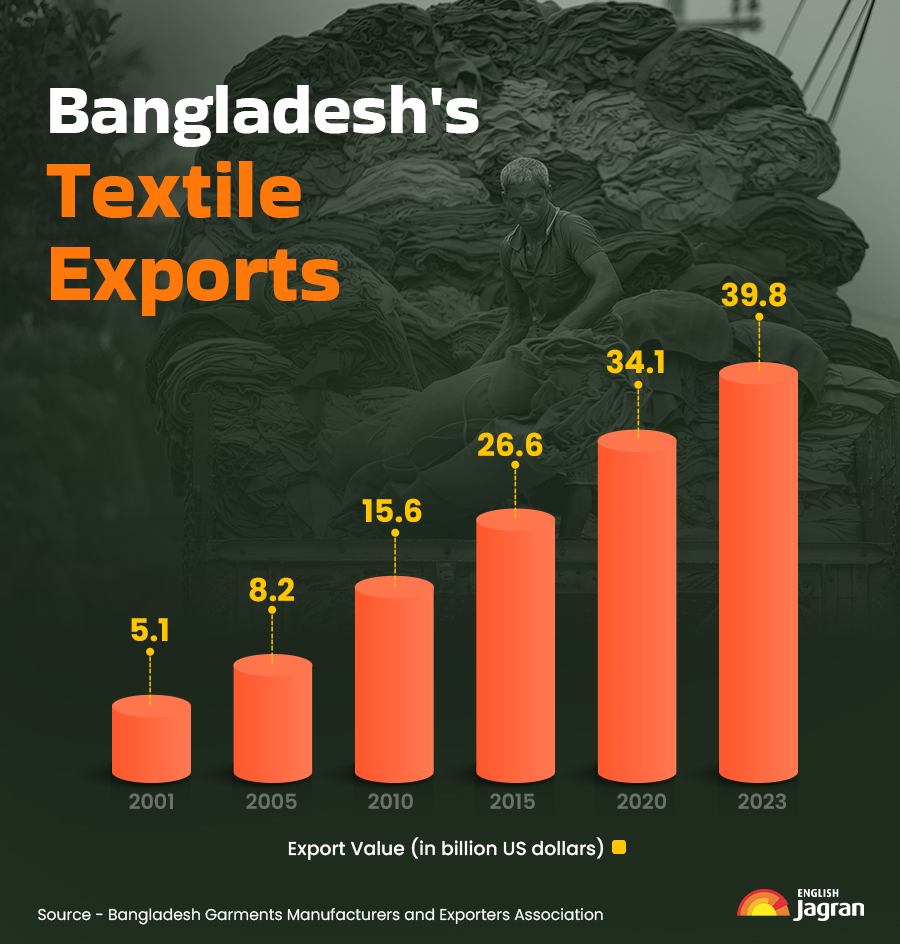
Bangladesh’s performance in the textile industry, particularly in readymade garment exports, has been commendable. This industry has helped 25 million people rise out of poverty and contributed significantly to the empowerment of women. In recent years, Bangladesh’s per capita income has been higher than India’s, and its performance in various human development indicators has been impressive.
However, after the Covid-19 pandemic, global demand weakened, leading to deteriorating conditions in Bangladesh. The country’s GDP growth rate began to slow down, and the balance of payments crisis worsened. Last year, Bangladesh had to seek assistance from the International Monetary Fund (IMF).
To regain pre-Covid levels of economic growth and create employment opportunities, it is evident that Bangladesh needs to expand private investment beyond textile exports. However, the country seems to be struggling in this regard. Limited private investment has led to an increased reliance on government jobs among the youth. There have been allegations that the benefits of reservation in government jobs are being enjoyed by those affiliated with the ruling Awami League.
The Challenge Of Corruption And Poverty
Neeraj Singh Manhas, Senior Adviser for South Asia at the Parle Policy Initiative, says that corruption and poverty have been widespread challenges. These have affected governance and political stability in Bangladesh. Corruption has undermined the effectiveness of government institutions, leading to a cycle of political patronage and instability. Poverty has impeded development and fostered discontent, making it difficult to implement long-term, sustainable economic policies.
Dr Gunjan Singh, an Assistant Professor at OP Jindal Global University and a South Asian affairs expert, mentions that corruption has been a significant issue, with reports of senior officials under Sheikh Hasina being involved in scandals. Another notable aspect is that under Sheikh Hasina's rule, the development of her party's (Awami League) supporters has been prioritised. While it is true that per capita income has tripled in the past decade and economic growth has been rapid, it is also important to note who has benefited from this growth. If all manufacturing units were owned by Awami League supporters, it would naturally fuel public resentment. The growth has not been balanced.
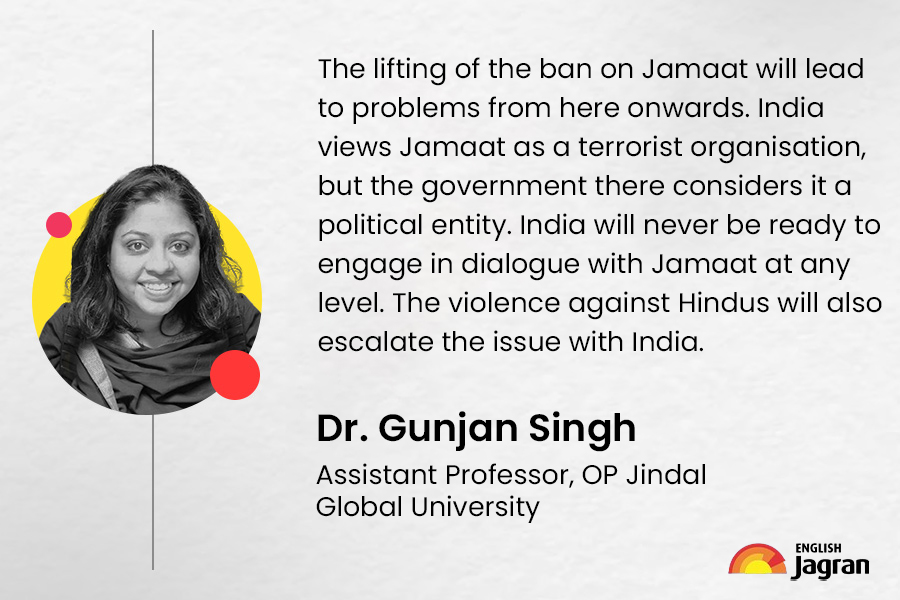
According to Dr Gunjan, while manufacturing in Bangladesh has increased, there are no jobs for educated youths. The jobs created in the manufacturing sector have primarily been for low-skilled workers and women. This is why students protested against the quota provisions. Their argument was that, in a country where jobs are already scarce, the introduction of quotas would leave them with even fewer opportunities. The Supreme Court later scrapped the government order, but by then, the public discontent had already escalated.
Dr Gunjan adds that along with corruption, poverty continued to rise because the income growth was concentrated in a particular section of society. Bangladesh's economy was dependent on just one sector. There were also numerous reports which stated that families of opposition party supporters' were pressured and removed from jobs.
There was also widespread discontent among the general public against Sheikh Hasina's 15-year rule. The way the government initially handled the student protests, where students died and police officers fired bullets indiscriminately, exacerbated the situation. However, the army had reportedly refused to open fire on students and protesters. This indicated that even within the military, discontent was brewing to some extent.
The UK's Foreign Minister, David Lammy, advocated for peace, stating that in recent weeks, Bangladesh had faced unprecedented levels of violence and loss of life. The army chief in Bangladesh had declared a transitional period. All parties are urged to work towards ending violence, restoring peace, and normalising the situation to prevent further loss of life.
The Role Of Other Countries In Bangladesh
According to Manhas, external countries have also played a role in Bangladesh’s political landscape. During the Cold War, major powers such as the Soviet Union and the United States, as well as regional powers like India and China, were involved in Bangladesh’s politics. Recently, India has had a significant influence, often seen as a defence ally. China has increased its presence through investments and diplomatic relations. These actions are sometimes viewed as interference in shaping Bangladesh’s foreign policy and internal decisions.
Dr Gunjan argues that external powers have played a minimal role in the recent changes in Bangladesh. Instability there benefits no country. During Sheikh Hasina's 15-year tenure, her relations with India were good, but her relations with China were also positive. She allowed China to invest under the Belt and Road Initiative (BRI). Sheikh Hasina balanced relations between India and China well, knowing that India’s support would be more beneficial in the long term. There were some statements about the United States’ role in toppling her government, but I do not believe it seeks instability there, says Dr Gunjan. The US was certainly exerting pressure through sanctions.
The US has imposed sanctions on many countries. At one time, it even imposed sanctions on India. It has sanctions on China and Iran too. The first step the US takes to apply pressure is usually sanctions. The US market is huge, and they have the financial power to influence others. Additionally, other countries rely on them for technology. The US is a major market for Bangladesh's ready-made garments. When the US imposes sanctions, it halts many activities. Bangladesh is an emerging economy and has been one of the fastest-growing in South Asia over the past 15 years.
Manhas explains that Bangladesh’s political climate has developed amidst various social movements. Movements like the 2013 Shahbag protests, which demanded harsh punishment for war criminals, demonstrated significant public participation in political processes. More recently, student-led movements against the government’s job reservation system forced the government to directly address public grievances.
The Catalyst Role Of The 2024 Elections
Gaurav Goyal, an expert on International Relations, Foreign Policy, and Strategic Affairs, notes that as the January 2024 election for Bangladesh’s National Parliament approached, the main opposition party, the Bangladesh Nationalist Party (BNP), increased pressure through large-scale rallies, demanding that the elections be held under a caretaker government. The BNP insisted that only a neutral, non-partisan administration could ensure free and fair elections. However, the ruling Awami League, under Prime Minister Sheikh Hasina (in power since 2009), was adamant about holding the elections under its own leadership.
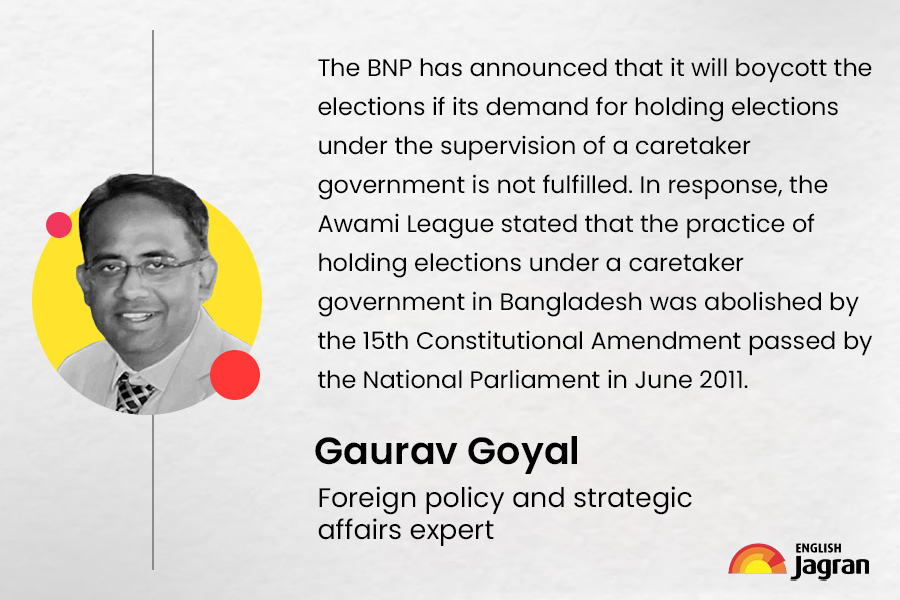
Gaurav explains that, from the beginning of 2023, the US, the UK, and some EU members had shown interest in the Bangladesh elections. Representatives from these countries met with the opposition and Awami League leaders, and the Election Commission to discuss the prospects of 'free, fair, and participatory elections'. During these meetings, the BNP declared that it would boycott the elections if its demand for a caretaker government was not met. The Awami League responded by pointing out that the 15th Constitutional Amendment, passed by the Jatiya Sangsad (National Parliament) in June 2011, abolished the practice of holding elections under caretaker governments in Bangladesh.
According to Gaurav, the US, the UK, and the EU supported the BNP’s claim that holding free and fair elections would be difficult under the Awami League’s government. They emphasised that the only way to guarantee equal opportunities was for the Awami government to step down. These same countries had praised the 2009 elections as “the most free and fair elections since the restoration of parliamentary democracy in 1991”. Western countries began to pressure Sheikh Hasina to step down and meet the BNP's demands.
In the past, the US had also tried to promote Western-style democracy in Bangladesh. Joe Biden excluded Bangladesh from his 2021 and 2023 summits. After that, his administration ignored Prime Minister Hasina during her visit to the World Bank in Washington, DC. Subsequently, the White House announced several punitive measures, particularly against Bangladesh’s Rapid Action Battalion (RAB), which the White House believed had helped Sheikh Hasina in previous elections.
Western pressure emboldened the BNP, which organised large rallies against the government. In June 2023, Jamaat-e-Islami held a massive rally in Dhaka for the first time in 10 years.
Shrinking political space has drawn Sheikh Hasina closer to China. This is a cause for concern for India, along with the United States and the West, as the foundation of Bangladesh-China bilateral relations has been primarily rooted in defence partnerships. China accounts for 72 per cent of Bangladesh’s defence supplies, making it the second-largest buyer of Chinese arms after Pakistan. Since 2010, Bangladesh has purchased over USD 2 billion worth of arms from China.
In March 2023, Hasina inaugurated Bangladesh's first submarine base near Kutubdia Channel in the Bay of Bengal, which will house two Chinese submarines. Chinese experts have also trained Bangladeshi personnel to operate the base and submarines.
Meanwhile, the US offered Sheikh Hasina free real-time access to satellite data to monitor the impacts of climate change. However, this raises questions about whether the offer was solely for monitoring climate change. It could lead to suspicions about US intervention in other countries under the guise of promoting democratic principles and supporting democratic movements globally. Manju Seth, a former Indian diplomat to Bangladesh, says, "It’s hard to say whether the military was backed by anyone, but they weren’t acting to stop the protests. It seemed they received a message from somewhere."
China Could Have Fuelled Political Instability
Gaurav Goyal suggests that the violence in Bangladesh before Sheikh Hasina left the country raised concerns that China could have fostered political instability to spread unrest and weaken the Hasina government. This strategy may have been aimed at countering New Delhi’s growing influence.
In a statement on July 14, 2024, after meeting Modi in New Delhi following the June elections in India, Sheikh Hasina explicitly prioritised India over China in the USD 1 billion Teesta River project. She was also frustrated with Beijing’s failure to fulfil its financial aid promise and for not receiving proper diplomatic protocol. She cut short her trip to China and returned to Dhaka a day earlier.
Gaurav Goyal believes Bangladesh has become aware of the negative consequences of Chinese involvement and wishes to avoid them. They were mindful of their national interests when dealing with Beijing. Choosing not to proceed with the Teesta project in partnership with China wasn’t a sudden decision.
He says, "I’ve seen Yunus and members of his advisory council use terms like ‘reset’, ‘rebuild’ and ‘strengthen’, which implies reconstructing something in need of repair."
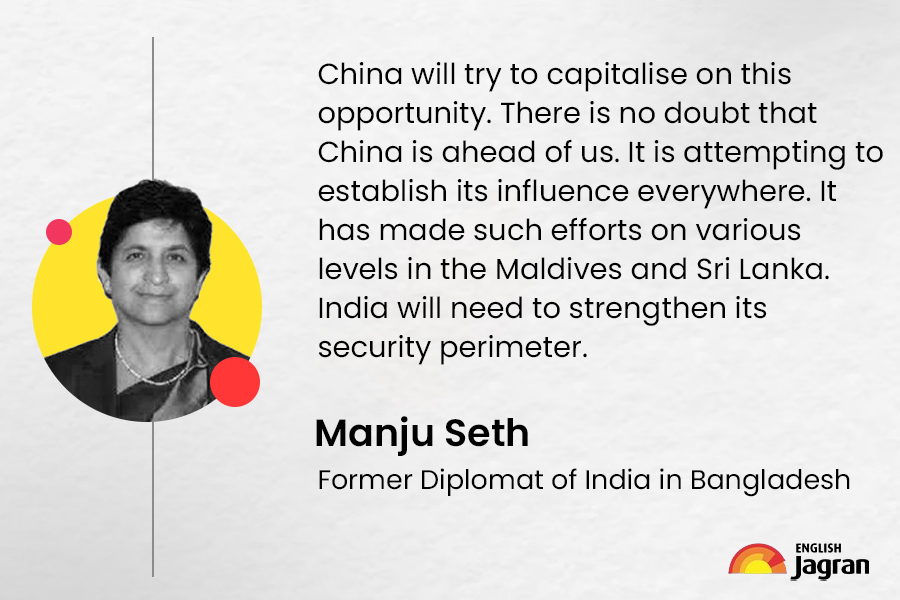
Manju Seth, a former Indian diplomat to Bangladesh, remarks that China is unhappy with India’s relations and trade with its neighbours. China wants to be the sole priority. Thus, China would likely seek to exploit this opportunity. There’s no doubt China is ahead of us; it’s trying to assert its influence everywhere. In places like the Maldives and Sri Lanka, China has made multiple attempts. India will need to strengthen its security perimeter further.
Lifting Ban On Jamaat Endangers Hindu Minorities In Bangladesh
Gunjan Singh points out that the interim government has lifted the ban on Jamaat-e-Islami and its student wing. Jamaat has been trying to re-emerge as a political party for some time, and they won a few seats in the last election. Sheikh Hasina had banned them, calling them a terrorist organisation. Lifting the ban on Jamaat will likely trouble the US as well since it is considered a terrorist group. India has banned Jamaat. The ban’s removal will also increase US pressure on Pakistan to keep Jamaat under control. Since China has investments in Bangladesh, it could also pressure Pakistan regarding Jamaat.
Gaurav Goyal mentions that the head of the interim government, Mohammad Yunus, spoke of stopping attacks on Hindus and other religious minorities after Sheikh Hasina left the country. In his opinion, Yunus feared potential anger against minorities and Hindus. Among those who faced violence were Awami League supporters, including many Hindu party supporters. The violence against Hindus was primarily due to the anger directed at Hasina, which Goyal believes may have eventually subsided.
However, Yunus' decision to lift the ban on Jamaat-e-Islami has placed minorities, particularly Hindus, at double risk. The BNP (whose leaders have also been released) centres its politics around an anti-India and anti-Hindu agenda. Whenever the BNP has come to power, minorities, especially Hindus, have faced persecution. The party supports religious Bangladeshi nationalism and provides protection to Jamaat-e-Islami, whose goal is to establish Bangladesh as an Islamic state governed by strict Sharia law.
Gaurav Goyal notes that the BNP clearly leans towards Pakistan, which is why Hindus will likely be targeted by anti-India sentiment. However, he also believes that international pressure on the interim government to act against the BNP and extremist groups will be crucial for governance.
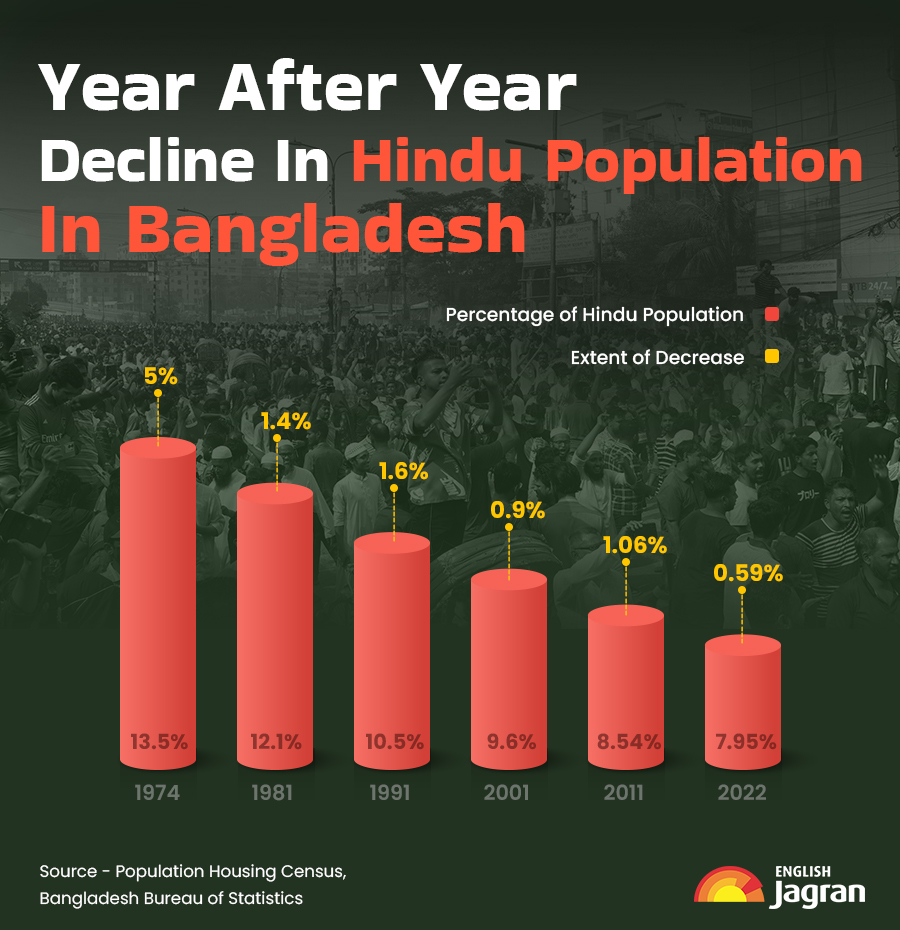
In the 1950s, the Hindu population in what was then East Pakistan was around 22 per cent, but it has now dwindled to 7-8 per cent. While several factors, such as persecution, conversion, lower birth rates among Hindus, and higher birth rates among Muslims, have contributed to this decline, political events like these have often served as flashpoints for communal violence, with Hindus bearing the brunt. If unchecked, the BNP will help resurrect Jamaat, posing a significant threat to a secular Bangladesh.
According to Goyal, this situation will heighten security concerns, particularly in India. New Delhi will likely raise the issue with Bangladesh and demand action against communal forces. Goyal also anticipates protests and rallies from those concerned about violence against Hindus and other minorities, which will increase pressure on the interim government.
It will be interesting to see how long the US and Western countries remain silent. The West has overlooked how Pakistan, in previous elections, supported Jamaat and the BNP to promote jihadism. Western sanctions over human rights violations in Bangladesh have shrunk the political space for Sheikh Hasina, strengthening Islamic extremist groups opposed to her before the January elections. In Goyal’s view, this pressure is prompting Yunus to take steps against these elements.
Gunjan Singh comments that there were problems during Sheikh Hasina’s government, but there was no political instability under her leadership. Instability is also unfavourable for India, which is already grappling with the refugee crisis. This problem could spread to other regions, and there are increasing reports of violence against Hindu minorities in Bangladesh, signalling a rise in religious extremism.
During Sheikh Hasina’s tenure, Bangladesh was moving towards becoming a democratic, secular, and progressive nation. Minorities did not face significant issues, and given Awami League and Sheikh Hasina's close ties with India, there was resentment towards Hindus. If Jamaat secures more seats in the upcoming elections, it will be interesting to see in which direction Bangladesh heads.
India-Bangladesh Ties: Impact On Border Security
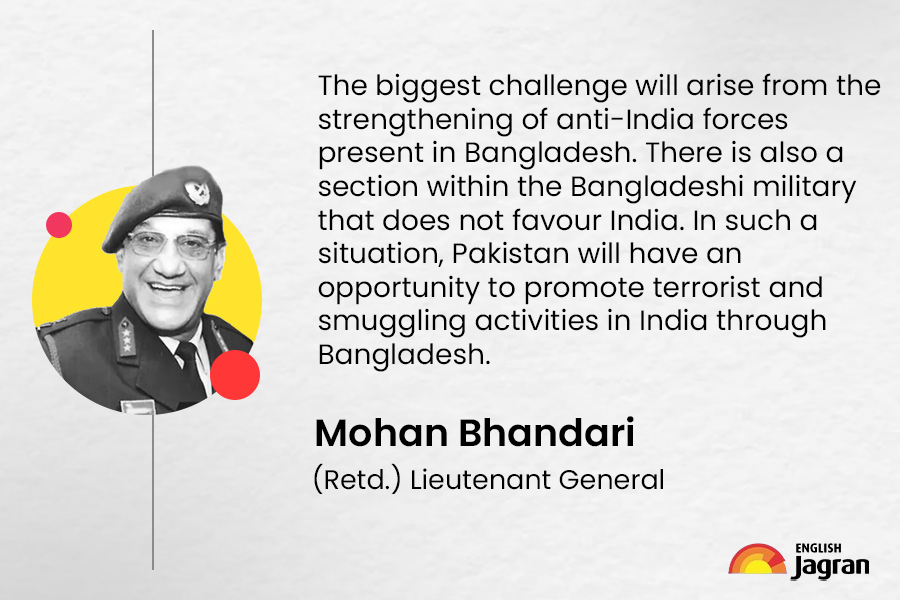
According to Lieutenant General (Retd) Mohan Bhandari, the current situation may create several challenges for India. The biggest issue will arise from the strengthening of anti-India forces within Bangladesh. There is also a section of the Bangladeshi military that is not fond of India. In this context, Pakistan could use Bangladesh as a base to promote terrorist and smuggling activities into India. He adds that given the situation in Bangladesh and neighbouring countries, India must remain extremely vigilant. India will need to focus on both external and internal security.
Jamaat-e-Islami could have some influence over Bangladesh's interim government. India has always had an uneasy relationship with Jamaat, and this could open the door for Pakistan to re-enter Bangladeshi politics. This would also affect India's border security with Bangladesh.
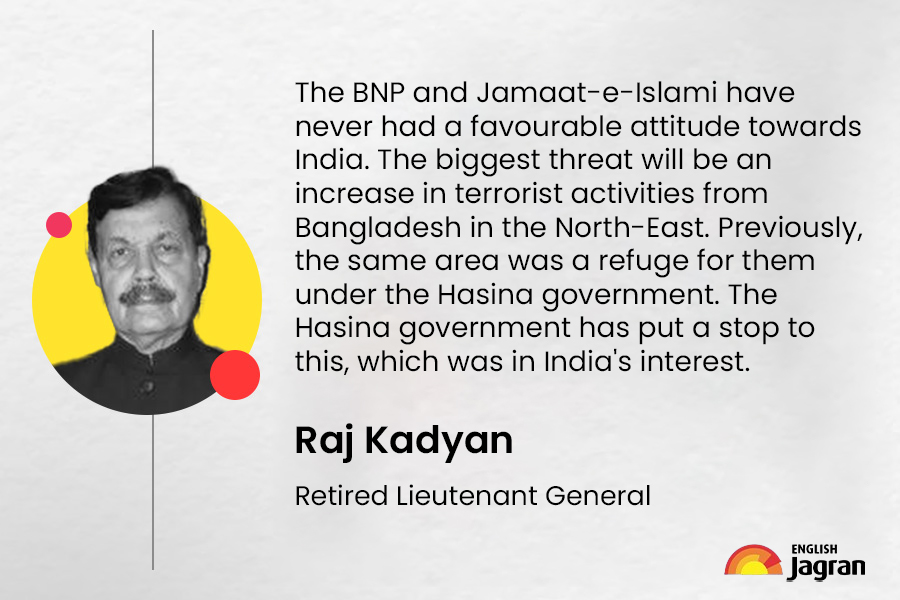
Lieutenant General (Retd) Raj Kadyan, who played a crucial role in the creation of Bangladesh in 1971, warns of potential future threats. He highlights that the BNP and Jamaat-e-Islami have never had a positive view of India. The greatest danger lies in the potential rise in terrorist activities from the northeast region of Bangladesh. Before Sheikh Hasina’s government, these groups had found refuge in that area. Hasina's government had curtailed their activities, which was in India's favour.
Kadyan also notes that India undertook several development projects in Bangladesh, establishing connections through road and rail networks. India had a strong influence there, but with Sheikh Hasina’s departure, there is concern that Bangladesh could fall under China's sway. India must ensure that the new government does not allow this. India will need to rebuild its relationships with the new leadership. While India enjoyed close ties with Hasina, such relations are unlikely to be replicated with the new government. Nonetheless, the United States also does not want China’s influence in Bangladesh to increase, so India will need to work with the US in this regard.
India-Bangladesh Trade Relations
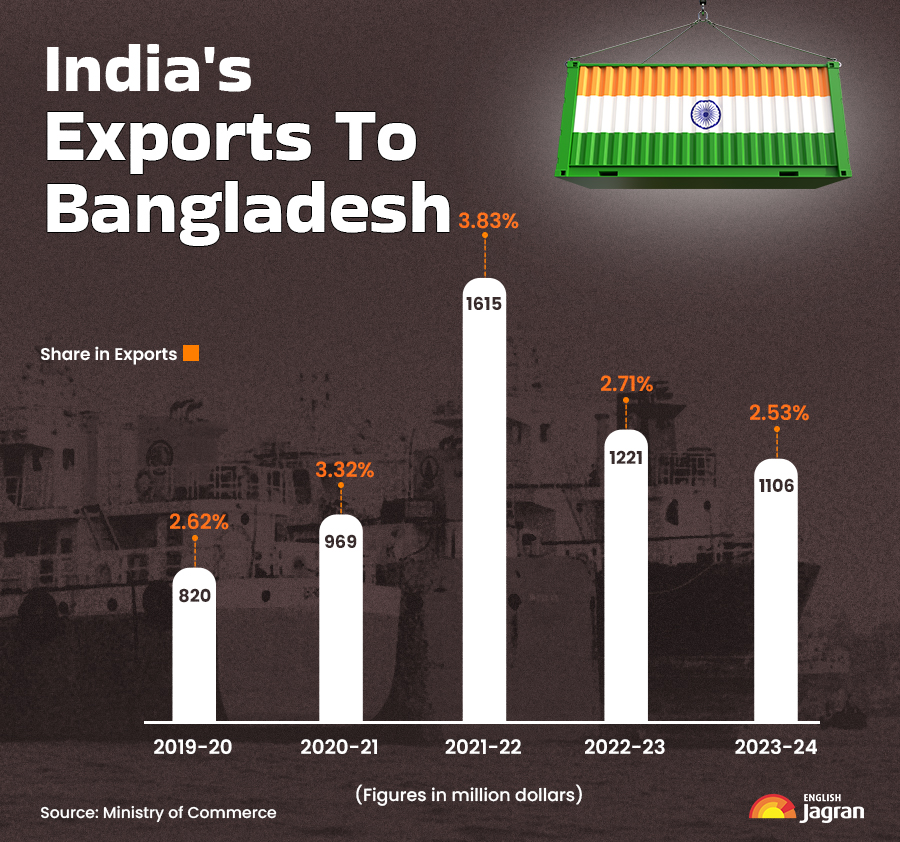
At present, it is unclear whether the Free Trade Agreement (FTA) will progress under the interim Bangladeshi government or its successor, and how it will move forward. In recent years, bilateral relations have developed with progress in cross-border trade, transit arrangements, security cooperation, and people-to-people exchanges.
With Sheikh Hasina out of power, these achievements come under scrutiny. According to the Ministry of Commerce, Bangladesh is India’s largest trading partner in the subcontinent, while India is Bangladesh’s second-largest partner in Asia after China. The total bilateral trade in FY 2023-24 stood at USD 13 billion.
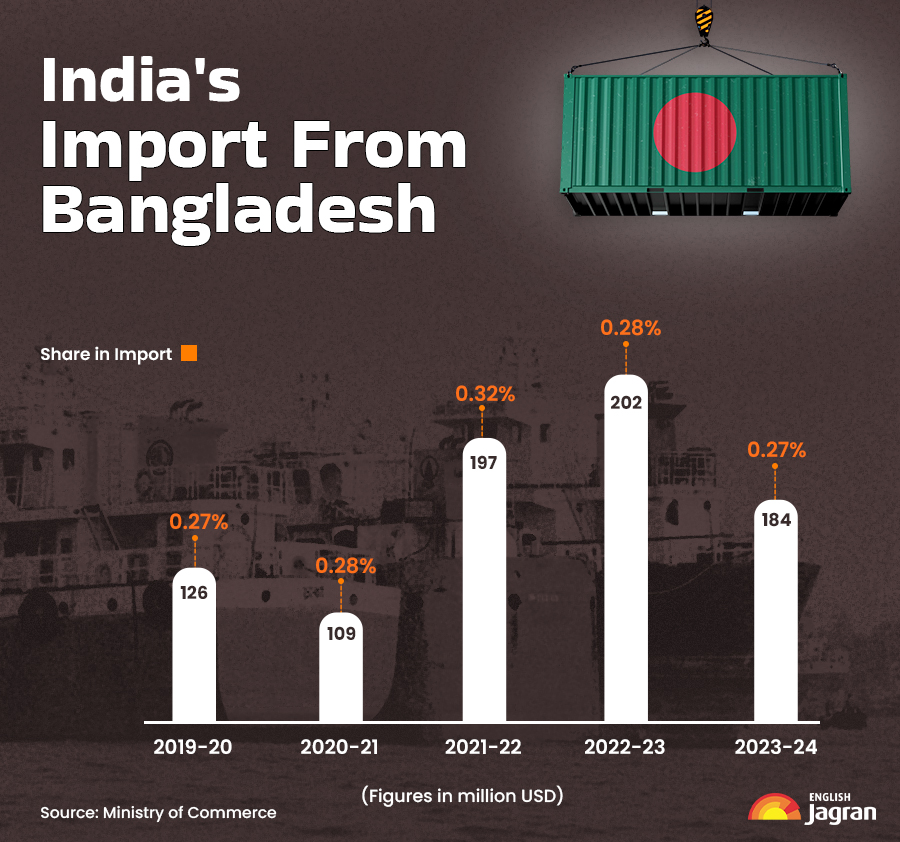
Bangladesh is the largest export destination for Indian cotton, accounting for 34.9 per cent of India’s total cotton exports (about USD 2.4 billion in FY 2024). Other major Indian exports include vegetables, coffee, tea, spices, sugar, confectionery, refined petroleum oil, chemicals, cotton, iron and steel, and vehicles. Major imports from Bangladesh include fish, plastics, leather, and apparel.
Former diplomat Manju Seth remarks that the current situation will affect bilateral relations. There is a need to strengthen democracy in Bangladesh. Anti-India sentiments are being fuelled there. India has made significant investments, and trade between the two countries has increased in recent years. It is a cause for concern for India, especially since the border is long and porous. Strengthening the border is crucial as refugees may arrive from there, which must be monitored.
Impact On Garment Industry In Bangladesh
Due to the violence and political crisis in Bangladesh, global attention is being drawn to Raymond, according to Gautam Hari Singhania, Chairman and Managing Director of Raymond. He stated that Raymond, the world's third-largest suit manufacturer, is prepared to "capitalise" on the current situation. He hinted at the possibility of some garment business relocating from Bangladesh to India. Singhania said India is better positioned with its end-to-end supply chain capabilities, as companies like Raymond operate in both fabric and garment businesses, saving time on final deliveries to international brands.
"Bangladesh lacks fabric supply. India has a major opportunity to leverage this as we have a strong fabric base. They (Bangladesh) only have a garment base," said the CMD of Raymond. He also noted that while Indian labour may be more expensive than Bangladesh’s, India is a politically stable country with a large middle class, strong consumption patterns, and robust manufacturing capabilities.
What Should India Do?
Gunjan Singh says that India must wait for now. In her view, the problem will arise from the lifting of the ban on Jamaat, as India views Jamaat as a terrorist organisation, whereas the Bangladeshi government considers it a political group. India would never engage in any form of dialogue with Jamaat. Violence against Hindus will also exacerbate issues with India.
Sheikh Hasina is currently in India, and Bangladesh’s interim government has requested her return. However, Gunjan believes India will not send her back. If the BNP government comes to power and India grants asylum to Sheikh Hasina, tensions will escalate. If Jamaat emerges as a major political force, the situation will worsen. India had good relations with Sheikh Hasina, with discussions ongoing on the Teesta River and ports, as well as strong trade relations. Sheikh Hasina recently visited India twice. These conditions might change.
Lieutenant Colonel (Retired) JS Sodhi states that this presents a significant challenge for India. Out of India’s eight neighbours in South Asia, seven have turned against it, with Bhutan being the only exception. Even with Bhutan, negotiations with China are ongoing, and a formal announcement to resolve their border dispute could come at any time. Diplomatic relations between the two would then be established. India is surrounded by countries it cannot fully trust.
The biggest challenge for India is to focus on its region first. A two-front war is expected in 11 years, with Pakistan and China jointly attacking us. If seven of our eight neighbours remain hostile at that time, Pakistan and China will exploit the situation. We have seen what has happened in the Maldives, Bangladesh, and Sri Lanka.
China is 30 years ahead of us in military preparations, and its partnership with Pakistan is setting new definitions in international relations. Last year, on 7 August 2023, General M.M. Naravane, the 28th Chief of the Indian Army, who retired two years ago, wrote an article in The Print. He explicitly stated that a two-front war would create significant difficulties for India. When a former Army Chief, who retired only two years ago, is publicly saying this, people should take note and understand the gravity of the situation.
One major difference between India and China is that China completes projects in other countries within the stipulated time frame, whereas our projects often drag on for years. Today, neighbouring countries view China as a country that delivers on its promises quickly, while India is seen as taking years.
Most Of Eastern India Was Once Bengal
The history of civilisation in Bangladesh is quite ancient. Much of what is now eastern India was once known as Bengal. By the 16th century, Bengal had emerged as a major trading hub in Asia. European merchants began arriving in the region in the 15th century, and by the 16th century, British influence started growing through the East India Company. By the 18th century, British control was firmly established over the region, which eventually spread across India. In 1947, when India gained independence, political reasons led to the division of the country into Hindu-majority India and Muslim-majority Pakistan.
Neeraj Singh Manhas says, "British colonial rule significantly influenced the socio-political landscape of present-day Bangladesh, which was initially part of British India. The introduction of the Permanent Settlement in 1793 changed the land ownership system, concentrating wealth and power in the hands of a few landlords (zamindars) and altering the region’s economic structure. The British also introduced administrative and educational reforms, which brought Western ideas of governance and law, but also led to economic inequalities and created several social strata. The partition of Bengal in 1905, although reversed in 1911, sparked significant nationalist movements, sowing the seeds for a distinct regional identity."
Partition Of Pakistan And Foundation Of Bangladesh
At the time of Pakistan’s formation, the western region was home to a large number of Sindhis, Pathans, Baloch, and Muhajirs, known as West Pakistan, while the majority in the eastern part were Bengali speakers, known as East Pakistan. Although the eastern part never lacked political consciousness, it never received fair representation in the country’s power structure and was politically neglected. This led to considerable discontent among the people of East Pakistan. In response, East Pakistan’s leader Sheikh Mujibur Rahman formed the Awami League, demanding greater autonomy within Pakistan. In the general elections of 1970, Sheikh Mujib’s party won a landslide victory in the eastern region. His party also secured a majority in parliament, but instead of being made Prime Minister, he was imprisoned. This laid the foundation for Pakistan’s partition.
In 1971, General Yahya Khan was the President of Pakistan, and he tasked General Tikka Khan with addressing the discontent in the eastern region. However, attempts to resolve the issue through force only worsened the situation. On 25 March 1971, a brutal massacre took place in this part of Pakistan, led by the military and police. This provoked anger among residents of the eastern region serving in the Pakistani army, who formed a separate Mukti Bahini. The atrocities committed by the Pakistani army against unarmed, innocent civilians continued, leading to mass migration. India appealed to the international community to intervene in the situation in East Pakistan, but no country paid attention. When the flow of refugees into India increased, in April 1971, then Prime Minister Indira Gandhi decided to support the Mukti Bahini and assist in Bangladesh’s liberation.
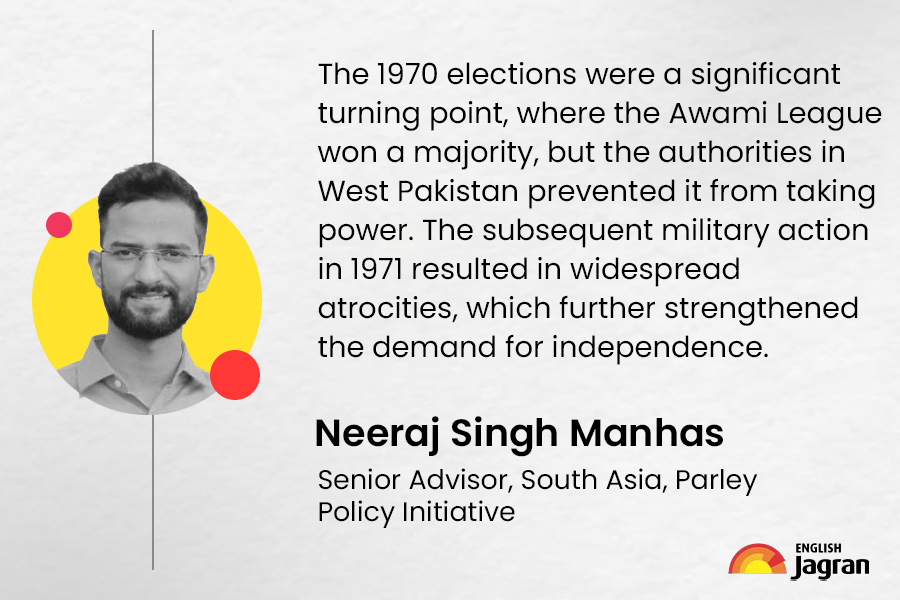
Neeraj Singh Manhas explains that the demand for independence from Pakistan was driven by linguistic and cultural discrimination against the Bengali-speaking majority by politically dominant West Pakistan. Inequality in political power and economic opportunities escalated tensions. The key turning point was the 1970 election, where the Awami League won a majority, but West Pakistan’s authorities prevented them from assuming power. The subsequent military actions in 1971 resulted in mass atrocities, which intensified the demand for independence. Eventually, this led to direct military intervention by India, culminating in the 1971 Indo-Pakistani War.
Challenges Of First Bangladesh Govt And Sheikh Mujibur's Death
According to Manhas, Bangladesh’s first government faced immense challenges after independence. There was an urgent need to rebuild infrastructure and the economy after the devastation caused by war. The new country had to establish a governance structure while managing the expectations of various political factions. Additionally, there were serious humanitarian crises, including the return of millions of refugees in 1974 and dealing with famine. The government also had to navigate complex international relations, seeking recognition and assistance from other nations.
On 15 August 1975, a group of junior officers in the Bangladeshi army attacked Sheikh Mujibur’s house with a tank. Mujib, his family, and his security staff were killed in the attack. His two daughters, Sheikh Hasina and Sheikh Rehana, survived as they were visiting Germany at the time. Following the assassination of her father, Sheikh Hasina and her family moved to India. The then Indira Gandhi government granted them asylum in India, although the country was under a state of emergency. After spending nearly six years in India, Sheikh Hasina returned to Dhaka with her family in 1981, where she received a warm welcome.
Foundations Of Partition Of Bangladesh
The seeds of the partition of Bangladesh were sown at the time of the country’s formation. Retired Lieutenant Colonel JS Sodhi says that when India gained independence in 1947, Bengal was divided into two parts: West Bengal and East Bengal. West Bengal remained in India, while East Bengal became part of Pakistan. At that time, Pakistan was divided into West Pakistan (now Pakistan) and East Pakistan (now Bangladesh). A few years later, a law was passed in Pakistan declaring Urdu as the official language of both Pakistans. This led to a movement in East Bengal against the law, as the language spoken there was Bengali. Eventually, the Pakistani government had to reverse its order and allow both languages to be used.
That movement united the people of East Bengal. They feared that West Pakistan would do something that would prevent them from ever gaining complete freedom. When Pakistan held its first general election in 1970, the Awami League became the largest party in East Pakistan. The Awami League won the most seats in both East and West Pakistan, followed by Zulfiqar Ali Bhutto’s Pakistan People’s Party (PPP). The rulers of West Pakistan could not tolerate the idea of Bengalis ruling over them.
Despite winning the most seats, Sheikh Mujibur Rahman, the leader of the Awami League, was not made the Prime Minister of Pakistan, leading to widespread protests in East Pakistan. To suppress these, Pakistan launched Operation Searchlight, during which the Pakistani army killed or disappeared most of East Pakistan’s prominent leaders. Millions of people fled to India as refugees. India raised the issue at various international forums, including with the United States and the then Soviet Union, stating that the influx of such a large number of refugees was creating problems in India. However, Pakistan refused to listen.
In August 1971, the Soviet ambassador to Pakistan met with Pakistan’s president and delivered a confidential message from the Soviet president. The message warned that if the unrest in East Pakistan was not addressed, it could prove catastrophic for Pakistan. Pakistan ignored this warning.
India supported the independence of East Pakistan. According to Lt. Col. Sodhi, Pakistan attacked six of our airbases in the west on December 3, 1971. Then Prime Minister Indira Gandhi announced in a radio message that Pakistan’s attack was a declaration of war and would be met with war. From December 3 to December 16, we fought Pakistan on both the eastern and western fronts. Due to effective planning, we captured the capital of East Pakistan, Dhaka. With this, East Pakistan emerged as a new country named Bangladesh.
Sheikh Mujibur Rahman became the first President of Bangladesh. The world expected peace in Bangladesh, but this did not materialise. Sheikh Mujib arrested opposition leaders, which led to growing resentment. In 1975, some officers of the Bangladeshi army killed Sheikh Mujib’s family members. Since then, there has been a climate of tension in Bangladesh. Since the country’s formation in 1971, there have been 21 attempts by the military to seize power, some successful and some unsuccessful.
Military Rule In Pakistan And Bangladesh
The roots of military rule in Pakistan and Bangladesh can be traced back to the partition of India in 1947. Despite the linguistic and cultural differences, two geographically separate regions were combined into one country. After partition, Pakistan faced political instability following the death of Muhammad Ali Jinnah and the assassination of Liaquat Ali Khan, delaying the adoption of a constitution. This also sowed the seeds of discontent in East Pakistan.
Despite gaining independence, the newly formed Bangladeshi military inherited the structure and principles of the Pakistani military, as it initially included officers and soldiers who had served in the Pakistani army before the liberation struggle. Most of the senior officers were from Western Pakistan and were demoted after the war. They had to work in lower positions after the liberation war. Consequently, the Bangladeshi army became fragmented into factions, weakening it internally.
Ziaur Rahman Formed Nationalist Party
After Mujib’s assassination in 1975, the military ruled Bangladesh for over a decade and a half. Between 1978 and 1979, presidential and parliamentary elections were held under the leadership of former army chief Ziaur Rahman. His newly formed Bangladesh Nationalist Party won a vast majority. At that time, the Awami League accused him of election fraud. Ziaur Rahman’s rule marked the beginning of practices that had a long-term impact on the secular framework of the country.