- By Shivangi Sharma
- Thu, 08 May 2025 11:35 PM (IST)
- Source:JND
The Indian government confirmed on Thursday that its Armed Forces carried out precision strikes targeting Pakistani air defence radars and missile systems at multiple locations, including Lahore. The strikes were part of India’s retaliatory operations following a series of drone and missile attacks by Pakistan on Indian border cities.
According to a report by India Today, “Indian response has been in the same domain with the same intensity as Pakistan,” adding that it had been “reliably learnt that an air defence system in Lahore has been neutralised.” Reports indicate that the counterstrike took place on the intervening night of May 7 and 8, and also targeted HQ-16A systems used by Pakistan.
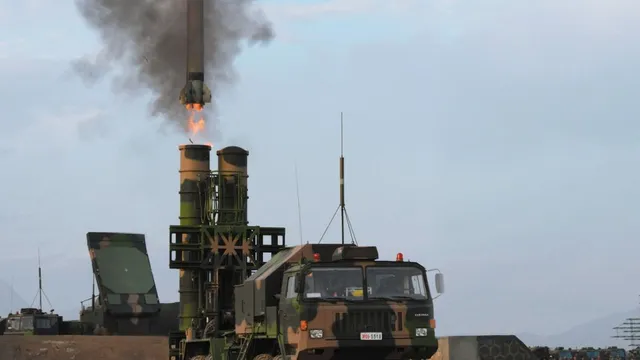
Pakistan uses a customised Chinese HQ-9P air defence system, a variant of the HQ-9, to shield key areas like Lahore. The HQ-9, inspired by Russia’s S-300 system, forms the upper tier of Pakistan’s layered air defence.
What Is HQ-9 Missile System?
The HQ-9, developed by China, is a long-range surface-to-air missile (SAM) system designed to intercept a wide range of aerial threats, including aircraft, cruise missiles, unmanned aerial vehicles (UAVs), and tactical ballistic missiles. The HQ-9's base variant has a range of 120 kilometres, while the HQ-9B can reach up to 300 kilometres and operate at altitudes of up to 50 km.
The HQ-9 system features semi-active radar homing, anti-jamming capabilities, and multi-target tracking, and is armed with a 180 kg high-explosive fragmentation warhead. While capable, it is generally considered slower and less sophisticated compared to India’s Russian-supplied S-400 system. According to Defence News, the HQ-9P variant in Pakistani service, which entered service in 2021, has a reduced range of 125 kilometres, significantly less than the variants used by China itself.
What Is HQ-16 System?
The HQ-16, or LY-80 in its export form, is a medium-range air defence system designed for the protection of high-value targets such as military bases, airfields, and strategic infrastructure. It has a range of 40–70 kilometres and is capable of engaging multiple aerial threats, including fighter jets and cruise missiles.
Operated by Pakistan’s 4th Air Defence Regiment, the HQ-16 is a key part of Pakistan’s layered air defence strategy. Damage to these systems, especially in strategic areas like Lahore, could temporarily reduce Pakistan’s ability to deter or respond to future aerial incursions.