
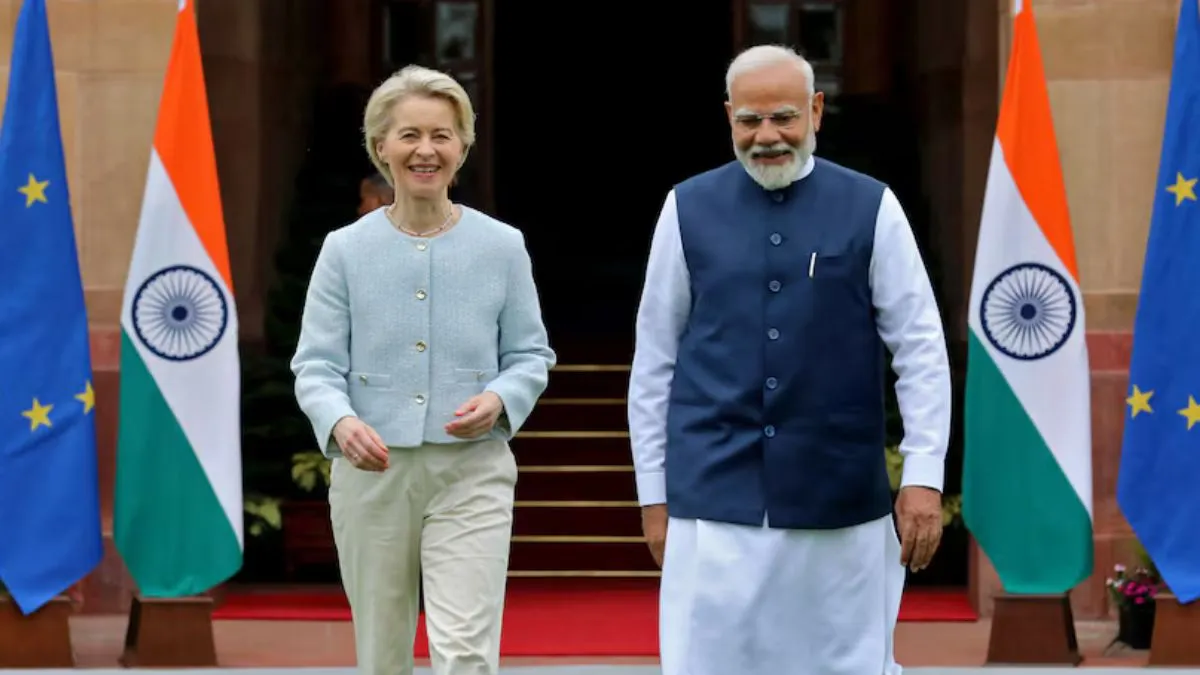
India-EU Trade Deal:India and the European Union are still negotiating the fine print of a long-delayed trade pact just days before European leaders are set to arrive in India for the 16th EU-India Summit. The meeting, scheduled for January 27, will focus on a proposed Free Trade Agreement (FTA) that has been under discussion for over two decades and has faced repeated setbacks due to contentious issues.
Ahead of the visit, European Commission President Ursula von der Leyen described the proposed pact as the “mother of all trade deals.” Posting on X, she said negotiations were nearing completion and confirmed her arrival in New Delhi. Von der Leyen, along with European Council President Antonio Luis Santos da Costa, will be chief guests at India’s Republic Day celebrations and will co-chair the summit with Prime Minister Narendra Modi.
« The mother of all trade deals »
— Ursula von der Leyen (@vonderleyen) January 24, 2026
We are closing in on the 🇪🇺🇮🇳 Free Trade Agreement.
See you soon in Delhi. pic.twitter.com/gfiLv2eEam
Key Points: Agriculture, Carbon Taxes and Services
Negotiations have been complicated by sensitivities around agriculture, carbon border adjustment taxes, service delivery and non-tariff barriers. Commerce Secretary Rajesh Agrawal confirmed on January 15 that sensitive agricultural issues on both sides were kept off the table. EU officials, however, declined to share specifics, confirming only that negotiations could be concluded but not signed during the visit.
What Strategic Agenda Includes
According to the European Council, leaders are expected to adopt a joint EU-India comprehensive strategic agenda covering prosperity and sustainability, technology and innovation, security and defence, connectivity and global issues.
Recommended For You
India, facing 50 per cent US tariffs since mid-2025, has accelerated efforts to diversify exports. The EU deal would be India’s ninth trade agreement in four years. Indian exports to the EU, such as smartphones, garments, footwear, pharmaceuticals, auto parts, refined fuels and cut diamonds, largely replace EU imports from third countries rather than competing directly with European manufacturing.
EU Exports That Power India’s Industrial Growth
India’s goods imports from the EU stood at USD 60.7 billion in FY2025, dominated by capital- and technology-intensive products. High-end machinery worth USD 13 billion formed the largest share, followed by electronics imports of USD 9.4 billion, aircraft worth USD 6.3 billion, medical devices and scientific instruments worth USD 3.8 billion, and specialised medicines worth USD 1.4 billion.
Technology Transfer And Defence Cooperation
On defence technology transfer, EU officials said cooperation would continue but remain subject to company and country-level export controls. This has raised questions about the depth of future collaboration.
The partnership also highlights differences over Russia. While the EU has objected to India’s military exercises and oil trade with Moscow, New Delhi has pushed back, pointing to Europe’s own dealings. Separately, both sides plan to conclude an MoU on mobility covering skilled workers, students, researchers and seasonal workers.
The two sides reaffirmed commitment to the India-Middle East-Europe Economic Corridor, delayed by the Israel-Gaza conflict. With US-EU and US-India trade ties strained under Donald Trump, shifting global dynamics have accelerated India-EU convergence.