
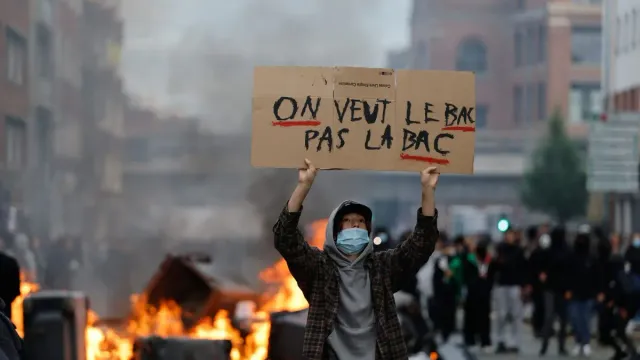
- Students protest staff shortages, underfunding, and poor school conditions.
- Overcrowded classrooms and long school hours fuel student anger.
- Concerns over opaque university admission platform, Parcoursup, add to unrest.
France Students Protest: Since late September, high school students across France have been holding widespread protests over staff shortages, underfunding and resource shortages in education.
Demonstrators have been setting up blockades at numerous lycées, schools serving 15-to-18-year-olds. The movement has spiralled into violence in several cities, leaving hundreds of students, teachers, and police officers injured. Thousands of people, including outside agitators, have been detained.
Tensions boiled over early on Thursday in northeastern Paris, where dozens of students dragged rubbish bins into position outside a high school to erect fresh barricades before police moved in with tear gas as the nationwide unrest shows few signs of ending.
Why Are Students Protesting In France?
While students' grievances are numerous, the main ones are overcrowded classrooms, a shortage of teachers and support staff, and poorly maintained school buildings.
Highlighting the ongoing disruption in schools, Paris student Madalena told the BBC, "Sometimes our teachers are absent for several weeks without being replaced."
Students are also protesting against gruelling daily routines, with classes stretching from 8:00 AM to 6:00 PM.
Speaking to France 2, one lycéen said, "You get home at 19:00, and have no time to sleep or do your homework."
Anxiety over higher education admission has further fueled student anger. Frustration centres on Parcoursup, France's online university placement platform, which students criticise as deeply opaque. While roughly 80 per cent of students pass the baccalauréat exam, qualifying them for higher education, it does not guarantee them a place in their preferred program, leading to intense competition for top courses.
Government Response
In a TV address, Prime Minister Sebastien Lecornu lamented the "violence, students and staff being attacked, police officers and gendarmes injured, schools set on fire or vandalised, thousands of hours of classes lost, not to mention threats and insults".
He took aim at "political leaders who use this anger to conduct their electoral battles" ahead of the upcoming presidential election in April.
"We cannot play with the safety of France's youth," Lecornu said.
In his latest message, Lecornu insisted security forces are not under orders to "confront high-school students," but strictly to enforce the law. He added that the government and school authorities need to listen to students and find solutions to their concerns.
The Education Ministry has launched an online platform where high school students can anonymously share problems they face at school and suggest changes.
(With Inputs From Agencies)
You May Also Like To Watch