
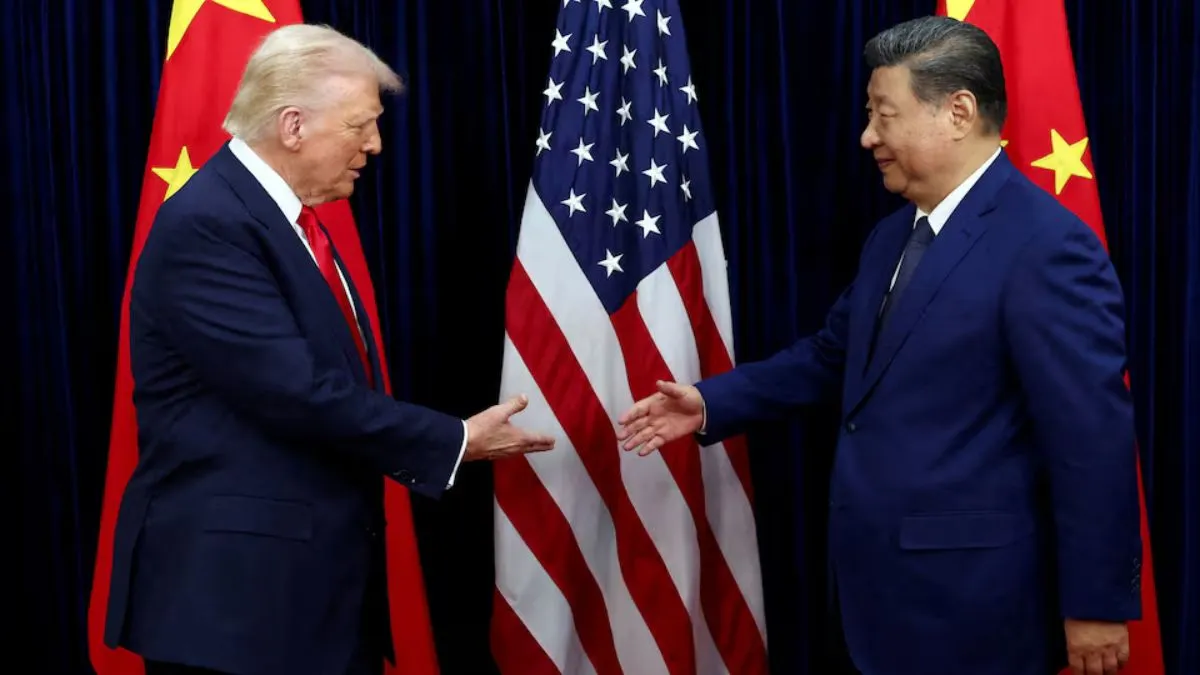
- Trump to visit China May 13-15 for talks.
- First US presidential visit in almost nine years.
- Visit amidst trade deal expectations and global tensions.
US President Donald Trump will pay an official visit to China from May 13 to 15 at the invitation of Chinese President Xi Jinping, a Chinese foreign ministry spokesperson announced on Monday. This will be the first visit to China by a US president in almost nine years.
First visit in 9 years
The visit comes in the midst of a prolonged US-Israel-Iran war, crisis over the blockade of Strait of Hormuz causing a global energy crisis and the increasing tensions between the two countries over a host of issues, including Taiwan.
ALSO READ: Did He Say B***h? Trump Lashes Out At Female Reporter As She Asks 'Stupid Question' On Iran
On Sunday, US principal deputy press secretary Anna Kelly said Trump would arrive in Beijing on Wednesday evening for what she described as a "visit of tremendous symbolic significance".
According to Kelly, the US leader will attend a welcome ceremony and a bilateral meeting with President Xi Jinping on Thursday, followed by a visit to the Temple of Heaven and a state banquet, the Hong Kong-based South China Morning Post reported.
Recommended For You
Bilateral tea
The two leaders will meet again on Friday for a bilateral tea and working lunch, she said, adding that the US planned to host the Chinese leader for a reciprocal visit later this year.
Both sides announced on Sunday that Vice-Premier He Lifeng will travel to South Korea for trade talks with US Treasury Secretary Scott Bessent on May 12 and 13 in the final round of negotiations before Trump's visit.
What's at stake?
Trump's visit is also taking place amid expectations of a trade deal over tariffs between the top two economies clamped by the US president. The talks would be "guided by the important consensus" reached between the two heads of state at their meeting in Busan, South Korea and in previous phone calls and address "economic and trade issues of mutual concern", a Chinese commerce ministry statement said.
On Sunday (local time), senior US officials said that the discussions between the US and China are set to continue on the topic of Iran as the two countries gear up for the much-anticipated meeting between US President Donald Trump and Chinese President Xi Jinping.
Speaking about the engagements between the leaders, the senior US officials said that Trump and Xi had spoken multiple times about Iran and also about Russia and how Chinese revenue provides for not only components but also the potential of weapons exports to these two countries.
They said, "The President has spoken multiple times with General Secretary Xi Jinping about the topic of Iran and about the topic of Russia, to include the revenue that China provides for both those regimes and therefore as well as do use goods, components and parts, not to mention the potential of weapons exports."
Senior US officials also said that topics expected between the two sides include continued work on a US-China Board of Trade and Board of Investment. The two countries will focus on identifying mutual areas of interest in trade.
The two sides will also discuss additional agreements on industry, spanning aerospace, agriculture and energy, and following this productive visit, Trump looks forward to hosting President Xi and Madam Peng for a reciprocal visit in Washington DC later this year, the official said.
The official said that the two leaders have an ongoing conversation about Taiwan and that there has been no change in American policy.
When asked if there was a potential shift in the stance of the United States towards Taiwan ahead of the meeting, the officials said, "There is an ongoing conversation between President Trump and General Secretary Xi Jinping about Taiwan. Certainly, the last couple of times they've interacted, it has been a point of discussion. There's been no change of US policy coming out of those. We don't expect to see any changes in US policy going forward."
(With inputs from agencies)