

- US Supreme Court struck down Trump's broad reciprocal tariffs.
- Indian goods revert to MFN rates; new 10% global tariff planned.
- Trump confirms India pays tariffs; exporters face trade uncertainty.
After the US Supreme Court struck down a broad set of tariffs imposed under President Donald Trump, the duty rates that apply to Indian goods entering the United States have shifted again, creating a complex and evolving tariff landscape for exporters. Before the ruling, Indian exports to the US faced steep "reciprocal" tariffs that at times reached as high as 50 per cent, depending on the product. These elevated duties were part of Trump’s aggressive trade policy under emergency powers.
Tariff puzzle for India
Following the court decision invalidating those emergency-based tariffs, the United States has reverted to Most Favoured Nation (MFN) tariff levels for most Indian products, roughly around 3 pr cent. This means that for a large chunk of Indian exports, the duty burden has fallen back to the baseline rates that the US applies to all World Trade Organisation members.
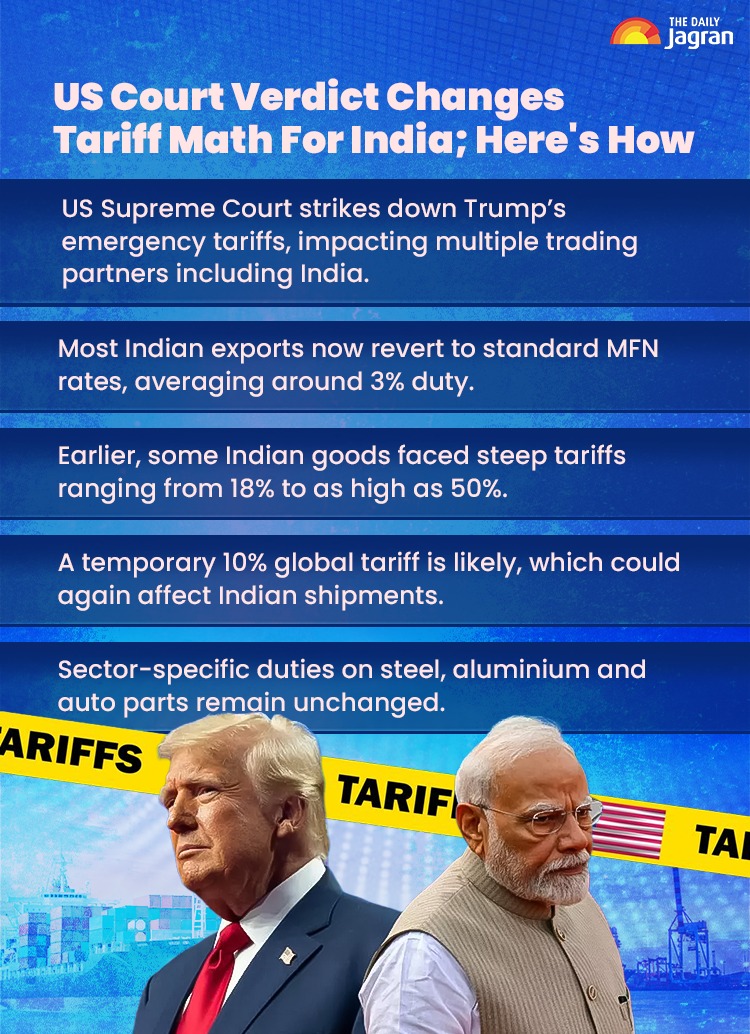
However, the tariff picture remains unsettled because the US administration is preparing to introduce a temporary 10 per cent global tariff that could soon be applied to imports including those from India. President Trump announced that this new levy would take effect within days, further complicating export planning.
In addition to the broad MFN reversion and the planned 10 per cent global levy, sector-specific tariffs remain in force. Duties imposed under statutory provisions for national security, such as those on steel, aluminium and certain auto parts, have not been affected by the Supreme Court's decision.
ALSO READ: Neal Katyal: How An Indian-American Lawyer Stopped Trump's Tariffs Tantrum In Court
Trump responds to tariff impact after court verdict
When asked whether the framework for an interim agreement on trade with India, expected to be signed soon, stands in the wake of the Supreme Court ruling, Trump said "nothing changes".
"Nothing changes. They'll (India) be paying tariffs, and we will not be paying tariffs. So deal with India is they pay tariffs. This is a reversal for what it used to be. As you know, India and I think Prime Minister Modi is a great gentleman, a great man, actually, but he was much smarter than the people that he was against in terms of the United States, he was ripping us off. So we made a deal with India. It's a fair deal now, and we are not paying tariffs to them, and they are paying tariffs. We did a little flip," Trump said.
"The India deal is on, all the deals are on, we're just going to do it" in a different way, Trump said.
Indian exporters continue to face uncertainty
The US had imposed a reciprocal tariff of 25 per cent on India in August. Later, an additional 25 per cent was imposed for buying Russian crude oil, taking the total tariffs on India to 50 per cent. Earlier this month, both countries agreed to finalise an interim trade deal, under which Washington will cut down the tariffs to 18 per cent.
So far, the punitive 25 per cent has been removed. The remaining 25 per cent exists.
But now, after the proclamation, the tariffs on Indian goods will be 10 per cent, Federation of Indian Export Organisations (FIEO) Director General Ajay Sahai said.
The 10 per cent levy is over and above the existing MFN or import duties in the US. For instance, if a product faces a 5 per cent MFN duty, an additional 10 per cent will be imposed, taking the effective duty to 15 per cent. Earlier, this was 5 plus 25 per cent.
Think tank Global Trade Research Initiative (GTRI) said: "Reciprocal tariffs are down to 10 per cent now".
The shifting tariff regime means that Indian exporters continue to face uncertainty. While the broad reciprocal rates climb down to around 3 per cent, nearly all exporters must now factor in the upcoming global tariff and existing targeted duties on key industrial categories.
ALSO READ: 'Will Take Effect Almost Immediately': Trump Signs 10% Global Tariff After Supreme Court Setback
Industry analysts say the ruling could provide a long-term boost to trade relations by curbing the executive’s ability to unilaterally impose large tariffs without legislative backing. But until the US implements new tariff measures and the India-US interim trade framework is finalised, exporters will likely operate amid fluctuating duty rates.
(With inputs from agency)