
- By Supratik Das
- Sun, 03 Aug 2025 09:01 AM (IST)
- Source:JND
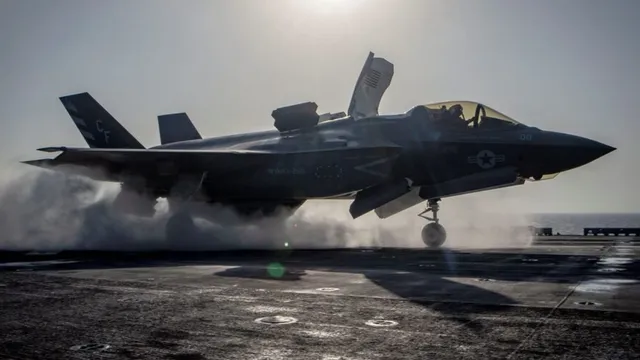
US vs Russia Fighter Jets: There is a stark contrast between affordability and technological superiority in the global market of fighter aircraft. While US fighter aircraft such as the Lockheed Martin F-35 Lightning II and F-15EX tend to command price ranges upwards of USD 80–100 million per aircraft, their Russian counterparts like the Sukhoi Su-30MKI, Su-35, and fifth-generation Su-57 are far cheaper, sparking some serious questions in defence circles about the underlying rationale for this difference. Regardless of the United States' trillion-dollar defence budget and state-of-the-art technology that drives its aircraft, Russian fighter planes remain the darling of countries focused on cost, reliability, and sheer firepower. In dogfights and actual combat air-to-air manoeuvres, Russian planes can hold their own with their unsurpassed agility and thrust-vectoring power despite American domination in stealth capabilities and long-range air combat.
Cost Differences Based on Philosophy, Not Technology
The cost difference is not merely in materials and systems but a reflection of different design philosophies. US jets such as the F-35 and F-22 are built for information superiority. For example, the F-22 Raptor allegedly has more than 8 million lines of code to manage radar avoidance, infrared suppression, and acoustic signature management. Such complexity requires not just a high production cost but long-term intensive maintenance. Conversely, Russian combat aircraft are based on principles of Soviet-era design that prioritize mechanical simplicity, ease of maintenance, and resilience. Intended for quick deployment from unprepared airstrips in war-torn environments, planes produced by firms such as Sukhoi and Mikoyan-Gurevich are designed for mass production. Unlike private American contractors working on profit-based models, numerous Russian defence companies are subsidized by the government, further lowering the costs of manufacturing. During the Cold War years, the USSR controlled more than 40 per cent of world military aircraft production, a heritage that continues to dominate Russia's low-cost strategy to developing fighter jets even today.
Russia has now dropped behind the US, France, and South Korea in fighter jet exports, as per a 2024 SIPRI report. Yet, numerous emerging economies continue to turn to Russia for cost-effective air power solutions. As of 2025, the F-16 is still the most popularly utilized jet in the world, with over 2,000 currently active in 21 air forces. Russian warplanes are particularly appealing to nations looking for a compromise between performance and budget. Though they do not have the stealth and sensor fusion of US planes, their handling, as in planes such as the MiG-29 and Su-35, is still unmatched in dogfighting.
While the F-35 excels with its stealth, sensor fusion, and potential to act as a data hub in network-centric warfare, the Rafale excels with its agility, flexibility, and ability to be used for multiple purposes, ranging from nuclear deterrence and close air support to maritime strike and reconnaissance. Russia's response to fifth-gen combat, the Su-57, features supercruise, state-of-the-art radar, and limited stealth, though its limited export success and production scale give pause. In agility, the Rafale is more manoeuvrable at higher angles of attack due to its delta wing and fly-by-wire avionics. The F-35, being less agile, makes up for it with better situational awareness and electronic warfare capability.
India's Fighter Jet Dilemma: Performance, Price, And Politics
India is perhaps the principal case study in measuring the trade-offs between expensive Western high-end fighters and low-cost Russian jets. The Indian Air Force (IAF) has traditionally flown Russian-origin aircraft like the Su-30MKI, and more recently introduced the French-made Rafale. India had originally sanctioned the procurement of 114 fighter aircraft under the Multirole Fighter Aircraft (MRFA) program with the Rafale F4 variant as the front-runner. But strategic requirements and local threats have prompted a change of priority towards procuring actual fifth-generation stealth aircraft. Consequently, India is now dividing its order — purchasing 60 Rafales from France under a G2G agreement, while acquiring the other 54 aircraft either from the US (F-35A) or Russia (Su-57).
ALSO READ: ‘No Formal Discussions Yet’: Centre Denies Any Deal With US To Buy F-35 Fighter Jets
Both Su-57 and F-35 are next-generation aircraft, but they have radically different price tags and operating philosophies. Although the F-35A has a rough estimate of USD 80–100 million per aircraft in flyaway cost, it has a much greater life cycle cost (LCC). As per various Indian defence analysis reports, fielding 110 F-35As over 40 years could cost India USD 80.16 billion, while for a similar fleet of Rafale F4s, it could be USD 48.71 billion. This disparity is mainly caused because of the F-35's stealth paints, advanced electronics, and its software-intensive maintenance systems such as ALIS (Autonomic Logistics Information System) and ODIN. As compared to that, the modular nature of Rafale and its ease of integration with legacy IAF infrastructure maintain operational costs in check. India's choice will be based on its changing threat perceptions, fiscal constraints, and its larger Make in India objectives. Dassault Aviation has made a proposal for creating a line of production in India, while Lockheed Martin and Russia's UAC have also put localization proposals on the table.
Ultimately, Russian jets are cheaper not because they are inferior, but because they are engineered with a different end goal, mass deployment, rugged performance, and simplified logistics. The F-35 represents the pinnacle of digital warfare readiness but comes with a steep cost, both in money and maintenance. As modern aerial warfare moves toward drones, electronic jamming, and multi-domain operations, cost-effective and easily deployable platforms may reclaim tactical importance. Whether India leans toward American sophistication, French versatility, or Russian ruggedness will define the next chapter of its air power strategy.