

Israel-Palestine War: Israel and the armed Palestinian group Hamas are currently engaged in a rapidly intensifying conflict that has resulted in the death of over 1100 people including civilians and military personnel across the border in a mere three days. On Saturday, October 7 Hamas carried out an unprecedented assault on Israel, destroying segments of the heavily fortified separation barrier and infiltrating Israeli communities along the Gaza border with their fighters.
This sudden attack from the terror fit in Gaza prompted Prime Minister Benjamin Netanyahu to warn of “a long and difficult war” and led the Israeli jets to bomb the Gaza Strip, levelling high rises and civilian neighbourhoods.
The Palestinian terrorist group, Hamas made headlines after they fired 5,000 rockets at Israel and overpowering its formidable aerial defence system, the Iron Dome. Here's everything you need to know about Hamas and their reason for attacking Israel.
What Is Hamas?
The group Hamas stands for the Islamic Resistance Movement and in Arabic means “zeal”. It politically controls the Gaza Strip, a territory of about 365 sq km that is home to more than two million people but is blockaded by Israel. The organisation was founded in 1987 by Ahmed Yassin and Abdel Aziz al-Rantissi as an arm of the Egyptian Muslim Brotherhood shortly after the start of the first Intifada, an uprising against Israel’s occupation of the Palestinian territories. The initiative then, was started as an offshoot of the Muslim Brotherhood in Egypt and it created a military wing, the Izz al-Din al-Qassam Brigades, to pursue an armed struggle against Israel with the aim of liberating historic Palestine.
Later in 1988, the group stated that its goal was to liberate Palestine and to establish an Islamic State in the area that spans Israel, the West Bank and the Gaza Strip. It then wanted Israel to re-treat from pre-1967 borders and allow the Palestinian refugees to return and offered to end it links with the Muslim Brotherhood.
Who Are Hamas' Allies and Supporters?
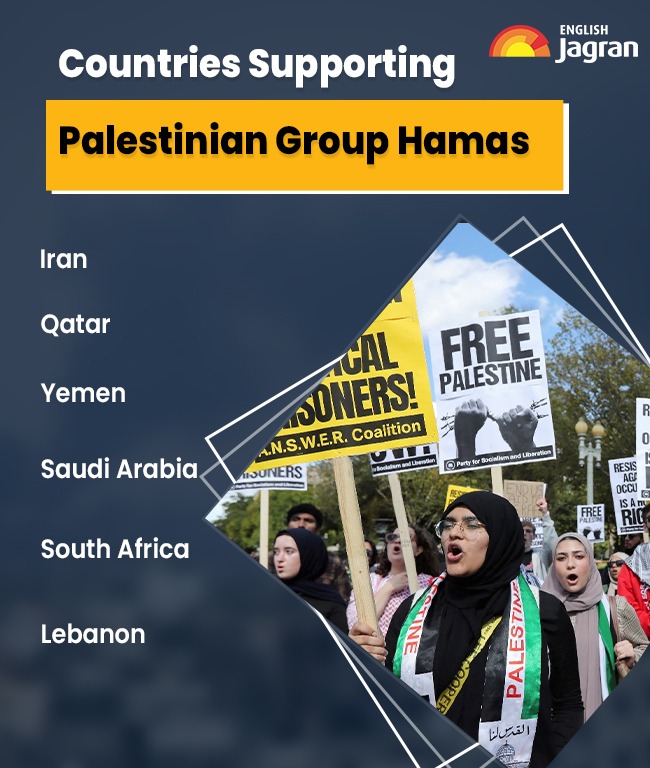
Hamas enjoys support across Palestinian territories and in various Middle Eastern countries. Within the region, Iran, Syria, and Yemen have expressed their endorsement of Hamas' attacks, characterizing them as "praiseworthy" and "courageous." Qatar has placed sole responsibility on Israel for the current situation, while the Arab League and Jordan have raised concerns about Israel's policies and their connection to the ongoing conflict. Egypt, Morocco, and Saudi Arabia have issued calls for restraint.
On a global scale, Hamas has been classified as a terrorist organization by Israel, the United States, the European Union, Canada, Egypt, and Japan. In 2018, a resolution brought forward by the United States condemning Hamas' activities was voted down in the United Nations General Assembly.
Meanwhile, Hamas and Islamic Jihad, the second-largest armed group in the region, are often united against Israel and are the most important members of the joint operations room that coordinates military activity among the various armed groups in Gaza.
Why Did Hamas Attack Israel?
The group carried out its military operation in response to atrocities that Palestinians have faced over decades, Al Jazeera reported Hamas spokesperson Khaled Qadomi as saying. “We want the international community to stop atrocities in Gaza against Palestinian people, our holy sites like Al-Aqsa [Mosque]. All these things are the reason behind starting this battle,” he said. Hamas also called on other groups to join the fight, saying Saturday’s attacks were just the beginning.
Muhammad Deif, the leader of the military wing of Hamas, said in a recorded message that the group had decided to launch an “operation” so that “the enemy will understand that the time of their rampaging without accountability has ended.”
How Did Hamas Carry Out The Attacks On Israel?
The group began firing thousands of rockets on Saturday morning, striking targets as far away as Tel Aviv and the outskirts of Jerusalem. The commencement of the attack was marked by a flurry of rocket launches at approximately 06:30 local time. The rockets often struggle to bypass Israel's advanced Iron Dome missile defence system, and the sheer volume of rockets fired in a short span aimed to overwhelm this defence 'Air Dome'. Following the strikes, sirens were sounded in Tel Aviv, approximately 60km (38 miles) from Gaza, and western Jerusalem.
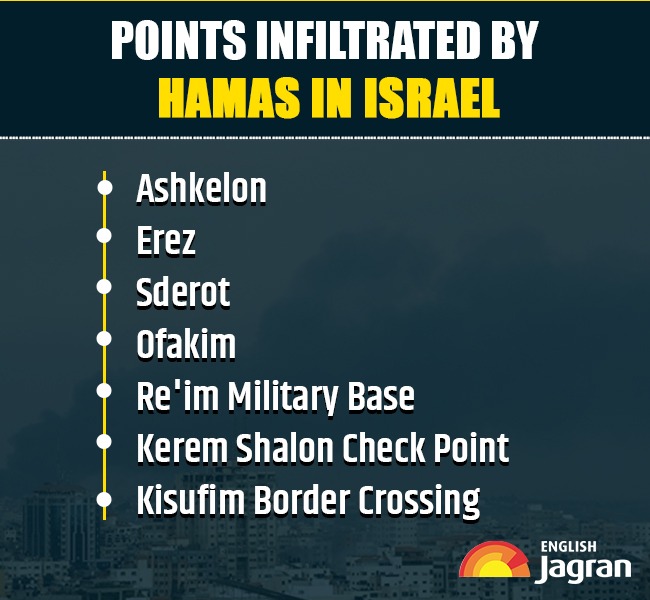
Simultaneously, Hamas fighters gathered at strategic points along the heavily fortified Gaza barrier, intending to breach it. About an hour after the first rocket attacks, Hamas militants crossed into Israel by land, sea and air, according to the Israeli military, leading to some of the first pitched battles between Israeli and Arab forces on Israeli soil in decades.
Some fighters used paragliders to fly over the barrier, while others attempted to land vessels on the beach. The Israel Defense Forces reported repelling two such attempts by Hamas.
The militants infiltrated 22 Israeli towns and army bases and took civilians and soldiers hostages, many of whom they brought back to Gaza. At least 700 Israelis had been reported dead by officials as of Sunday.
At 05:50 local time, a Telegram account associated with Hamas's armed wing shared the first ground images from Kerem Shalom, the southernmost of Gaza's crossings. These images portrayed militants overpowering a checkpoint and the bodies of two Israeli soldiers on the ground. Another image depicted a group of at least five motorbikes, each carrying two armed militants, passing through a hole cut in the wire fence section of the barrier.
Further north at Erez, approximately 43.4km (27 miles) from Kerem Shalom, Hamas swarmed another crossing. A militant was seen guiding a group of fighters toward the blast site. Eight individuals in bulletproof vests, armed with rifles, rushed towards the heavily fortified checkpoint and engaged Israeli troops.