
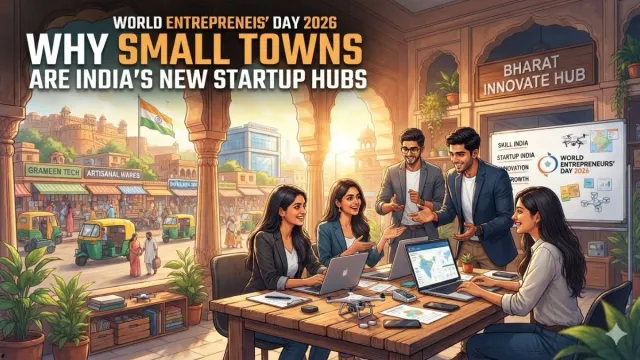
Smaller town accounted for nearly half of officially recognised Startups in India, reflecting the entrepreneurship potential the nation possesses beyond metro cities. With over two lakh DPIIT-recognised startups as of December 2025, around 50 per cent of them have their bases in Tier-II and Tier-III cities.
Additionally, India has seen a wave of entrepreneurship in the past decade, growing its recognised startups base from below 500 in 2016 to over two lakhs by the end of 2025, thanks to the ‘Start-up’ India scheme. India is among the world’s largest startup ecosystems, signalling the democratisation of entrepreneurship.
Smaller Towns Stand Firm In This Journey
The good thing about India’s remarkable entrepreneurship and startup journey is that smaller cities have steadily contributed to the momentum, with around 50 per cent of the startups emerging from Tier II/ III cities.
Recommended For You
Entrepreneurs in smaller towns are increasingly bridging India’s rural- urban divide by bringing solutions-oriented business models across agri-tech, telemedicine, microfinance, tourism, ed-tech and other sectors. This directly addresses developmental gaps and supports rural livelihoods.
As we celebrate ‘World Entrepreneurs' Day ', Indian founders highlighted the importance of smaller towns in India’s entrepreneurship journey, weighing in on ‘ Why Small Towns Are India’s New Startup Hubs
Gaurav Dubey, Founder & CEO, LivLong 365 says, "Preventive healthcare in India has, for the longest time, been built around metros; that's where the diagnostic chains, the hospital networks, and the awareness campaigns have concentrated. But the real gap, and the real opportunity, is in Tier 1 and Tier 2 towns, where people are just as exposed to lifestyle diseases and deficiencies but have far less access to structured checkups or preventive care.”
That's exactly where founders need to be building. Smaller towns force you to design leaner, more accessible models instead of replicating what already works in a metro — and that constraint tends to produce better, more scalable ideas, he noted.
Highlighting how the internet opened doors for small-town youths, Archisman Misra, Founder & CEO of StudioBackdrops, noted that for twenty years, where you built a business was decided by infrastructure, and infrastructure meant a big city.
“That is over. The internet arrived everywhere at roughly the same quality, and once it did, paying Gurugram rent and dealing with Bengaluru traffic every day became a choice rather than a cost of entry. A founder in Indore has the same customers, the same payment rails and the same software as one in New Delhi,” Misra said.
Prashant Daroch, Founder of Atravelq says, “It's not simply that costs are lower or that good internet access is readily available in small towns. The reason why we are seeing the emergence of small towns as startup hubs speaks to a bigger change. Entrepreneurs are now building for a national or even international market without moving to a metro.”
The travel industry offers an interesting example. Travel businesses are often built on relationships, destination knowledge and an ability to understand people — factors that are not dependent on geography, Daroch stated.
Ladeesh PC, Director and Co-Founder of Estilocus says, "When we started Estilocus, the assumption was that a real brand had to be built out of Bangalore or Mumbai; that's where the talent, the capital, and the credibility were supposed to sit. That assumption doesn't hold anymore.”
Small towns today have the same internet, the same logistics networks, and often a hungrier, more resourceful workforce than metros do, he emphasised.
Ameet Padiyar, Founder of Skyljo, says, “The idea that entrepreneurship is exclusive to Bengaluru, Mumbai, or Delhi, like Tier1 cities only, is old-fashioned now. The numbers tell a different story: more than 50% of DPIIT-recognised startups now come from Tier-II and Tier-III cities.
What is interesting is not just where these startups are coming from, but what is enabling them. Digital access has reduced the distance between a small-town founder and a national market. But access to markets alone is not enough. The next challenge is access to capable, job-ready talent, he highlighted.