
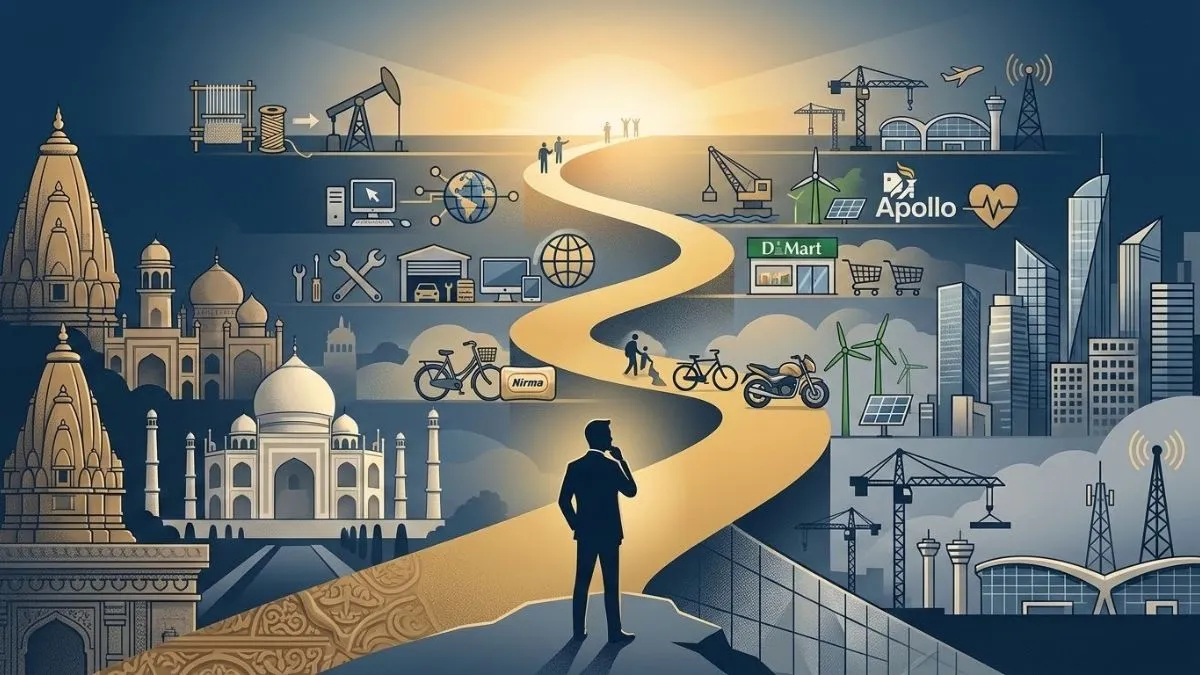
- Dhirubhai Ambani built Reliance Industries from humble yarn trading to a global software giant.
- Narayana Murthy co-founded Infosys with Rs 10,000,
- Karsanbhai Patel's Nirma disrupted FMCG with affordable, quality detergent.
We often get surprised seeing a business empire created by a successful entrepreneur; however, if we dive into their background, most successful businesses were once started in humble circumstances. Founders fueled by determination, vision, and relentless work have created history, as many of them started in small towns and scaled their businesses to the global stage, while many failed many times to find a path to success.
In India as well, many entrepreneurs turned small initiatives into massive conglomerates by identifying market gaps and overcoming economic hurdles. Their journeys tell a story of resilience, demonstrating that innovation and consumer insights can reshape a nation's economic landscape. Below are the stories of ten visionaries who started with very little and built legacies that define modern India.
10 Entrepreneurs Who Started With Very Little And Built Big Businesses
Dhirubhai Ambani
Dhirubhai Ambani started his journey by leaving his village in Gujarat for Yemen, where he worked as a gas station attendant and clerk.
Returning to India with just Rs 1,000, he set up a tiny yarn trading business operating out of a shared 350-square-foot room in Mumbai. Facing immense competition from established colonial-era trading houses, Ambani leveraged aggressive marketing and innovative equity-based financing.
Recommended For You
Later, he played a master stroke. Ambani started backwards-integrating from textiles into petrochemicals, oil refining, and telecommunications; he created India’s largest private-sector conglomerate. His journey remains the ultimate blueprint for rags-to-riches success in Indian corporate history.
Narayana Murthy
Narayana Murthy co-founded Infosys in 1981 alongside six engineer friends with a capital of just Rs 10,000, which he borrowed from his wife, Sudha Murthy. Initially, he operated the company from a small front room in a residential flat. Murthy, through his high ethical corporate governance, championed a unique global delivery model.
He faced severe bureaucratic hurdles during India's pre-liberalisation era, including taking a year just to get a telephone connection or import a computer. Despite these roadblocks, he continued working on his vision to transform India into a global software powerhouse.
Later, Infosys became the first Indian-registered company to list on NASDAQ, the key stock exchange in the US.
Shiv Nadar
Shiv Nadar left a secure corporate job in 1976 to venture into the nascent field of computer hardware. Starting a garage in Delhi, with a collective seed capital of Rs 1.83 lakh, Nadar founded HCL alongside five other partners. He identified the potential and future impact of personal computers long before global tech giants dominated the Indian market.
Over the decades, Nadar successfully pivoted the business from hardware manufacturing to high-end IT services and global software consulting. His leadership skills turned HCL into a multi-billion-dollar enterprise operating in dozens of countries, cementing his legacy as one of the ultimate pioneers of India's technology revolution.
Karsanbhai Patel (Nirma)
Karsanbhai Patel was once working as a lab technician in Gujarat. He later began mixing a phosphate-free detergent powder in his backyard in 1969 and started selling it himself. In an era dominated by expensive multinational brands, Patel priced his product at just Rs 3 per kilogram when competitors sold theirs for Rs 13. He personally cycled through neighbourhoods to sell his product door-to-door.
The brand, Nirma, disrupted the FMCG sector completely by targeting low-income and rural households. Through brilliant marketing and advertisement strategies and an unmatched price-to-quality strategy, Patel scaled his kitchen operation into a massive conglomerate, proving that a deep understanding of local consumer needs can defeat global monopolies.
Brijmohan Lall Munjal (Hero Group)
Brijmohan Lall Munjal came to Amritsar as a displaced refugee following the partition of India. He started his first business of trading bicycle components and manufacturing small parts to support his family.
He later shifted his base to Ludhiana, and their Munjal founded Hero Cycles in 1956. The brand eventually grew into the world's largest bicycle manufacturer.
Munjal played a masterstroke in the 1980s, forging a joint venture with Japan’s Honda to manufacture fuel-efficient motorcycles.
His hands-on relationship management with dealers and deep understanding of the Indian consumer’s need for affordability transformed Hero MotoCorp into the world's largest manufacturer of two-wheelers, embodying resilience and immense industrial foresight.
Gautam Adani (Adani Group)
Gautam Adani, a college dropout, moved to Mumbai with nothing but a few hundred rupees in his pocket. He initially worked as a diamond sorter and later returned to Gujarat to run a plastics factory.
He founded Adani Exports in 1988, which originally focused on agricultural and power commodities. Over the decades, Adani strategically expanded into heavy infrastructure, acquiring and building ports, airports, power grids, and green energy plants.
Through aggressive capital allocation and infrastructure scaling, he turned his small trading house into a massive global conglomerate.
Radhakishan Damani (DMart)
Radhakishan Damani grew up in a single-room apartment in Mumbai. He started his journey trading ball bearings. Following his father's demise, he shifted to the stock market, where he became an exceptionally successful investor and trader.
Despite his immense market wealth, Damani decided to enter the brick-and-mortar retail business in 2002 by launching DMart.
He adopted a highly conservative, unique business model that focused on owning properties rather than leasing them, allowing the company to cut operational costs drastically. This cost advantage was passed directly to everyday consumers through heavy discounts, turning DMart into a highly profitable retail empire.
Dr Pratap C. Reddy (Apollo Hospitals)
Dr Pratap C. Reddy was a highly successful cardiologist practising in the United States. He chose to return to India with an aim to revolutionise the country's struggling healthcare landscape.
Reddy risked his savings to launch India's first corporate hospital network, Apollo Hospitals, in 1983.
He had to fight rigorous bureaucratic systems to get healthcare recognised as an official industry sector. Now, the brand is known as one of the best healthcare brands in India.
Grandhi Mallikarjuna Rao (GMR Group)
Grandhi Mallikarjuna Rao started his career in a small village in Andhra Pradesh, managing a modest family commodity business and trading jute. He gradually used those initial profits to venture into asset-light industries like banking, insurance, and manufacturing.
Recognising India's massive infrastructure deficit during the economic liberalisation era, Rao pivoted his company entirely toward heavy infrastructure development.
Under his leadership, the GMR Group won competitive bids to construct and modernise massive public assets, including the world-class Delhi and Hyderabad international airports.
Sunil Bharti Mittal (Bharti Airtel)
Sunil Bharti Mittal borrowed Rs 20,000 from his father in 1976 to set up a small business manufacturing bicycle crankshafts. Earning a decent amount from the venture, he pivoted to importing portable electric generators and push-button telephones. His definitive breakthrough came in the early 1990s when the Indian government opened up the telecommunications sector to private players.
Spotting the massive future potential of mobile connectivity, he secured licenses and launched Bharti Airtel. With his commitment, Mittal built a telecom giant that now connects hundreds of millions of subscribers across Asia and Africa.