
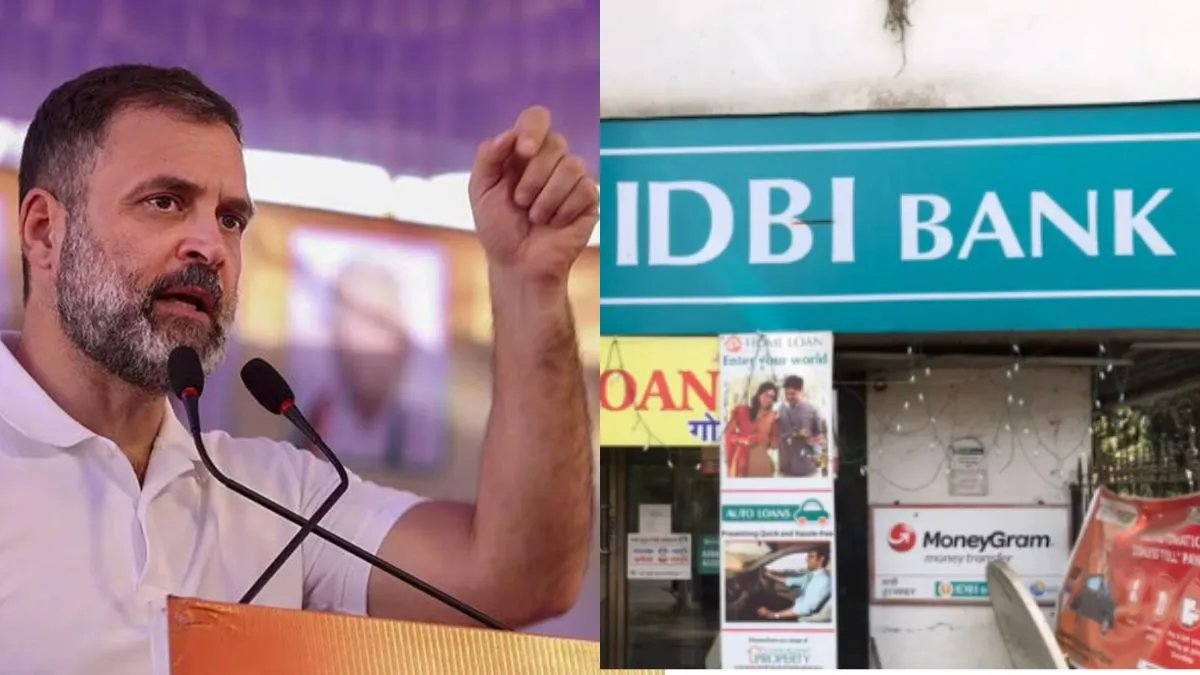
- Rahul Gandhi supports IDBI Bank employees against privatisation.
- Questions government's decision to sell profitable public institution.
- Raises concerns over transparency and employee protection.
Congress leader and Leader of Opposition (LoP) in the Lok Sabha Rahul Gandhi has extended his support to IDBI Bank employees opposing the Centre's proposed sale of a majority stake in the lender to Canada-based Fairfax Financial Holdings. Questioning the government's decision, Gandhi accused it of selling a profitable public institution built with taxpayers' money.
Gandhi expressed solidarity with the protesting employees, questioning why the government was seeking to privatise a public sector bank that had returned to profitability after years of financial challenges.
Following his intervention, IDBI Bank employees from Bihar and Jharkhand thanked the LoP for supporting their concerns and taking a stand against the proposed disinvestment.
In a statement, they said, "The IDBI Bank family sincerely thanks Shri Rahul Gandhi ji, Hon’ble Leader of Opposition in the Lok Sabha, for standing with IDBI Bank employees and supporting their legitimate concerns.

IDBI Bank is not just a bank; it is a legacy of nation-building, public trust, and social responsibility. A profitable public institution built with public money deserves transparency, accountability, and protection of public interest."
ALSO READ: Why Fairfax Plans To Merge Go Digit, IIFL Into IDBI Bank: Rs 52,878 Cr Deal Explained
What Rahul Gandhi Said on IDBI Bank Privatisation
The Leader of Opposition asserted that public sector banks should not be treated as assets to be sold but as institutions that contribute to nation-building.
In a post on X, Gandhi wrote, "During Congress's time, IDBI was established to build the nation's industry. During Modi's time, first the bidding was seen, then the price was set."
कांग्रेस के समय में IDBI बना - देश का उद्योग खड़ा करने के लिए। मोदी के समय में पहले बोली देखी गई, फिर दाम तय हुआ। कांग्रेस के time पे बैंक बनते थे। मोदी के time में बिकते हैं। मैं IDBI बैंक के कर्मचारियों के साथ खड़ा हूँ। https://t.co/uLT7mWTYyr
— Rahul Gandhi (@RahulGandhi) October 30, 2026
"During Congress's time, banks were being created. During Modi's time, they are being sold. I stand with the employees of IDBI Bank," he said.
Gandhi also shared an open letter addressed to members of the IDBI Bank family, recalling his meeting with a group of bank employees in Parliament House in March last year.
According to Gandhi, the employees had raised a fundamental question about the government's decision to sell a bank that they had worked hard to make profitable.
ALSO READ: Government Approves IDBI Bank Sale To Fairfax: All You Need To Know About Rs 52,878 Cr Deal
"I took that question to the Lok Sabha. I asked why a profitable public bank was being sold and how its employees and depositors would be protected. The government gave no reason. Now it has decided to sell IDBI Bank to Fairfax, a Canadian company," Gandhi said.
Recommended For You
Highlighting the bank's financial turnaround, Gandhi noted that IDBI Bank had started as a pioneering development financial institution and had subsequently faced several challenges during its transition into a commercial bank.
"Seven years ago, IDBI was losing money. Last year, it earned a profit of over nine thousand crore rupees. That turnaround is your work," he said in his open letter to bank employees.
Gandhi maintained that an institution established with public money ultimately belongs to the people.
He further pointed out that the government and LIC currently hold a combined 95 per cent stake in the bank, which would decline to 34 per cent following the proposed transaction. He made the observation in his letter dated October 29.
Recalling a commitment made in Parliament in 2003, Gandhi said the government had promised to retain at least a 50 per cent stake in IDBI Bank.
"That promise may not be written into law, but a promise made to Parliament is a promise made to the people of India," Gandhi asserted.
The Congress leader also raised concerns about the potential impact of privatisation on reservation provisions for candidates belonging to Scheduled Castes (SC), Scheduled Tribes (ST) and Other Backward Classes (OBCs).
He argued that the existing reservation protections could be affected once the bank came under private ownership.
"Your service conditions, already weakened, will lose their last protection. The Congress has always believed in a strong public sector working alongside the private sector. Public banks are not assets to be sold off, they are tools to build the nation," Gandhi stressed.
Reiterating his support for the employees, he added, "You asked me to stand with you. I stand with you in your fight today, and fully support all your legitimate demands. Stay together. Stay determined," the former Congress president said.
What Is IDBI Bank Disinvestment Controversy?
The controversy surrounding IDBI Bank's privatisation intensified after the government, on October 14, approved the sale of a 60.72 per cent stake in the lender to Canada-based Fairfax Financial Holdings for approximately Rs 53,000 crore (USD 5.5 billion).
The proposed transaction would mark one of the largest foreign investments in India's banking sector and a significant development in the country's long-delayed banking privatisation programme.
Under the proposed deal, Fairfax will acquire the government's 30.48 per cent stake, valued at approximately Rs 26,620 crore, along with LIC's 30.24 per cent holding, valued at around Rs 26,440 crore.
Fairfax, led by Canadian billionaire Prem Watsa, has offered Rs 81 per share, exceeding the benchmark fair value of Rs 75.99 per share determined by two independent valuation agencies.
The transaction is expected to be completed by the end of the current financial year, subject to regulatory approval from the Reserve Bank of India (RBI).
Why Has the IDBI Bank Sale Faced Questions?
The proposed disinvestment has come under scrutiny following a Businessworld investigation into the valuation and bidding process, which raised questions about whether changes in the valuation methodology may have favoured Fairfax's offer.
According to the report, government officials opened Fairfax Financial's revised bid of Rs 81 per share on July 13, 2026, before ordering fresh valuations that established a benchmark price of Rs 75.99 per share.
The investigation has questioned whether the benchmark valuation was recalculated after the bid was opened, potentially making Fairfax's offer more favourable.
It also reportedly identified changes in the valuation methodology, including the exclusion of private sector banks from the list of comparable institutions used to determine the bank's valuation.
The report questioned the rationale behind excluding certain private sector banks and whether the decision influenced the final valuation.
Another issue highlighted in the investigation concerns the government's reported agreement to pay the buyer against certain disputed tax liabilities of up to Rs 627 crore. Under the arrangement, the government may have to bear the financial burden, subject to the terms of the indemnity.
How Has the Government Responded?
The Department of Investment and Public Asset Management (DIPAM) has defended the proposed transaction, rejecting concerns surrounding the valuation and bidding process.
According to DIPAM, the valuation methodology was reviewed in April, before the final bids were invited. It has also maintained that the bidding process remained double-blind, ensuring that bidders' offers were kept confidential during the process.
The department has further argued that the transaction increased the bid value by Rs 3,917 crore.
Meanwhile, the United Forum of IDBI Officers and Employees on Thursday opposed the proposed sale of a majority stake in IDBI Bank to Fairfax Financial Holdings.
The employees' organisation demanded an immediate suspension of the disinvestment process and called for a comprehensive review of the proposed transaction under parliamentary scrutiny.