
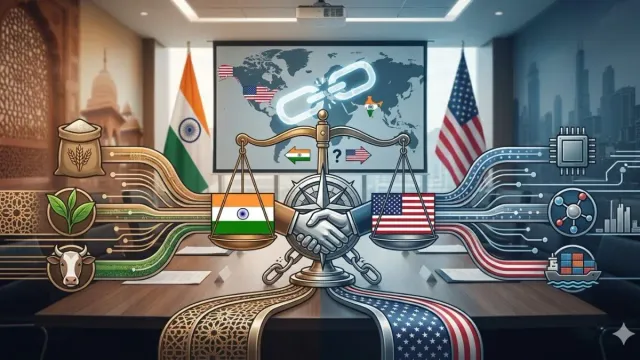
- India-US trade deal conclusion is not imminent; negotiations have plateaued.
- Russian oil purchases by India are a major point of contention.
- Disagreements persist over manufacturing capacity and trade balance.
The India-US bilateral trade deal seems not to be coming into picture anytime soon, at least if we take into account pessimistic commentary from both sides after the recent meeting between trade representatives. Earlier, Jamieson Greer, the trade representative of the United States, said that the trade agreement was in its final stage; however, it is unlikely to happen soon. He emphasised that concluding a deal was "not imminent" as both countries were still working on many unresolved issues. Greer statement came after he met India's commerce minister Piyush Goyal.
Meanwhile, a statement on Monday from Indian Finance Minister Nirmala Sitharaman indicated that negotiations have reached a plateau and that further talks may be very difficult. The minister’s statement made it clearer that the trade talks, which were initiated in February of this year, have yet to find common ground despite multiple rounds of discussion.
Why the US-India Trade Deal Did Not Conclude: Key factors
Considering the commentaries from officials from both nations in the past few months, it was reported by several media houses that the agreement was very close to being concluded. Now, the latest update is 'It did not'. Let’s take a look at what could be potential reasons for the latest outcome.
Russian Oil Factor
India’s continues to buy Russian oil amid supply chain disruption in the Strait of Hormuz. Meanwhile, Last month, US President Donald Trump signed into law the Lindsey O. Graham Sanctioning Russia and Iran Act of 2026, which provides for tariffs of up to 100% on imports from key buyers of Russian energy, including India.
This legislation introduces further uncertainty for Indian exporters. Unlike previous US tariff frameworks under the International Emergency Economic Powers Act—which were struck down by the US Supreme Court—these new Russia-related tariffs are exempt from judicial challenge.
A primary source of instability remains Washington's evolving stance toward nations purchasing Russian energy products.
In February, the US agreed to lift an additional 25% tariff on Indian imports following India's commitment to halt Russian oil purchases.
However, Indian authorities have occasionally resisted aligning with US directives regarding energy procurement.
India pushes back on the ‘excess capacity’ argument
Earlier, India dismissed assertions that its manufacturing industry experiences structural overcapacity. In his meetings in the US, Commerce Minister Piyush Goyal emphasised that Indian manufacturing capacity is designed to cater to both domestic demands and global supply chains. He noted that India aligns with various G20 nations in condemning market-distorting subsidies elsewhere, which trigger unfair trade practices such as dumping and predatory pricing.
The Minister highlighted that India counters these practices by enforcing evidence-based countermeasures aligned with World Trade Organisation standards, such as anti-dumping levies and countervailing duties.
The topic remains a critical focal point in discussions, as Washington's scrutiny over industrial capacity could result in pressure for further policy concessions from India.
What Did Greer and Sitharaman Say?
Sitharaman, while speaking at the Munich Leaders Meeting in New Delhi, said that the negotiations are still ongoing, although we would like to believe both sides have reached a plateau beyond which giving or taking might be very, very difficult.
Sitharaman said the trade balance favoured India and that Washington wanted to reduce its deficit. Meanwhile, Greer said that both sides had a very constructive conversation and the US is continually trying to finish the trade deal with India.
“I would characterise it as we say in the US, ‘we’re in the short strokes’. We’re towards the end of it,” Greer noted.
Meanwhile, he said that US President Donald Trump and Indian Prime Minister Narendra Modi had a constructive call. He pointed out that he doesn’t think that there was anything imminent to finalise the agreement. Greer commentary came at a press conference after the G20 meeting.
However, both Greer and Sitharaman noted that the nations could explore any remaining room for negotiation going forward.