
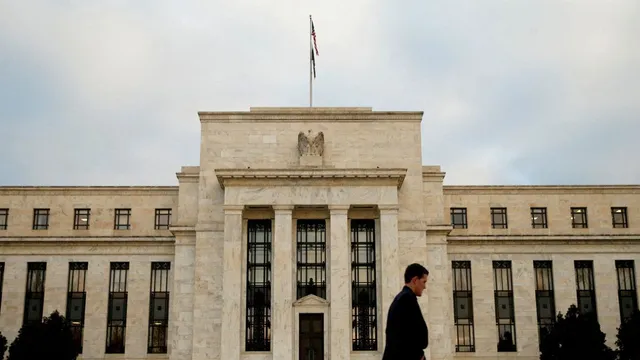
The US Federal Reserve held its benchmark interest rate steady in its first rate decision since new Chair Kevin Warsh took office last month, with at least half of its policymakers anticipating a higher rate later this year. During the two-day Federal Open Market Committee (FOMC) meeting, the central bank decided unanimously to leave the rate unchanged at the 3.5-3.75 per cent range, marking its fourth consecutive pause, amid lingering concerns over the economic fallout of the U.S.-Israeli war against Iran, reports Yonhap news agency.
According to the FOMC members' new median economic projection, the federal funds rate is expected to be cut to 3.8 per cent at the end of this year, up from the March projection of 3.4 per cent, suggesting a higher year-end rate than previously projected.
The "dot plot" projection chart showed that nine of the 19 FOMC participants expected borrowing costs to be higher by year-end. Warsh did not submit a dot plot projection.
The meeting came a week after the U.S. Labour Department reported that the consumer price index rose 4.2 per cent in May from a year earlier -- a rise largely driven by higher energy prices caused by the U.S.-Israeli war against Iran. It marked the largest annual increase since 2023. Commenting on inflation, Warsh said that the FOMC under his leadership will deliver price stability, stressing that its members are "unambiguous and unanimous."
Recommended For You
"We recognise that inflation has been running well ahead of the Fed's long-stated inflation goal of 2 per cent. That's been going on for more than five years," he said. "Persistently high prices are a burden for the American people, but the recent past need not be prologue."
Also Read: Unlisted, Unregulated, Unsafe: Sebi’s Red Flag On Trading Platforms
U.S. gross domestic product is expected to grow by 2.2 per cent this year, down from 2.4 percent projected in March, and by 2.3 per cent next year, the same as the previous forecast, according to the latest median projection. Personal Consumption Expenditures (PCE) inflation is projected to reach 3.6 per cent at the end of the year, a jump from the March projection of 2.7 per cent, and 2.3 per cent at the end of next year, up from 2.2 per cent projected in March.
PCE is a measure of household consumer spending on goods and services in the U.S. The latest rate decision left the gap between the key rates of South Korea and the United States at up to 1.25 percentage points.
Warsh was sworn in as the new Fed chair, succeeding Jerome Powell on May 22, who had repeatedly been slammed by U.S. President Donald Trump for not lowering interest rates."
Disclaimer: This story has been directly published from the agency feed (IANS). No changes have been made except the headline.