
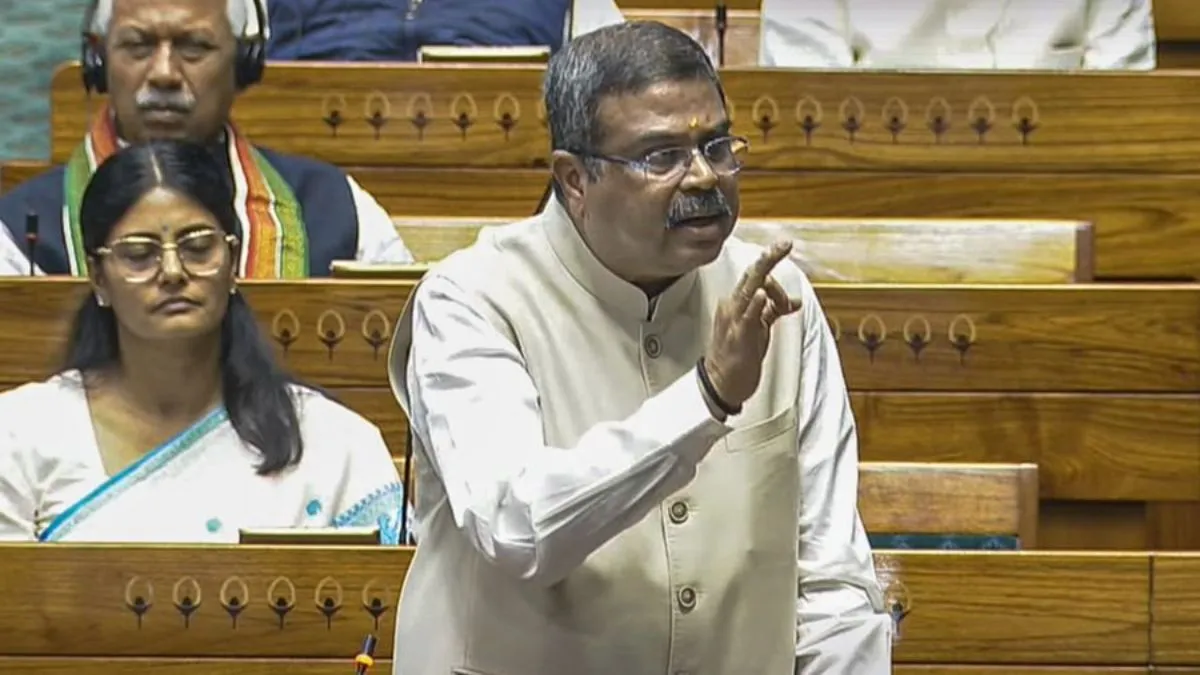
Viksit Bharat Shiksha Adhishthan Bill: The 'Viksit Bharat Shiksha Adhishthan Bill' 2025, introduced in the Lok Sabha, has been referred to a Joint Parliamentary Committee (JPC) for further examination. The Bill aims to empower universities and other higher education institutions to excel in teaching, learning, research, and innovation. It also seeks to promote excellence through a robust and transparent accreditation and autonomy system.
Education Bill Sent to JPC for Wider Consultation:
When Union Education Minister Dharmendra Pradhan introduced the Bill, opposition members opposed the introduction. Parliamentary Affairs Minister Kiren Rijiju said that during the Business Advisory Committee meeting, several MPs had emphasized wider consultations on the Bill. He said, considering their request, the government has proposed to send the Bill to the JPC for wider consultation. Mr Rijiju requested the speaker to appoint members for the constitution of the committee.
Viksit Bharat Shiksha Adhishthan to Empower Youth:
The Viksit Bharat Shiksha Adhishthan will pave the way for Atmanirbharta in the higher education sector and create a talent pool of students. This will facilitate the empowerment of youth by developing critical and innovative thinking with a focus on reskilling and upskilling.
Recommended For You
What is the Composition of the Viksit Bharat Shiksha Adhishthan?
The proposed law presents an ambitious plan to create a unified framework for regulation, accreditation, and standard-setting in higher education. It also emphasises outcome-based education and the integration of Indian knowledge systems, aligning with the government's broader vision of a self-reliant India.
The Viksit Bharat Shiksha Adhishthan Bill 2025, earlier named the Higher Education Council of India (HECI) 2025, has been introduced in line with the National Education Policy (NEP) 2020 which seeks to merge three existing regulators—the University Grants Commission (UGC), the All India Council for Technical Education (AICTE), and the National Council for Teacher Education (NCTE)—into a unified commission called the Viksit Bharat Shiksha Adhishthan.
Currently, the UGC regulates non-technical higher education institutions in India, the AICTE oversees technical education, and the NCTE regulates teacher education. Under the proposed commission, there will be three councils for regulation, accreditation and ensuring academic standards for universities and higher education institutions (HEI) in India.
Under the proposed structure, the commission will function through three distinct wings: a Regulatory Council, an Accreditation Council, and a Standards Council.
The 12-member Developed India Education Foundation will comprise the chairpersons of these three councils, the Central Higher Education Secretary, two eminent academicians below the rank of professor from state higher education institutions, five distinguished experts, and a member secretary.
According to the regulations, the commission will also have its own fund and all sums that may be granted to it by the Central Government from time to time.
This move follows the New National Education Policy (NEP), 2020, which stated that the regulatory system "needs a complete overhaul" and emphasized the need for separate, empowered bodies handling distinct roles.
Attempts to create a single regulator began with the draft Higher Education Commission of India (HECI) Bill released in 2018, but gained renewed momentum after Dharmendra Pradhan became Education Minister in 2021.
The Bill proposes that the regulatory council will have the authority to impose substantial penalties on higher education institutions (HEIs) for violating provisions of the Act or the rules and regulations under it. Penalties will range from Rs 10 lakh to Rs 75 lakh for repeated violations. Establishing an HEI without approval from the commission or the state government will attract a penalty of Rs 2 crore.
However, it was withdrawn after facing criticism for the centralization of power and the removal of the UGC's funding role.