
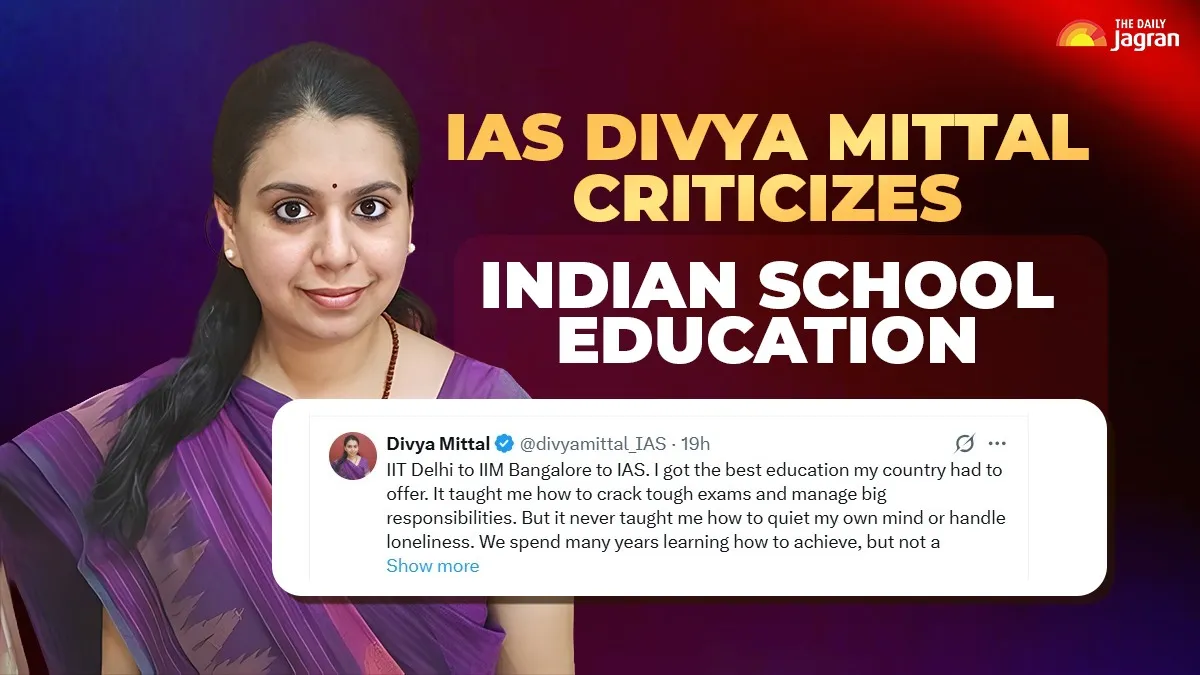
Indian School Education: Amidst the NEET UG paper leak crisis and complaints from some students regarding discrepancies in marks under the CBSE's 'on-screen marking' system, the Indian education system has come under intense scrutiny following a profound and scathing critique by a senior civil servant. IAS officer Divya Mittal, an alumna of India's most prestigious institutions, IIT Delhi and IIM Bangalore, has publicly questioned the structural foundations of modern schooling.
She pointed out a stark reality: while schools spend years training students to crack complex exams and chase materialistic milestones, they fail to dedicate even a single day to teaching them how to process difficult emotions or maintain internal peace.
Expressing her candid observations, she shared her views on the social media platform X (previously Twitter), where her detailed thread instantly went viral and triggered a massive debate among parents, educators, and working professionals.
IIT Delhi to IIM Bangalore to IAS. I got the best education my country had to offer. It taught me how to crack tough exams and manage big responsibilities. But it never taught me how to quiet my own mind or handle loneliness. We spend many years learning how to achieve, but not a…
— Divya Mittal (@divyamittal_IAS) May 17, 2026
She highlighted that academic environments routinely mistake institutional silence for actual peace, forcing children to suppress their psychological vulnerabilities rather than process them.
Recommended For You
This lopsided focus, she argues, leaves adults highly qualified on paper but thoroughly unequipped to handle the isolation, financial traps, and emotional turbulence of real life.
The Core Skills Deficit: What Classrooms Fail to Teach
In her comprehensive breakdown, the IAS officer listed several vital life skills that are entirely missing from traditional school curricula:
Emotional Regulation: Schools demand that students remain quiet but never explain the emotional chemistry of a broken heart or failure. As a result, adults suppress their stress and drown in their internal storms because they were never taught how to navigate them.
Deep Communication: While institutions focus on essay writing, they fail to teach the vocabulary of adult boundaries. Students are rarely taught how to voice their pain, stand their ground against workplace bullying, or comfortably say "No."
Financial Literacy: Classrooms spend years solving for 'x' in algebra, but fail to teach students how to avoid devastating debt traps. Education focuses entirely on earning money someday rather than managing impulse spending, investment compounding, or the relationship between financial strain and mental peace.
Self-Discipline and Loneliness: School operates on strict external schedules and ringing bells, leaving adults stranded in the total silence of adulthood without the habit of keeping promises to themselves. Furthermore, it fails to teach that being alone is a sacred space for self-discovery rather than a sign of being unwanted.
The Failure of Critical Thinking and Reading People
Beyond personal coping mechanisms, the current academic structure severely impairs how individuals interact with information and society:
Blind Conformity: In a standard school setting, the individual with the most memorized answers wins, causing children to accept everything as absolute truth. Consequently, adults confidently repeat mainstream opinions without ever questioning where those biases originated.
Inability to Read Intentions: Childhood friendships are often structured and innocent, but adulthood introduces hidden agendas. Because schools treat human relationships superficially, graduates often feel cheated later in life, lacking the quiet wisdom needed to see the masks people wear behind their words.
Prioritising Mental Health Maintenance and Self-Knowledge
Ultimately, the relentless drive to create the "perfect student" comes at a massive cost to individual well-being:
The Reality of Burnout: Physical education classes exist for the body, but absolutely nothing exists to protect the soul. Students are conditioned to push through extreme exhaustion to complete projects, establishing dangerous behavioral patterns that inevitably lead to severe professional burnout.
The Identity Crisis: Many overachievers realise too late that they have no idea who they are without a gold medal or an academic rank. True education must involve discovering what genuinely matters to an individual's soul before the competitive world dictates what they should want.