
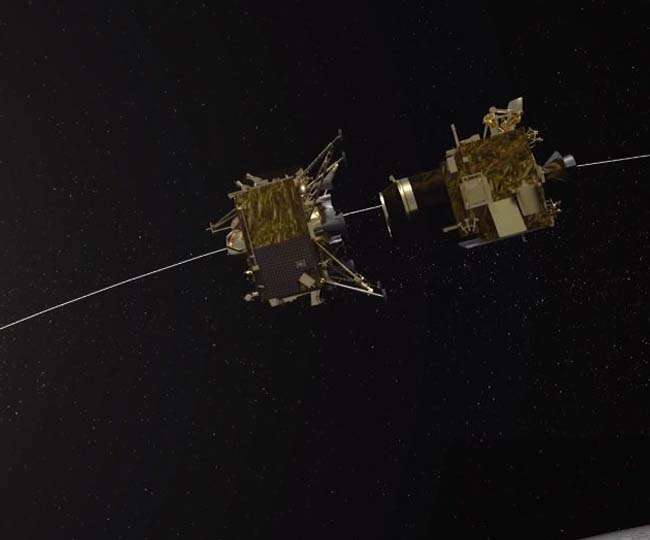
Bengaluru | Jagran News Desk: India's ambitious second lunar mission Chandrayaan 2 was expected to make its soft landing on the surface on the moon late on the intervening night of Friday and Saturday. Enthusiasm turned into a sense of distress at Indian Space Research Organisation's (Isro) Mission Operations Complex in Bengaluru as Chandrayaan 2's lander 'Vikram' lost communication with the ground stations on Saturday just ahead of the soft landing.
Even though Isro may have lost contact with Chandrayaan-2 lander Vikram moments before touchdown, but the ambitious Chandrayaan 2 mission has been far from a flop. With a mission life of one year, the Chandrayaan 2 orbiter remains in operation and will continue to study the Moon from afar.
The Chandrayaan-2 orbiter is healthy and safe in the Lunar orbit, an ISRO official said
after the Vikram lander lost contact with ground stations.
"Only 5 per cent of the mission has been lost - Vikram the lander and Pragyan the rover - while the remaining 95 per cent - that is the Chandrayaan 2 orbiter - is orbiting the moon successfully," an official of the Indian Space Research Organisation or ISRO told news agency IANS.
Recommended For You
The orbiter can take several pictures of the moon and send it to the ISRO over the next year. The orbiter can take pictures of the lander to find out its status too, the ISRO official added. The rover inside the lander had a lifespan of only 14 days.
The orbiter carries eight scientific payloads for mapping the lunar surface and study the exosphere (outer atmosphere) of the Moon. The orbiter payloads will conduct remote-sensing observations from a 100 km orbit.
The Chandrayaan-2 orbiter has eight payloads for different jobs.
1. It has Terrain Mapping Camera 2 (TMC 2) whose primary objective is mapping the lunar surface. The data collected by TMC 2 will give us clues about Moon's evolution and help us prepare 3D maps of the lunar surface.
2. It has Chandrayaan-2 Large Area Soft X-ray Spectrometer (CLASS). CLASS measures the Moon's X-ray Fluorescence (XRF) spectra. Basically it will examine the presence of major elements such as Magnesium, Aluminium, Silicon, Calcium, Titanium, Iron, and Sodium.
3. It has the Solar X-ray Monitor (XSM). XSM observes the X-rays emitted by the Sun and its corona, measures the intensity of solar radiation in these rays, and supports CLASS.
4. It has the Orbiter High-Resolution Camera (OHRC). OHRC provides high-resolution images of the landing site.
5. It has Imaging IR Spectrometer (IIRS). One of its objectives is the global mineralogical and volatile mapping of the Moon.
6. It has Dual Frequency Synthetic Aperture Radar (DFSAR). The main scientific objectives of this payload are High-resolution lunar mapping in the polar regions, quantitative estimation of water-ice in the polar regions and estimation of regolith thickness and its distribution.
7. It has Chandrayaan-2 Atmospheric Compositional Explorer 2 (CHACE 2). CHACE 2's primary objective is to carry out a study of the composition and distribution of the lunar neutral exosphere and its variability.
8. And finally, the last payload Vikram has is a Dual Frequency Radio Science (DFRS) experiment. Its objective is to study the temporal evolution of electron density in the Lunar ionosphere.
Writer and managing editor of Nasa Spaceflight Chris G agreed. He said that "The orbiter is where 95 per cent of the experiments are".
If Vikram failed to land - which it looks like - REMEMBER the ORBITER is where 95% of the experiments are. The Orbiter is safely in Lunar orbit and performing its mission. This is not a total failure. Not at all. #Chandrayaan2 #India #MoonLanding #VikramLander
— Chris G - NSF (@ChrisG_NSF) September 6, 2019
"If Vikram failed to land - which it looks like remember the orbiter is where 95 per cent of the experiments are. The orbiter is safely in lunar orbit and performing its mission. This is not a total failure. Not at all," Chris G said.
Chandrayaan-2, a follow-on mission to the Chandrayaan-1 mission undertaken more than a decade ago, comprises an orbiter, lander (Vikram) and rover (Pragyan). ISRO on September 2 successfully carried out the separation of lander Vikram (with rover Pragyan housed inside) from the Chandrayaan-2 orbiter.
In the early hours of Saturday, communication from 'Vikram' lander to ground stations was lost during its powered descent to the Lunar surface, and ISRO said data is being analysed.
"Vikram lander descent was as planned and normal performance was observed up to an altitude of 2.1 km. Subsequently, the communication from lander to groundstations was lost," ISRO Chairman K Sivan said.
Also Read: Chandrayaan-2: Lander ‘Vikram’ goes incommunicado | 10 points
ISRO had acknowledged before the landing that it was a complex manoeuvre, which K Sivan called "15 minutes of terror".