
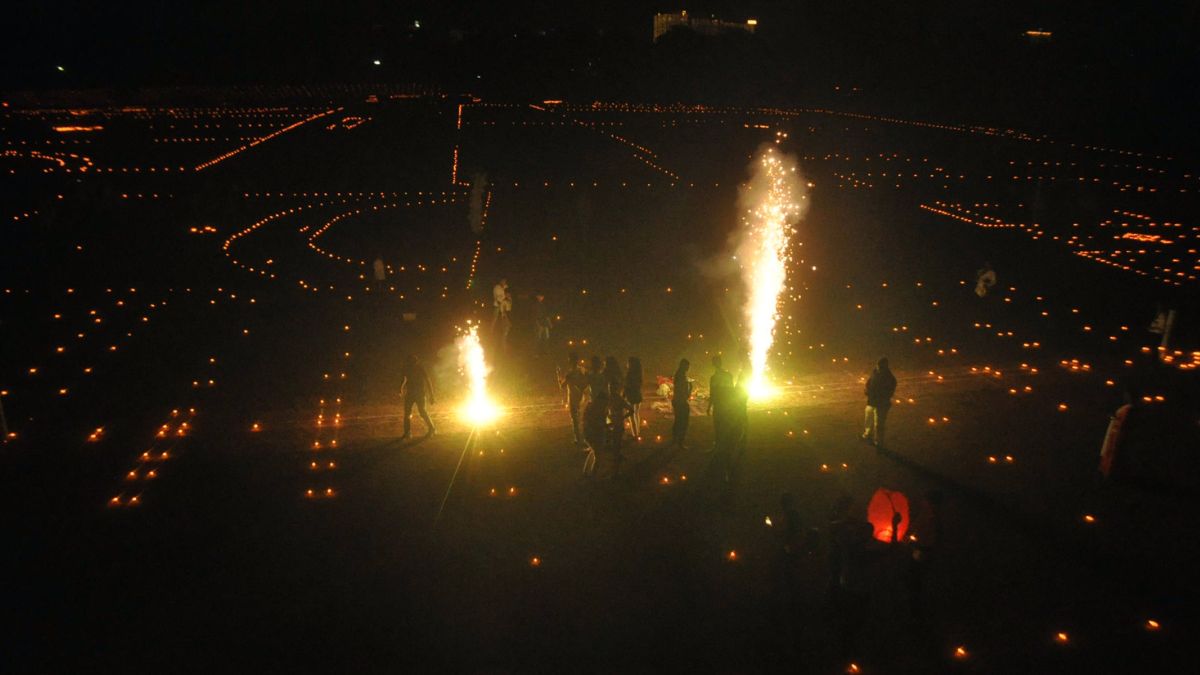
DIWALI celebrations and the bursting of firecrackers go hand in hand, however, the depleting air quality index in many parts of the country and health hazards related to it have restricted these celebrations. Several states including Delhi have banned the sale, purchase and bursting of firecrackers to reduce air pollution levels. However, a large number of high-decibel firecrackers thundered throughout Diwali night as people in Delhi flouted the ban imposed on these by the city government.
Despite the legal deterrent in the national capital, where the bursting of firecrackers attracts a jail term of up to six months and a fine of Rs 200. people in many parts of the city started bursting crackers by Monday evening. As the night progressed, the intensity of firecrackers increased breaching permissible decibel limits, prompting some to wonder "if there was any ban at all".
Firecracker waste seen in various places post-Diwali celebrations
— ANI (@ANI) October 25, 2022
(Pic 1 from Delhi's Akshardham area, pics 2 & 3 Delhi's Arjun Nagar, pic 4 from UP's Moradabad) pic.twitter.com/Dre9w4YYpS
Delhi's air quality turned 'very poor' on Tuesday amid an increase in stubble burning, bursting of firecrackers and moderately unfavourable meteorological conditions which allowed the accumulation of pollutants. However, the 24-hour average air quality index (AQI) of 323 was still the second-best for Diwali in seven years. The city recorded an AQI of 281 on Diwali in 2018.
Delhi | Air Quality Index (AQI) is presently at 323 (overall) in the 'very poor' category, as per SAFAR-India
— ANI (@ANI) October 25, 2022
(Visuals from near Akshardham temple) pic.twitter.com/pOqaqk6ogk
Delhi's air quality in 'very poor' category, with AQI standing at 323; visuals from India Gate pic.twitter.com/YATIwXfCBk
— ANI (@ANI) October 25, 2022
Earlier in the day, experts feared that if the volume of firecrackers burst goes up again this year, the air quality would dip further. In case firecrackers burst like last year, the air quality may plunge to 'severe' levels on the night of Diwali itself and continue to remain in the 'red' zone for another day, the System of Air Quality and Weather Forecasting and Research (SAFAR) had earlier predicted.
Recommended For You
In south Delhi's East of Kailash and neighbouring places like Nehru Place and Moolchand, firecrackers could be heard going off mid-air in the evening. Some residents burst crackers in their neighbourhood like every year. In Burari too, many residents burst firecrackers despite widespread dissemination of information about the ban.
Many people complained of itchy skin and a burning sensation in their eyes due to smoke from bursting firecrackers. In neighbouring cities of Gurugram and Faridabad too, many people burst firecrackers. "I will not step out tomorrow, I know what the air quality will be tomorrow," said Reetu Nandan, a student, who lives in south Delhi.
Ghaziabad (301), Noida (303), Greater Noida (270), Gurugram (325) and Faridabad (256) reported 'poor' to 'very poor' air quality on Monday. An AQI between zero and 50 is considered 'good', 51 and 100 'satisfactory', 101 and 200 'moderate', 201 and 300 'poor', 301 and 400 'very poor', and 401 and 500 'severe'.
(With Agency Inputs)