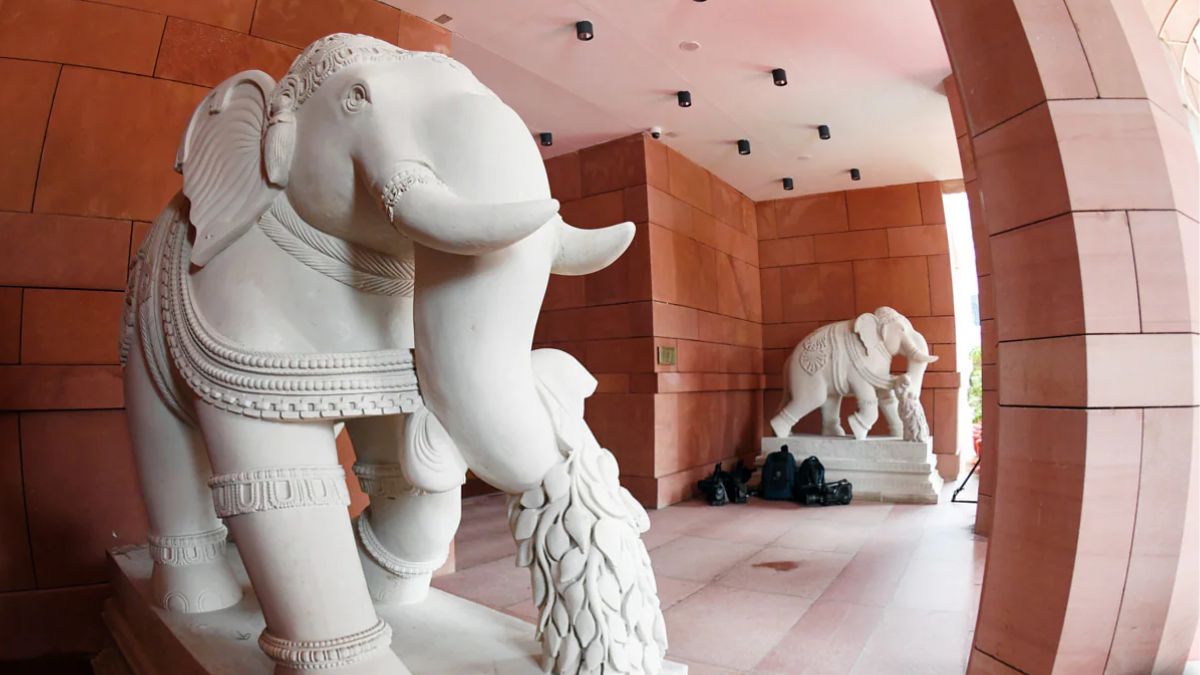
The new Parliament building where the parliamentary proceedings will begin on Tuesday, on the occasion of Ganesh Chaturthi, has six gates which have been named after creatures, some are real and some mythological.
The names of these gates are, Gaja Dwar, Ashwa Dwar, Garuda Dwar, Makara Dwar, Shardula Dwar and Hamsa Dwar. Reportedly, each creature highlights different aspects of Parliament and represents 140 crore Indians.

The new Parliament building was inaugurated by Prime Minister Narendra Modi on May 28. (Image: ANI)
All About Six Creatures Guarding Gates Of New Parliament Building:
Gaja Dwar
The Gaja Dwar is placed on the north ceremonial entry and named after the elephant, which symbolises memory, intellect, wealth, and wisdom. The Elephant motifs have been used extensively in Indian art, since the Mauryan period. The entrances of palaces and forts usually have representations of elephants which can commonly seen at the forts of Rajasthan and other places.
ALSO READ: PM Modi Bids 'Goodbye' To Old Parliament Building, Says 'Will Continue To Inspire For Years'
On Sunday, Jagdeep Dhankhar, Vice-President and Chairman of Rajya Sabha, also hoisted the national flag at the Gaja Dwar of the new Parliament building
Ashwa Dwar
The Ashwa Dwar is named after the horse and inspired by the Sun Temple Complex at Konark, which was established approximately 1250 CE by Narasimhadeva I of the Eastern Ganga dynasty. It is a symbol of power and courage which are needed in governance.
Garuda Dwar
The third entrance gate of the new Parliament building is named after Garuda - the king of birds. Garuda appears with Vishnu on Gupta-period coins. It symbolises power and dharma.
Makara Dwar
The Makara Dwar is named after a sea creature that is a combination of different animals. The statue at the western public entrance is inspired by the 12th century CE Hoysaleshwara Temple at Halebidu, Karnataka.
Shardula Dwar
The fifth gate of the new Parliament building is named after another creature Shardula, a mythological creature with the body of a lion but the head of a horse, elephant, or parrot. It represents the balance of strength and grace.
Recommended For You
Hamsa Dwar
The sixth gate of the new Parliament building is the Hamsa Dwar which is named after swan. The statue is inspired by the Vijay Vitthala Temple, Hampi, Karnataka, dated 15th century CE.
Hamsa is a symbol of self-realisation and wisdom. Reportedly, Hamsas are frequently used as decorative motifs on columns in Vijayanagara architecture, usually as low reliefs.