
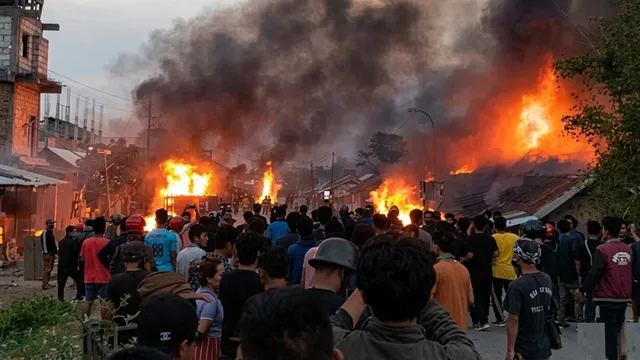
- Three Kuki-Zo men killed in Manipur's Noney district.
- Kuki-Naga conflict escalated from a minor Litan village dispute.
- Widespread ethnic tensions persist, demanding SoO pact abrogation.
Three Kuki-Zo individuals, identified as Thanglensang Singson, Thangkhosei Haokip, and Lamminsang Kipgen, were killed on Saturday during a heavy exchange of gunfire with armed Naga groups at Kekru Naga (Tazeikaiphun) village in Manipur's Noney district. Additionally, two Kuki civilians who had gone missing from Taphou Kuki village were found dead days later, as confirmed by Manipur Police.
These deaths brought the total toll in clashes between Naga and Kuki groups since February to 68. The incident occurred in a Rongmei-Naga majority area following days of intermittent attacks and the alleged burning of structures in the region.
The attack coincided with demonstrations by thousands of Meitei and Naga protesters demanding that the Centre abrogate its Suspension of Operations (SoO) peace pact with Kuki armed groups. Meanwhile, the Committee on Tribal Unity (CoTU) called for a shutdown in the nearby Kangpokpi district over the recent abduction of two Kuki youths, highlighting widespread ethnic mobilisation. Kuki leadership specifically accused Naga insurgent groups, notably the NSCN-IM and ZUF-K, of carrying out the attack. While the violence began in early May 2023, the unrest remains an active and critical issue.
How did the conflict escalate?
A minor drunken street brawl on February 7, 2026, in Litan village opened a volatile new front of conflict between the Naga and Kuki-Zo communities in Manipur. This confrontation reactivated decades-old tribal fault lines that had previously been overshadowed by the larger Meitei-Kuki conflict.
Recommended For You
There are two versions of the incident. A 48-year-old Naga man, Stalin Shimrey, belonging to the Naga community, said that he and a friend stepped onto a dark road where a third associate was waving a torchlight. The light fell on three Kuki men, who took offense and confronted them. Shimrey claimed the Kuki men returned with reinforcements and assaulted them, leaving him with a broken jaw.
The Kuki resident, Nemneikim Baite, disputed this, claiming that a Naga man flashed a torch directly into her brother's face and began shouting abuses. She stated her brother acted in self-defence during the ensuing physical scuffle, causing Shimrey to fall and break his jaw.
Was the matter resolved ?
As per the tribal law, the matter was to be resolved through a customary animal sacrifice/compensation rather than involving the local police. The next morning, peace talks did not meet a conclusion. Naga villagers alleged that Kuki militants protected the accused man, leading to retaliatory house-shattering and gunfire. On the other hand, Kuki villagers claimed Naga militants disrupted the meeting by demanding the youth be handed over, firing weapons first.
The conflict gradually escalated, and between February 8 and 10, both factions began burning down each other's homes in Litan, forcing the deployment of central security forces (CRPF and BSF) to physically partition the village.
The conflict quickly spread outward from Litan to other hill districts including Kamjong, Kangpokpi, and Noney. By late 2026, the newly reignited Naga-Kuki clashes had claimed 65 lives and displaced thousands.
The Kuki-Meitei conflict
The conflict initially started between the two Manipuri communities, Kuki-Zo and Meiti, following a "Tribal Solidarity March" organised by hill tribal student bodies. The demonstration opposed a high court directive on the inclusion of the Meitei community under the Scheduled Tribe (ST) status, which the tribal groups argued would infringe upon their lands and affirmative action benefits.
The tensions soon took a serious turn, with nearly 60,000 people forced to flee their homes, with many residing in makeshift relief camps or seeking refuge in neighbouring states. Over 200 lives were lost amid the rivalry. The violence paved the way to a massive destruction of houses and damage to properties, with thousands of homes burnt in the area.
ALSO READ: Manipur: Thousands Take To Streets, Bang Utensils To Protest Killings Across 5 Districts | Watch
President’s rule in 2025
In February 2025, following the resignation of the then Manipur Chief Minister, N Biren Singh, amid persistent instability, the federal government placed the Manipur assembly under suspended animation and imposed President's Rule. The state has effectively been partitioned into segregated ethnic zones. Central security troops patrol buffer zones separating the valley from the hills to prevent direct confrontations.
Meitei civil society groups continue to hold massive rallies demanding the termination of the Suspension of Operations (SoO) agreement with Kuki militant groups, accusing them of ongoing violations. Concurrently, Kuki-Zo groups have pivoted their political demands toward a completely separate administration or Union Territory status