
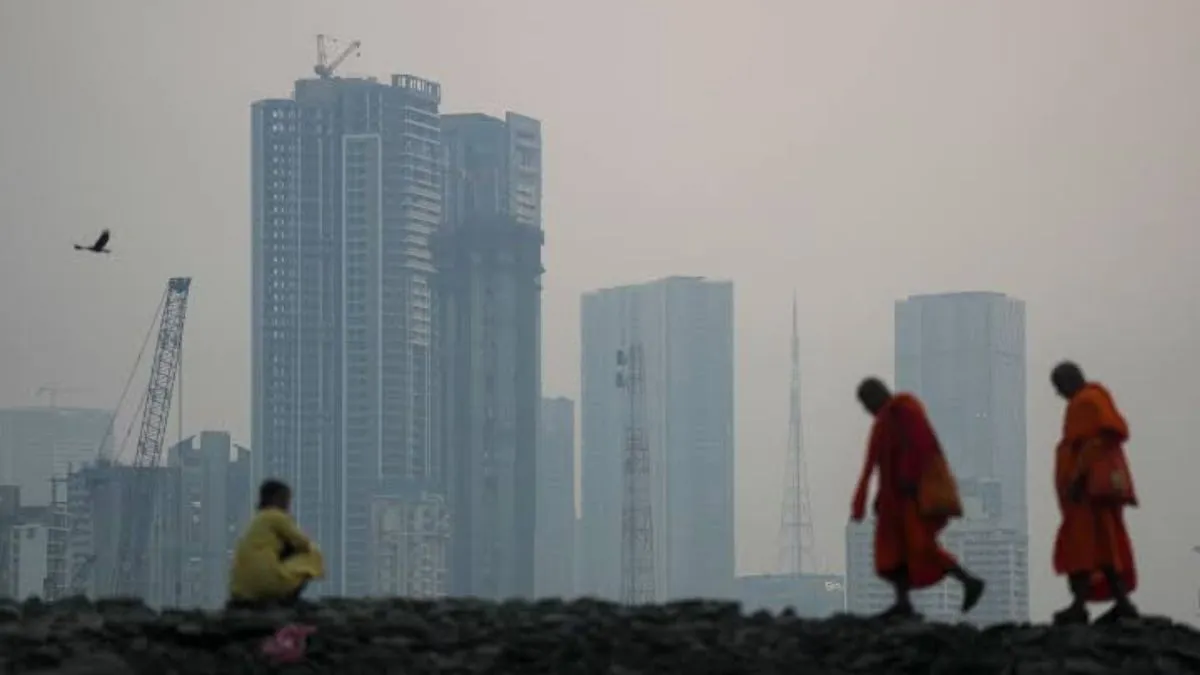
- Weak sea breezes, construction dust worsen Mumbai's air quality.
- BMC under pressure; sensor discrepancies raise monitoring concerns.
- Richa Chadha questions authorities on city's environmental issues.
With the onset of winter, Mumbai is witnessing worsening air quality, with rising Air Quality Index (AQI) levels and haze affecting parts of the city. However, the problem goes beyond pollution readings. Slowing sea breezes, construction dust, vehicle emissions, garbage burning and firecrackers are contributing to the deteriorating conditions, while discrepancies between nearby pollution sensors have raised questions about the accuracy of monitoring systems.
The crisis has also put the Brihanmumbai Municipal Corporation (BMC) under pressure to demonstrate that its pollution-control measures are working. Actor Richa Chadha has questioned the authorities over the city's air quality, drinking water and tree loss, while the Bombay High Court has sought details of enforcement measures from civic and police officials.
Why Mumbai's Sea Breeze Is Failing To Clear The Air
The coastal proximity has always saved Mumbai from pollution - but not at a time when wind is getting weaker, according to a scientist. The winds have been weakening in Mumbai, and that is allowing pollution to settle on the ground, News18 quoted Gufran Beig, a chair professor at the National Institute of Advanced Studies, on the IISc campus.
Recommended For You
Weather shifts, such as weather related to El Nino, could impact temperatures and circulation this season.
Construction dust and vehicle emissions continue to be significant sources of particulate pollution. The BMC has also said sodium chloride, or sea salt, has a role to play in the haze. Small particles from sea spray can join forces with pollutants from cars and industries, but sea salt isn't enough to account for Mumbai's worsening air quality.
Open garbage burning in areas around Mumbai and agricultural fires in neighbouring states may add to the pollution burden when winds carry emissions towards the city. Firecrackers during the festive season can further increase particulate pollution, particularly when winds are weak.
BMC Faces Questions Over Pollution Readings
The reliability of air-quality monitoring has emerged as another concern. A Times of India report published on October 24 highlighted a construction-site sensor at New Cuffe Parade that recorded an AQI of just 16, while a nearby ready-mix concrete plant registered PM2.5 at 49 and PM10 at 60.
Additional Municipal Commissioner Avinash Dhakane reportedly described the unusually low reading as practically impossible under the prevailing conditions, raising the possibility of a calibration problem, sensor malfunction or manipulation. The discrepancy warrants investigation but does not, by itself, prove deliberate tampering.
The issue matters because civic authorities use sensor data to identify pollution hotspots and assess compliance at construction sites. Unreliable readings could make it harder to identify violations and direct inspections where they are needed.
What Is The BMC Planning To Reduce Pollution?
The civic body is using artificial intelligence to scrutinise data from 3,000-odd sensors at construction sites and identify polluting hotspots and the location of tools that were repeatedly not reporting readings. It has also deployed 76 ward-wise mitigation squads to carry out surprise inspections. Construction sites committing violations are issued show-cause notices, stop-work orders or sealing of sites.
For controlling road dust, the BMC is planning to wash 677 km of roads with treated sewage water and other non-potable water. The proposal comes amid a 10 per cent water-supply cut, which had prompted the civic standing committee to stall an earlier road-washing plan. The revised approach would use water that is not intended for drinking.
Other measures include enforcing cleaner fuels at bakeries, installing air-pollution control devices at 10 crematoria, monitoring open-burning hotspots and enforcing construction-site pollution guidelines. The civic body has also urged residents not to burst firecrackers in public spaces.
Richa Chadha Questions Air Quality, Water And Tree Loss
Amid the worsening environmental concerns, Richa Chadha has called on Mumbai residents to demand answers from the authorities.
In a post on X, the actor wrote, “You got literal l poop in drinking water, and poison in the air.” She questioned what the authorities were doing to tackle air pollution and why residents continued to pay high taxes while facing deteriorating civic conditions.
Chadha also raised concerns about the proposed removal of around 7,500 trees, urging citizens not to leave environmental activism to a small group of campaigners and young people.
ALSO READ: Mumbai Is No Longer Breathing Easier Than Delhi: 5 Reasons Behind Its Rising Pollution
Her comments came after reports that the BMC's Tree Authority had approved the removal or transplantation of 7,633 trees over five months. Of these, 3,502 were approved for permanent felling and 4,131 for transplantation, with infrastructure and redevelopment projects among the reasons cited.
The debate now extends beyond Mumbai's rising AQI to the effectiveness of pollution controls, the reliability of monitoring data and the city's wider environmental management. While sea breezes may help disperse pollutants under favourable conditions, sustained improvements will depend on reducing emissions, enforcing existing rules and ensuring that the BMC's planned interventions deliver results.