
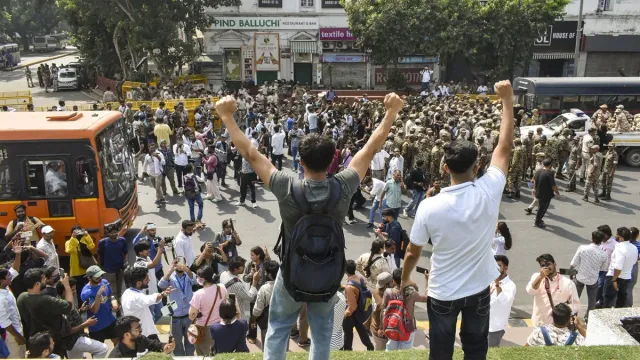
- Delhi under heavy security for CJP anti-CEC protest.
- Authorities monitored social media, suspended internet services.
- Protesters used Signal, burner phones to bypass surveillance.
CJP Protests: Delhi has been under an unprecedented security blanket, with around 25,000 police and paramilitary personnel deployed across the city, forty-five metro stations closed, and surveillance at the national capital's borders, railway stations, bus terminals and other sensitive locations ahead of a proposed protest by the Cockroach Janta Party (CJP) at Jantar Mantar, on Saturday. Despite all efforts by the authorities to thwart the stir against Chief Election Commissioner Gyanesh Kumar over alleged irregularities in the Special Intensive Revision (SIR), the national capital witnessed sporadic protests and mass detentions.
Social Media Platforms Monitoring
Authorities also monitored social media platforms for attempts to mobilise people for the protest. More than 200 content creators were reportedly under scrutiny as police examine online posts and messages linked to the proposed gathering.
ALSO READ: CJP Protest In Delhi: UN 'Concerned' Over Mass Detentions, Seeks Immediate Release Of Detainees
Internet Suspended In New Delhi
Internet services were also suspended within a 4-kilometre radius of Jantar Mantar from 10 pm on October 9 to 10 pm on October 10. The suspension was reportedly applied to all mobile internet services. Delhi Police has divided the New Delhi district into 20 zones as part of their preparations to handle the proposed protest on October 10.
How Protesters Countered Authorities' Moves
CJP supporters and members of the other organisation somehow managed to coordinate and hold assemblies near the protest site, Jantar Mantar. A technological battle beyond optics went on throughout the day, which gave an edge to the agitators. News18 reported that protesters used advanced counter-surveillance tactics, encrypted channels, and decentralised communication strategies to breach the authorities' restrictions.
As agitators were aware of heavy digital surveillance and preemptive detentions, they had planned for advanced technology-based communication. Their strategies reportedly included the use of closed-loop messaging applications with disappearing message features. They used decentralised Signal groups to stay in touch with fellow protesters across Delhi-NCR.
Unregistered burner devices loaded with temporary data plans were also reportedly used to counter authorities' restrictions. The protest organisers established strict digital hygiene protocols for the coordinators, which meant they were told to keep cleaning cache files, disable biometric unlock features, and limit live broadcasts. Peer-to-peer offline messaging tools and virtual private networks may also have been used by the protesters.
(With Agencies inputs)