
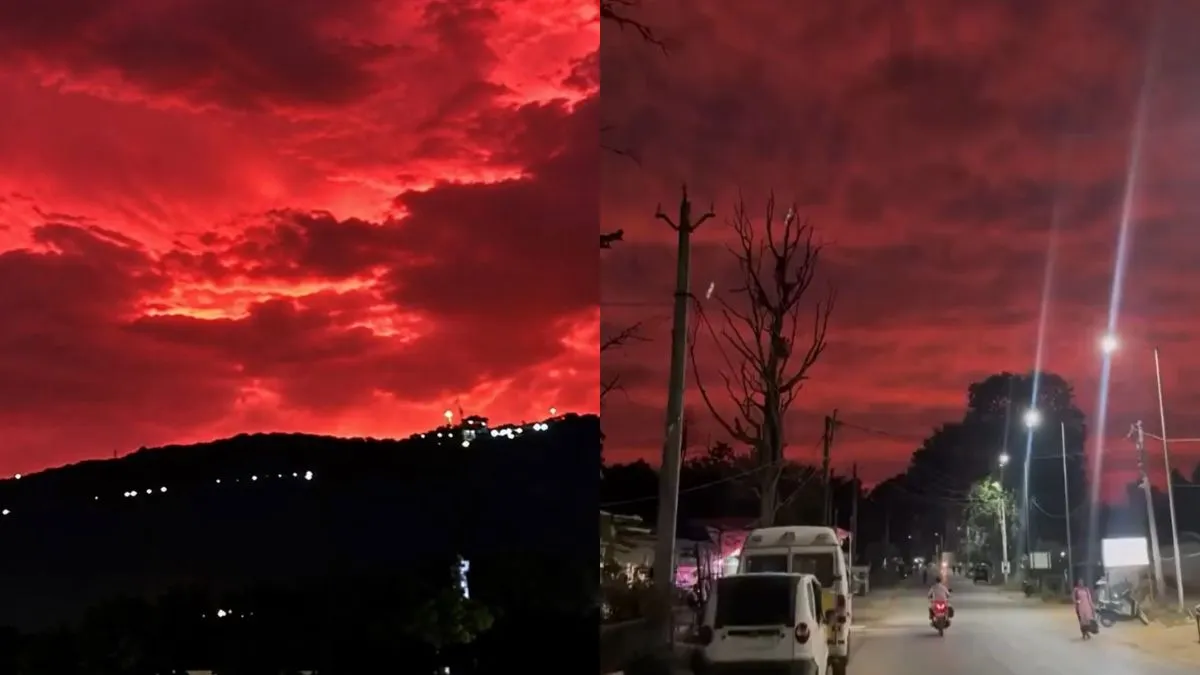
- Kirandul, Chhattisgarh witnessed a rare blood-red sky phenomenon.
- Atmospheric scattering and particulate matter caused the red hues.
- Not directly linked to Cyclone Arnab, but coincided with it.
Chhattisgarh: The skies over Kirandul in Chandigarh's Dantewada district turned blood red as strong winds and unsettled weather associated with Cyclone Arnab swept across the region. The striking spectacle left residents stunned, triggering widespread speculation about the unusual phenomenon. Users are sharing images and videos of the blood-red skies, claiming it happened due to Cyclone Arnab.
A striking blood-red sky emerged over Kirandul in Dantewada district as atmospheric disturbances linked to Cyclone Arnab swept across Chhattisgarh. Caused by Rayleigh scattering through dense storm moisture and particulate layers, the phenomenon coincided with high alerts for severe thunderstorms, gusty winds, and heavy downpours. #Kirandul #Chhattisgarh #CycloneArnab #RedSky #WeatherUpdate
— The Daily Jagran (@TheDailyJagran) October 28, 2026
While the phenomenon coincided with warnings of heavy rainfall, thunderstorms, and gusty winds due to Cyclone Arnab, meteorologists suggest that the exact cause behind the unusual phenomenon is broader atmospheric factors rather than a single storm system, India Today reported.
Is Cyclone Arnab Behind Chhattisgarh's Blood-Red Skies?
Although the weather system contributed to the atmospheric conditions, available information does not establish a direct link between Cyclone Arnab and the red sky. Several atmospheric elements interacted to create the rare spectacle:
Recommended For You
- During sunrise and sunset, sunlight travels through a longer stretch of the Earth's atmosphere. This path filters out shorter blue wavelengths and allows longer red and orange wavelengths to pass through and dominate the horizon.
- While standard Rayleigh scattering creates typical sunrise and sunset hues, larger airborne particles, such as suspended dust, smoke, and water droplets, influence light intensity and amplify the deep red shade.
- Dense storm clouds combined with changing atmospheric visibility during severe weather create unique light-and-shadow combinations, producing red and orange skies under certain conditions.
Pinpointing whether the Chhattisgarh sighting was driven primarily by cyclone-induced moisture layers or particulate dust requires precise atmospheric measurements at the time of the event.
Safety Precautions For Local Residents
While the red skies provided a captivating spectacle, safety concerns remain as Cyclone Arnab continues to impact the region. Local residents are urged to monitor advisories from meteorological authorities, avoid unnecessary travel, and exercise extreme caution during severe thunderstorm warnings and strong wind activity.