
- RAF deployed to Arunachal after violent Siang project protests.
- Protesters torched NHPC office, police station in East Siang.
- Project aims to counter China's dam, faces local opposition.
The Union Ministry of Home Affairs has dispatched two Rapid Action Force (RAF) companies, comprising nearly 250 personnel, from Navi Mumbai to Pasighat via an Indian Air Force (IAF) transport aircraft. The response comes after protests against the proposed 11,200 MW Siang Upper Multipurpose Project (SUMP) turned violent in East Siang district. Protestors torched an NHPC office and a police station and vandalised the residences of three political leaders, including that of the state BJP chief and clashed with security personnel.

What Is The Siang Upper Multipurpose Project?
Implemented by NHPC, the 11,200 MW SUMP project will be spread across three districts in Arunachal Pradesh's Siang belt: Upper Siang, Siang, and East Siang.
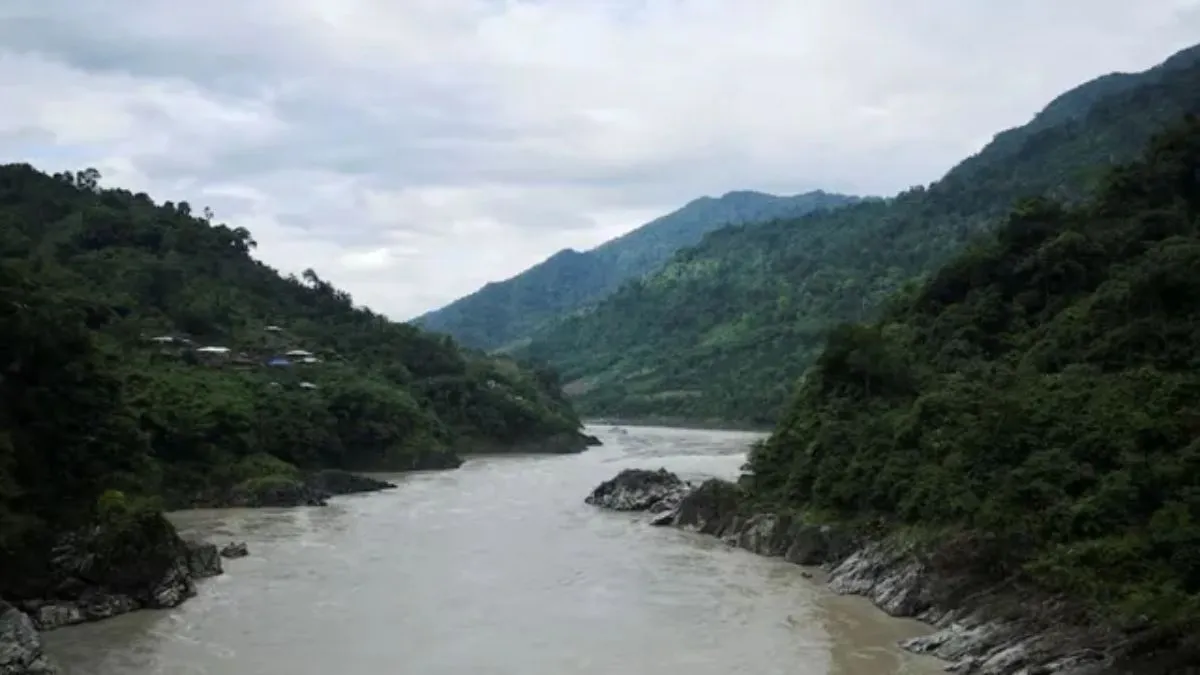
First proposed in 1983 and designated a national project in 2008, the proposal gained fresh momentum after the Union Cabinet decided in September this year to conduct a pre-feasibility survey. The dam sits on the Siang River, known as the Yarlung Tsangpo in Tibet, which flows 294 km through Arunachal Pradesh before joining the Dibang and Lohit in Assam to form the Brahmaputra.
Strategic Significance: Countering China's Mega Dam
Beijing is executing a massive 60,000 MW megadam upstream at Medog in Tibet. New Delhi and the state leadership view the Siang project as a strategic "counter" to protect national water rights, regulate floods in the Siang-Brahmaputra basin, and strengthen energy security.
Recommended For You
Arunachal Pradesh Chief Minister Pema Khandu clarified key differences between power generation capacity and water storage volume:
- China's Medog Project: Generates 60,000 MW primarily due to the steep drop at the Great Bend of the Yarlung Tsangpo, but relies on an estimated 5.5 billion cubic metres (BCM) of live storage.
- India's SUMP Project: Designed with 9.2 BCM of live storage, allowing it to hold back significantly more water to buffer against sudden upstream releases despite its lower generation capacity.
Citing regional projects to prove that power generation capacity does not equal storage volume, Khandu said that the proposed Etalin project will generate 3,097 MW with just 7.5 million cubic metres (MCM) of storage, whereas the Dibang project generates 2,880 MW with nearly 4 BCM of storage, The Times of India reported.
Why Local Communities Are Opposing The Project
Several groups, including the Adi Baane Kebang-United, SUMP-Affected Youth Association, Siang Indigenous Farmers Forum, and Adi Galo Welfare Society, warn of devastating socio-ecological impacts along the riverbank:

- Displacement Risk: The Siang Indigenous Farmers Forum estimates that the reservoir will submerge 27 villages and displace over 1.5 lakh residents, threatening fertile paddy fields and traditional livelihoods.
- Heritage Loss: Historical landmarks are at risk of permanent submergence, including Kekar Moying, a heritage site associated with the Anglo-Abor battle.
- Consent And Militarisation Concerns: Opponents criticise surveys conducted without the consent of affected communities and view the deployment of central security forces as militarisation. Former Chief Minister Gegong Apang has called for the project to be scrapped while questioning the utilisation of funds for preliminary work.
What Does The Pre-Feasibility Report (PFR) Entail?
CM Khandu clarified that the Pre-Feasibility Report (PFR) is simply an initial assessment of the project's technical and geographical viability, not a final clearance to commence construction. If the PFR shows the project is viable, it must still undergo:
- Social Impact Assessment (SIA)
- Environmental Impact Assessment (EIA)
- Detailed Project Report (DPR)
Although several villages have signed agreements to facilitate initial survey work, the state government maintains that it will consult affected communities, outline clear roadmaps, and address public concerns before moving forward.
(With Inputs From Jagran.com)