
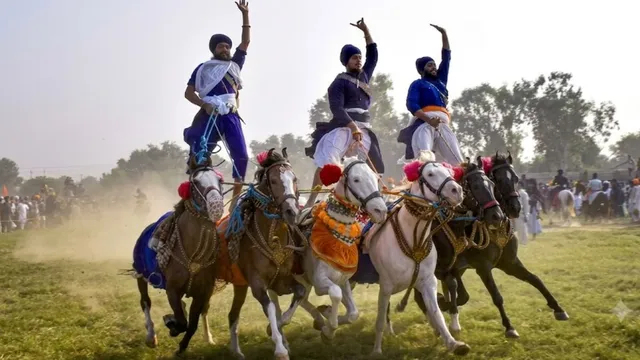
- The weapons signify their vow to defend the weak, protect religious freedom.
- The Rehatnama presents the Nihang not merely as a soldier but as a warrior devoted to Akal Purakh.
- The association of the Nihangs with cannabis has also come in for criticism
The recent clash in Uttarakhand's Rudraprayag district between the Nihangs and the local police has gained widespread attention over the past few days. The group demanded the release of four Nihangs who had been apprehended after a fight over a parking took place in nearby Karnaprayag that soon escalated into a violent exchange, injuring several locals. Although the group expressed satisfaction after discussions with senior Uttarakhand officials, they headed towards Gurudwara Singh in Mohali. Heavy police forces remained deployed in Premnagar, the Shimla bypass, and at the city's entry points. District Magistrate Dr Ashish Chauhan and SSP Pramod Doval remained on the front lines until late night.
Who Are The Nihangs?
The Nihangs have acted as a major part of the Sikh community for decades as a symbol of faith, military power and political authority. The group was founded to fight wars at a time when the Sikh community was threatened by the external powers, such as the Mughals and the Afghans. Over the years, the group has emerged as a significant part of the Sikh community.
The word "Nihang" means "unaffected by pain or comfort, given to meditation, penance, and charity" and "complete warrior". The Nihangs are usually identified by their blue attire and dumalla turbans and use spears and swords as their primary weapons.
What Do Their Weapons Signify?
The weapons of the Nihangs are not simply ceremonial objects like those of other baptised Sikhs who carry a kirpan as part of the five Kakars. Traditional Sikh texts describe the Nihangs as warrior saints whose duty was to defend the faith, protect the vulnerable, and remain prepared for battle at all times.The weapons signify their vow to defend the weak, protect religious freedom, and uphold justice. They aren't meant to attack the unarmed.
Recommended For You
However, there is a section of Nihangs who do not follow any restrictions on the colour of their dress. Though both sections follow the martial traditions. They are commonly known as Akalis or Akali Nihans. Several people identify them as custodians of the Khalsa's military traditions. The Rehatnama presents the Nihang not merely as a soldier but as a warrior devoted to Akal Purakh, the Timeless One, and prepared at all times to defend the faith.
A historical 1880 text written in Braj Bhasha by Baba Sumer Singh, Sri Gur Pad Prem Prakash, attributes the origins of the Nihang identity to an episode involving Sahibzada Fateh Singh, the youngest son of Guru Gobind Singh.
ALSO READ: Uttarakhand Gurdwara Standoff Ends: Four Nihang Sikhs Descend From Roof, Leave For Punjab On 4th Day
According to Baba Sumer Singh, the young Sahibzada was dressed in a blue dumalla and armed with weapons. Guru Gobind Singh is said to have admired this appearance and referred to such warriors as "Nihang Singhs". This is a reason some say that the Nihangs are considered the sons of Guru Gobind Singh.
The association of the Nihangs with cannabis has also come in for criticism. While consumption of cannabis was done for military campaigns and to alleviate pain, Sikh scholars criticise the practice as incompatible with Rehat Maryada, which prohibits intoxicants.