

- By S K Singh
- Mon, 16 Jun 2025 09:51 PM (IST)
- Source:JND
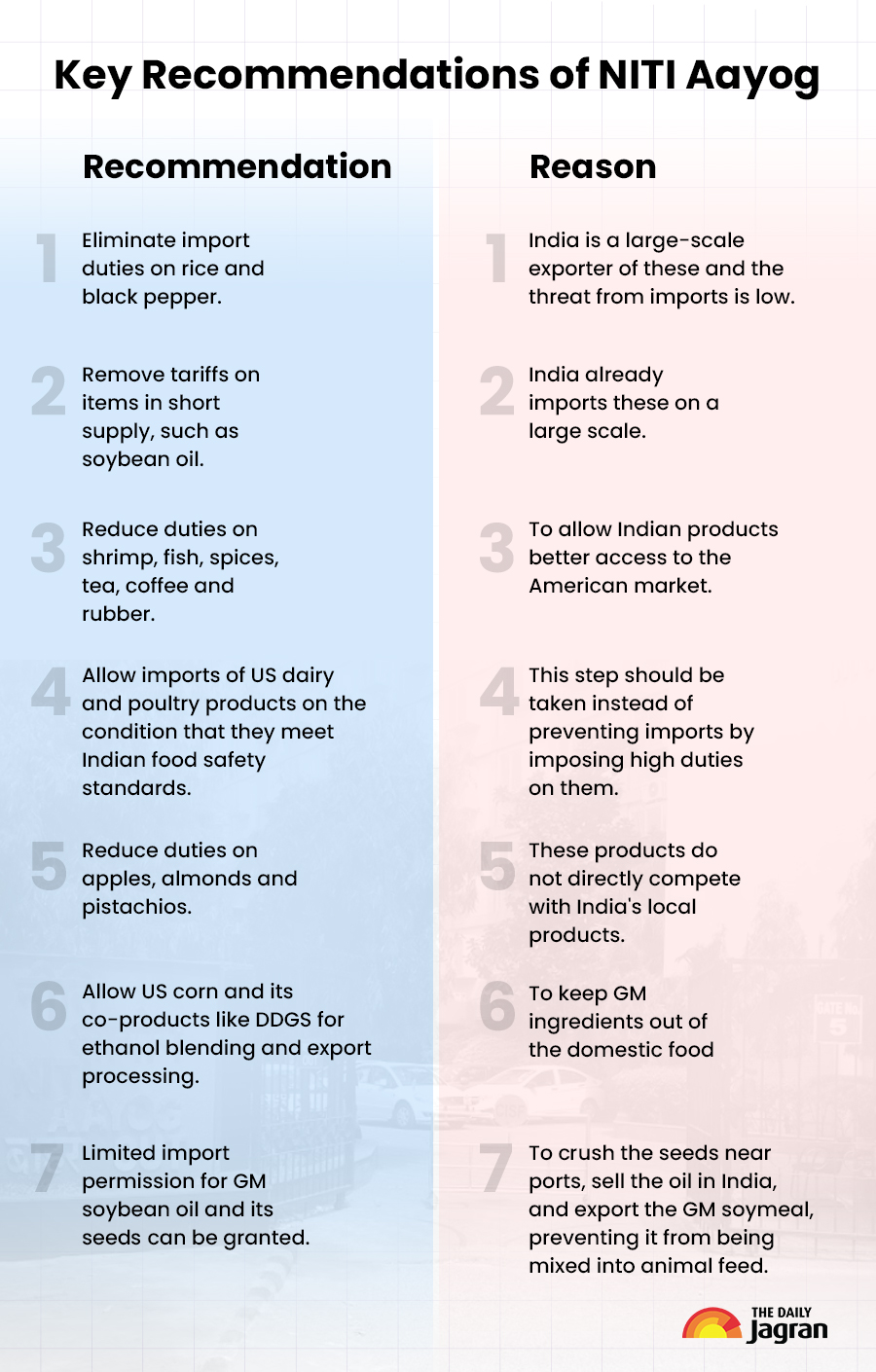
NITI Aayog has released a working paper on increasing agricultural trade between India and the US. It recommends that under the proposed India-US Free Trade Agreement (FTA), India should open its market for rice, black pepper, soybean oil, shrimp, tea, coffee, dairy products, poultry, apples, almonds, pistachios, corn and genetically modified (GM) soy products. India imports many of these products. Additionally, reciprocal access to each other's markets has been made the basis of this recommendation. However, other experts believe that doing so could be risky for the 700 million Indians dependent on agriculture. They also cite the GATT agreement of the 1960s/70s, under which zero duties on rice and wheat made India vulnerable and India had to renegotiate.
Experts state that reducing duties on produce like rice and maize could expose Indian farmers to risk during times of volatile global prices. Global prices are significantly influenced by the hefty subsidies provided by countries such as the US and the European Union. This very instability has devastated agriculture in many African nations, making them dependent on imports. The think tank Global Trade Research Initiative (GTRI) has termed these recommendations by NITI Aayog as risky and emphasized the need for extensive deliberation on them.
What Is In NITI Aayog Working Paper?
It states that concerns have grown following US President Donald Trump's announcement of reciprocal tariffs on imports on April 2, 2025 (implementation has been postponed for 90 days). These tariffs will apply to almost all countries. This has created a kind of panic worldwide because the new tariffs are exceptionally high and beyond any logic. Furthermore, the Trump administration is frequently changing tariffs. If such a tariff system is implemented, it could have a devastating impact on trade and the economy. India also uses tariffs to protect its producers. According to the changing US trade policy, it is essential for India to adopt a calibrated approach as well.
NITI Aayog member Ramesh Chand, also among the authors of this working paper, has discussed the potential impact of US reciprocal tariffs on India's agricultural sector. He has also identified areas of potential benefit for India. He suggested that some Indian agricultural exports, such as seafood and Basmati rice, could benefit from tariff changes. Under a bilateral trade agreement, import duties on certain agricultural commodities could be reduced. Such cuts would not endanger Indian farmers, as the price difference would protect domestic producers.
Ajay Srivastava, founder of GTRI, states, "NITI Aayog's recommendation that India reduce duties on agricultural products such as corn, soybean products, edible oils, dairy, and poultry is a matter of serious concern. Its long-term impact could be detrimental to Indian farmers."
Zero Duty Commitment Posed a Threat to Indian Farmers
NITI Aayog suggests that India could offer tariff concessions to the US on products like edible oils, as their domestic production is low. According to Srivastava, while this might sound pragmatic, this approach isn't suitable from a long-term perspective. India has adopted this strategy in the past and paid a heavy price. In the 1960s/70s, India was heavily dependent on the import of rice, wheat, and skimmed milk powder. At that time, India agreed to zero tariffs (zero bound rate) on these items during the GATT (General Agreement on Tariffs and Trade) negotiations. However, in the 1990s, when India started becoming self-reliant in these sectors, the zero-tariff commitment became a serious threat to millions of farmers.
Ultimately, India had to withdraw its tariff commitments by utilizing Article XXVIII of GATT. Although India succeeded in increasing bound tariffs (maximum duties) on major food items like rice, wheat, and milk powder, in return, it had to reduce bound tariffs on products such as butter, apples, and olive oil. This opened India's doors to subsidized agricultural imports.
Western subsidies devastate African agricultural systems
NITI Aayog argues that India should eliminate tariffs on products like rice and black pepper, as India exports large quantities of them. However, Srivastava states that the export of heavily subsidized grains from developed countries like the US and the European Union has been the primary cause of price instability in the global market. This has devastated the agricultural systems of many African countries.
Between 2005 and 2008, and again during 2010-2011, there was a sudden sharp increase in global grain prices. Wheat prices rose by 130 per cent and maize by nearly 70 per cent. This led to riots in countries like Ghana, Nigeria and Senegal, forcing governments to resort to expensive subsidy packages and emergency imports.
When their prices became artificially very low, that also proved to be highly damaging. During 2014-2016, global wheat prices dropped below 160 dollars per ton due to subsidized exports from Western countries. This forced local farmers to abandon farming and increased dependence on imports.
"It's a vicious cycle," says Srivastava. "Cheap imports reduce farmers' income, leading them to sow less. On the other hand, sudden price increases give rise to inflation, hunger and political instability. This vicious cycle has already destroyed Africa's once-robust grain system. India has over 100 million small farmers. If tariff protection on staple crops like rice and wheat is removed, India too could head towards such a danger."
According to Srivastava, reducing tariffs on rice would be akin to strengthening the hand of the US Rice Federation. This industrial group has consistently attacked India at the WTO, accusing it of violating subsidy limits, misusing the Peace Clause and distorting trade through Minimum Support Price (MSP) and government procurement. A tariff cut would embolden them.
Meeting Sanitary and Phytosanitary Standards
Another recommendation from NITI Aayog is that US dairy and poultry products be allowed for import on the condition that they meet India's Sanitary and Phytosanitary (SPS) standards, and that their import not be blocked by increasing customs duties. India's current rules state that imported milk must come from animals that have not been fed meat, blood, or internal organs. The US has long opposed this condition from India, considering it an unfair trade practice, while India views it as essential for its cultural values. According to Srivastava, implementing SPS conditions that are open to legal challenges instead of tariffs could weaken safety and ethical standards.
Furthermore, SPS conditions won't apply only to imports but also to domestic producers. If domestic producers fail to meet these standards, they won't be able to sell their products within the country. This would open up India's entire market to farmers and producers from developed countries, where farmers already adhere to SPS standards. Therefore, Srivastava states, "It's clear that SPS-related recommendations will backfire instead of protecting farmers, effectively pushing them out of the domestic market."
Import of GM Material
NITI Aayog has proposed allowing the import of maize (corn) from the US, especially for ethanol blending, which is currently restricted. Along with this, the commission wants to permit the processing and re-export of maize products like Distillers Dried Grains with Solubles (DDGS). It claims that this will prevent genetically modified (GM) material from entering India's food and animal feed supply chains. It has also suggested importing GM soybean seeds under a 'controlled model'. It states that these seeds should be crushed in coastal areas. The oil extracted from them will be sold in India, but the soy meal with GM traits will be exported so that it does not spread within the country.
This suggestion is based on the assumption that India can strictly control the movement of GM material through SPS (Sanitary and Phytosanitary) regulations. In reality, India's monitoring and compliance systems are weak. Once GM products enter the country, there will be a very high risk of them mixing with the domestic agricultural system. This could raise serious issues concerning food security and environmental impact. Additionally, countries that do not accept GM products could ban imports from India.
GTRI's Suggestions
Srivastava states that India should consider very carefully before reducing tariffs on agricultural products under the proposed India-US trade agreement. Once tariffs are lowered in such agreements, it becomes almost impossible to raise them again, even if prices fall, global trade is disrupted, or local farmers suffer heavy losses. In such a situation, India would become vulnerable, especially when wealthy countries like the US and the European Union are still providing heavy subsidies to agriculture.
According to Srivastava, maintaining tariff flexibility isn't an outdated protectionist method but a sensible and necessary policy. It enhances food security, rural income, and the ability to cope with market shocks. Therefore, GTRI (Global Trade Research Initiative) recommends that any binding commitments be preceded by open and transparent consultations with state governments, farmer organizations, and agricultural experts. Agriculture affects half of the country's population. Any major policy change must be based on solid evidence.
GTRI has also urged NITI Aayog to release a detailed and comprehensive position paper on the India-US FTA (Free Trade Agreement). It states that while the US expects India to reduce its MFN (Most Favoured Nation) tariffs, it is not offering any reciprocal concessions in return.
(This article was translated for The Daily Jagran by Akansha Pandey.)