
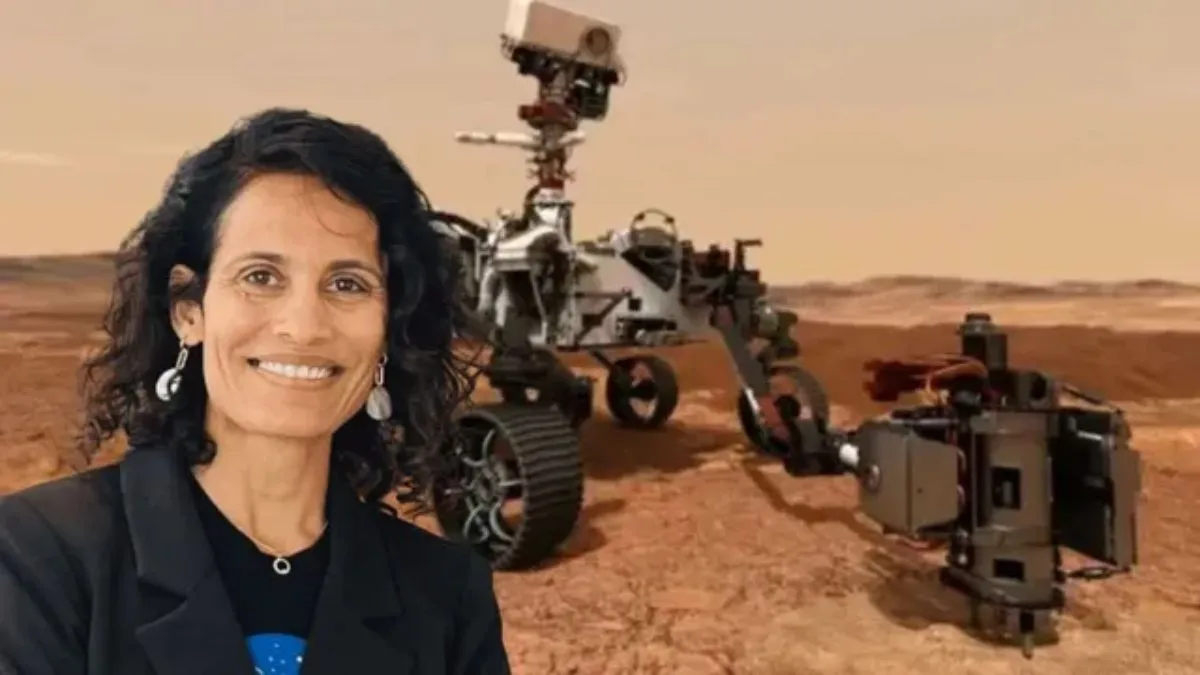
Vandi Verma, a distinguished scientist of Indian origin, has reached a significant milestone in space exploration, bringing immense pride to India. Her pioneering work has provided NASA’s Perseverance rover with enhanced capabilities for its mission on Mars.
A Historic Leap In Autonomous Driving
In late 2025, NASA conducted a groundbreaking test of autonomous driving on the Red Planet, led by robotics engineer Vandi Verma. For the first time, in December 2025, the Perseverance rover utilised Artificial Intelligence (AI) to independently navigate its path. This successful trial proves that future rovers can operate safely on the Martian surface without needing constant, direct commands from Earth.
Who Is Vandi Verma?
Born and raised in India, Vandi's real name is Vandana Verma. Her passion for technology and flight was sparked by her upbringing as the daughter of an Indian Air Force officer.
Educational Background: She earned her degree in Electrical Engineering from Punjab Engineering College (PEC) in Chandigarh.
Specialisation: She moved to the United States for higher studies, where she specialised in robotics and autonomous systems.
Empowering The Mars Mission With A "Digital Brain"
Vandi Verma's expertise in robotics has fundamentally transformed how NASA operates its space missions. By integrating AI, she essentially provided the rover with a digital brain, allowing it to plan its own driving routes.
Previously, every minor movement of a rover required manual instructions from Earth, a process that was both slow and complicated. With this AI-driven technology:
- The rover can now analyse the rugged Martian terrain in real-time.
- It can make rapid, safe decisions to navigate obstacles.
- During tests at the Jezero Crater, the AI successfully identified hazards and mapped out secure paths independently.
Recommended For You
A Legacy Of Space Excellence
Since joining NASA’s Jet Propulsion Laboratory (JPL) in 2007, Vandi Verma has been a pillar of the Mars exploration program. She has played critical roles in the Spirit, Opportunity, Curiosity and Perseverance missions.
Currently serving as the Chief Engineer for Robotic Operations on the Perseverance mission, her innovations allow the rover to explore high-risk areas that were previously considered inaccessible. According to NASA, this technology significantly reduces the time and manual labor required for rover operations, enabling the vehicle to cover record distances every hour.