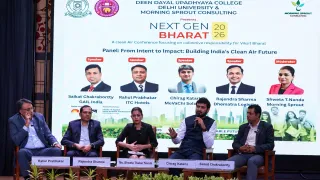
From GAIL’s focus on a diversified energy mix to ITC Hotels’ push for greater energy efficiency and cleaner operations, industry leaders at Next Gen Bharat 2026 – A Clean Air Conference underlined practical, technology-led solutions to advance India’s clean-air transition.
Saikat Chakraborrty, Chief Manager, GAIL (India) Limited, stressed that the transition to cleaner energy will not come from replacing one source with another overnight. He said businesses would need to work with a mix of energy sources as India’s clean-energy ecosystem develops.
“Govt is emphasising the adoption of multiple sources of energy including natural gas, biogas, renewables, green hydrogen etc. all of these together is the ecosystem that we are looking at GAIL.”
Chakraborrty, who also heads communication for GAIL Gas Ltd, said at the Next Gen Bharat 2026 – the Clean Air Conference organised by Morning Sprout Consulting and Deen Dayal Upadhyaya College, University of Delhi.
“At ITC Hotels, we see technology and innovation as powerful enablers of sustainable growth. Our journey is about continuously improving energy performance, accelerating renewable energy adoption and creating hotels that are more efficient, resilient and future-ready,” Rahul Prabhakar, Head of Technical Services at ITC Hotels Ltd, said while speaking at the Next Gen Bharat 2026 – the
Clean Air Conference.
“Boilers have been an integral part of industries for more than a century. At ITC Hotels, we felt electric boilers had the potential to do much more…This helped improve energy efficiency and reduce the carbon footprint associated with steam generation, while demonstrating how electrification can support our broader decarbonisation journey,” explained Prabhakar.
“This technology-led approach is reflected in ITC Hotels’ sustainability milestones. ITC Windsor in Bengaluru became the world’s first hotel to achieve LEED Zero Carbon certification from the U.S. Green Building Council (USGBC), marking a significant milestone for sustainable hospitality,” he
claimed.
For Rajendra Sharma, Managing Director of Dhematra Express Logistics, the challenge is not simply to stop using existing systems, but to identify where inefficiencies are creating additional environmental costs.
“We have to optimise and balance instead of stopping without the correct alternatives. We are using technology for fleet management and efficient use of warehouses,” Sharma said at the conference.
He said his company is conscious about the kind of transport vehicles used in different situations and locations to curb the carbon footprint.
“When we are transferring goods weighing 25-30 tonnes, then we use big trucks. Inside cities, we use small vehicles and choose efficient routes to improve efficiency and lower ecological impact,” Sharma said.
But reducing emissions is only one part of the climate challenge, said Shivam Chauhan of Ikaya Earth.
“We need to reduce emissions at source as our priority, while also investing in technologies and solutions that can remove carbon already present in the atmosphere. One addresses the problem at its source; the other helps us deal with the carbon that is already there. We need both approaches to meaningfully address air pollution,” said Chauhan.
Chirag Kataria, founder of MeVachi Solutions, brought the focus on indoor air and underlined the need for simple practices like ventilating indoor spaces. “Ventilating homes during afternoons, when
the outside air is better, and limiting ventilation when outdoor pollution levels are high – nights is easy to adopt,” said Chirag, whose company deals with indoor air-purification systems.
Swati Jain, Founder & CEO of GreenQurve, said young people have a crucial role, and everyday choices will go a long way.
“When youth choose products and practices that are better for the environment, those choices can influence families, communities and society at large,” she explained.