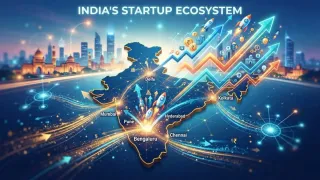
India’s startup landscape has seen a remarkable shift in the last decade, driven by over 2 lakh DPIIT-recognised ventures as of December 2025, up from fewer than 500 recognised startups in 2016. While major metropolitan hubs–Mumbai, Delhi, Bengaluru, Hyderabad– continue to lead, around 50 per cent of these startups emerged from Tier-II and Tier-III cities, highlighting a widespread democratisation of entrepreneurship across the country.
Meanwhile, as the startup ecosystem is picking up fresh momentum due to massive advancements in technologies, experts believe that over the next few years, startup capital is expected to align closely with this evolving landscape—increasingly flowing toward businesses that solve real-world problems, build strong fundamentals, and demonstrate a clear path to scale.
Sectors such as AI, deep tech, climate tech, healthcare, fintech, and enterprise technology will continue to attract investor interest; the larger shift will be towards how businesses create value and sustain growth.
AI Will Be a Major Investment Theme
Additionally, AI will remain a major investment theme, but the real opportunity lies in its application. Beyond building foundational models, there is significant potential in businesses using AI to transform manufacturing, healthcare, financial services, agriculture, and enterprise operations.
“Investors will increasingly look for companies that can translate technological capabilities into measurable improvements in productivity, costs, and customer outcomes,” said Amar Dixit, CEO, WOI India.
Deep Tech Be An Opportunity
Deep tech is another important opportunity for India. Advances in robotics, advanced materials, semiconductors, space technology, and industrial automation can help address critical challenges while creating globally competitive businesses.
“These ventures often require patient capital, specialised infrastructure, and stronger collaboration between research institutions, industry, and investors. Building these connections will be essential to unlocking their potential,” Dixit noted.
Also Read: Decoding Massive Sell-Off: 3 Reasons Behind Sensex's 876-Point Downslide
Climate Tech And Energy Transition And Healthcare
Climate tech and the energy transition will also create significant opportunities, particularly in energy storage, renewable energy infrastructure, electric mobility, resource efficiency, and circular economy models.
As sustainability becomes increasingly linked to business competitiveness, companies that combine measurable environmental impact with viable economics will be better positioned to attract long-term capital.
Additionally, Healthcare and enterprise technology could be a compelling opportunity as India needs solutions that improve access, affordability, and efficiency across healthcare delivery, diagnostics, supply chains, and business operations.
Tier 2 and Tier 3 Cities Could Be Next Hub
Dixit believes there will be an important shift in capital flow that will be geographical. India’s next generation of successful startups will not emerge exclusively from its established technology hubs. Tier 2 and Tier 3 cities have founders who understand local industries, consumer behaviour, and problems that remain underserved,” Dixit Emphasised.
“With better access to capital, mentorship, customers, and distribution networks, many of these businesses can become significant enterprises,” he added.
Also Read: Why Policy Experts Want Strict Guardrails On Foreign Satellite Operators Like Starlink
What Startups Need Beyond Capital
The startup ecosystem must evolve beyond capital alone. Founders need access to markets, experienced operators, industry partnerships, infrastructure, and global networks. Capital is most effective when it is supported by an ecosystem that helps businesses execute and scale.
“Investors, too, are likely to become more selective. Revenue quality, customer retention, capital efficiency, defensible technology, and the ability to build sustainable businesses will matter more than growth driven primarily by funding,” the expert said.
Startups remain a vital engine of India’s economic growth, job creation, and inclusive development. As initiatives like AIM 2.0 focus on piloting new strategies to bridge ecosystem gaps and scaling proven models across government, industry, and academia, the overall startup ecosystem must continue maturing beyond capital deployment alone.