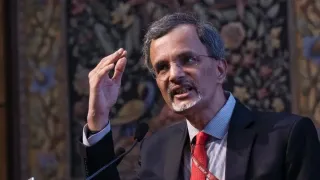
The year 2026 resembles 1991, and it could be deemed an inflection point for the Indian economy, which has been facing not only external challenges but also structural constraints in manufacturing, energy, agriculture and technology, Chief Economic Advisor V Anantha Nageswaran said on Thursday.
Addressing the ISID-IDRA national conference, Nageswaran further said that, in the global context, India is a source of macroeconomic stability and resilience, which sometimes tends to get forgotten in the noisy world of social media narratives.
"2026 resembles 1991, and many of you should not immediately think that when we talk about the word resemblance, it is not the same as identical. Identical means that you have the same balance of payments crisis.
Also Read: Decoding Stock Market Rally: 3 Reasons Why Sensex Surged 905 Points Today
"No. The point is, it was an inflexion point for us in 1991, and 2026 is also, or even 2025, could be deemed as inflection points for us," he said.
Nageswaran said that while the 1991 balance of crisis brought four decades of accumulated constraints to a head- a moment of reckoning more than a passing shock- the external stress of 2026 has brought India to a fork in its growth journey and invites a fundamental re-examination of strategy.
"In 2026, the challenge is not only external. Structural constraints in manufacturing, energy, agriculture and technology add to the pressure," he said.
Nageswaran pointed out that the worst shocks now arrive not because of accidents of nature, but by design.
"Just as last week, we saw China announcing an export licensing regime for tunnel boring machines and for many other products of infrastructure goods, which India will be needing," he said.
The CEA said the weaponised dependence ends up eroding the more they are used; that is true.
"The more countries weaponise their supplies, the less effective they become over time. But there is a period when they are binding, because other countries cannot ramp up production just like that," he said.
Nageswaran observed that the next 20-30 years will be different from the 40 years pre-pandemic and added that most of the shocks which we faced before the pandemic were largely demand deficiency shocks.
"So central bankers and fiscal policy could just stimulate and try to get out of trouble, whether it is the 1987 stock market crash, 1990-91 savings and loan crisis, the East Asian crisis of 1997–98, 2001 tech bubble or the 2008 global financial crisis.
"Every single crisis was met with a standard playbook of low interest rates, together with or without quantitative easing, and some fiscal stimulus as well," he said.
The CEA said it is easy to stimulate when you consider the problems as only a matter of demand deficiency, but when supply falls short, it is about real stuff.
"And that is not easily engineered or designed by monetary or fiscal policy. And higher interest rates, you can raise rates sky-high and cool an overheated economy," he said.
Nageswaran said in the next 30 years, monetary policy will be much more difficult to execute in a world of supply shortages causing real economic disruptions, both to output and to inflation.
"Fiscal policy, broad support, stimulating the economy where animal spirits are weak; it is easy to stimulate them with fiscal stimulus," he said.
Disclaimer: This story has been directly published from the agency feed. No changes have been made except the headline.