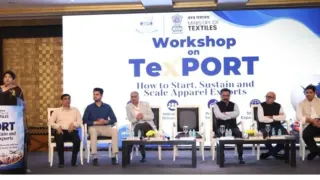
To promote textile and garment exports, the Ministry of Textiles organised the TEXPORT Capacity Building Program in Noida, aiming to prepare existing and new exporters to start, sustain, and expand their businesses in the international market. This program is part of the Ministry's National Export Continuity Program.
The Ministry and Apparel Export Promotion Council (AEPC) came together for the initiative.
The first session in this series was held in Surat, Gujarat, in collaboration with MATEXIL. The Ministry plans to organise several such training programs in major textile and garment hubs across the country.
Preparing for $100 billion exports
The program was chaired by Alaknanda Dayal, Joint Secretary, Ministry of Textiles. She stated that India aims to reach $100 billion in textile and garment exports by 2030. To achieve this goal, emphasis is being placed on enhancing exporters' capacity, identifying local business opportunities, and addressing export-related challenges. He also highlighted Noida's potential for apparel exports.
Emphasis on increasing access to foreign markets
At the event, A. Bipin Menon, Trade Advisor, Ministry of Textiles, highlighted the export potential of India's textile and apparel sector. He discussed issues such as expanding access to foreign markets through free trade agreements (FTAs), strengthening international competitiveness, gathering market information, adhering to required standards, and increasing contacts with foreign buyers.
AEPC Secretary General Mithileshwar Thakur stated that approximately 88 per cent of India's total exports come from just 100 districts. He emphasised the need to expand exports. He emphasised the strategy of developing 100 champion districts as global export centres and 100 aspirational districts as self-reliant manufacturing centres.
Also read: PM Kisan 24th Installment: PM Modi To Transfer Rs 2,000 To Over 9.34 Crore Farmers On October 30
Training and comprehensive information on regulations to boost exports
The program included three separate sessions for regular exporters, irregular exporters, and businesses planning to export for the first time. These sessions discussed issues related to export processes, regulations and compliance, finance, logistics, product development, contacting foreign buyers, and market access. A question-and-answer session also provided businesses with the opportunity to share their concerns directly with officials and experts.
According to the Ministry, the TEXPORT initiative will provide training in the country's major textile and apparel centres. Its objective is to connect more enterprises to exports, strengthen local manufacturing centres, and increase the presence of Indian companies in the international market.
(With input from jagran.com)